
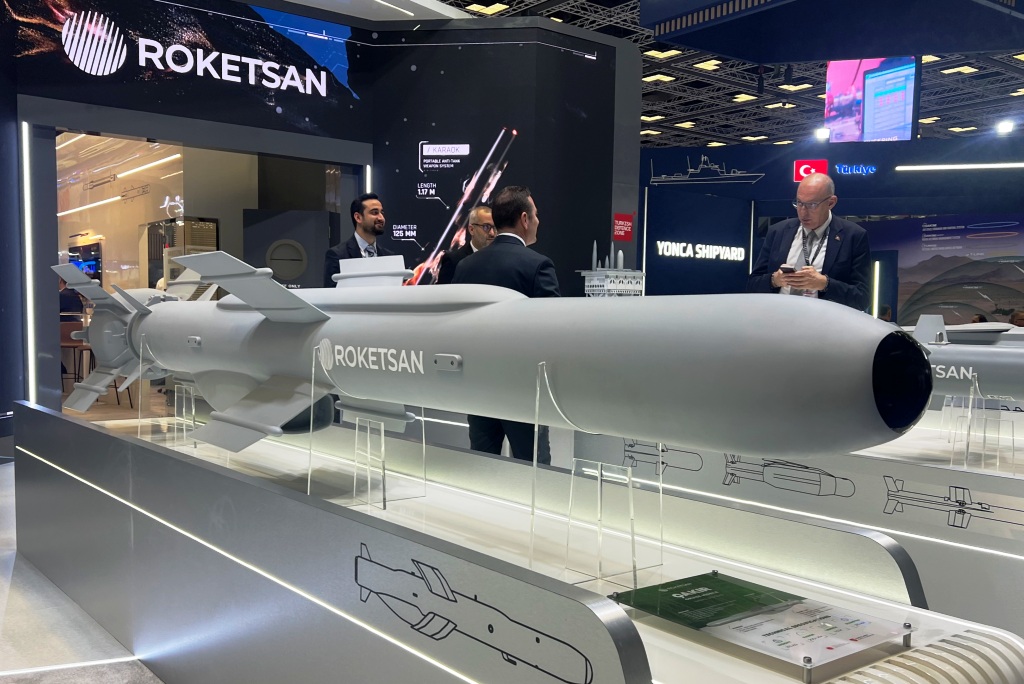
Roketsan fired two ÇAKIR cruise missiles from a mobile ground launcher on August 27, striking separate land and maritime targets in what the company says is the weapon's first publicly disclosed ground-launch trial. The video Roketsan released shows a booster carrying the missile clear of the launcher before its KTJ-1750 turbojet engine takes over, the same propulsion setup that powered ÇAKIR's original 2023 air-launch debut from a Bayraktar Akıncı drone. Beyond confirming both shots hit their targets, the company disclosed nothing else: no location, no range flown, no target description, no telemetry. That's a thin data set to build much certainty on, and it's worth being upfront that this looks like a marketing reel more than a qualification milestone until Roketsan says otherwise.
What ÇAKIR actually is matters more than this single test. Unveiled in 2022 as a modular missile family meant to fly off nearly anything, jets, helicopters, drones, ships, trucks, even unmanned surface vessels, it's a genuinely compact weapon, 275 kilograms without its booster, advertised past 150 kilometers of range, and available with a choice of imaging-infrared, radio-frequency, or hybrid terminal seekers. The version fired on the 27th used what Roketsan describes as a next-generation infrared seeker. A two-way datalink lets an operator retask, re-attack, or abort mid-flight, and the missile can hug terrain over land or skim the sea depending on the target, features that, on paper, put it somewhere between a tactical cruise missile and a loitering munition.
The more interesting story sits in Jakarta, not Ankara. Indonesia's ambassador to Turkey confirmed this month that Indonesia has already bought ÇAKIR missiles, and that Roketsan is setting up a joint rocket-and-missile production line inside Indonesia itself, no missile count, no contract value, and no firm delivery date attached. That fits a pattern Indonesia has been running with Turkish industry for over a year now: a 2025 joint venture to build Bayraktar TB3 and Akıncı drones locally, a separate June 2025 Roketsan tie-up covering Atmaca anti-ship missiles, Hisar and Sungur air-defense systems, and now ÇAKIR, and a May 2026 deal making Indonesia the first export customer for Turkey's Kızılelma unmanned fighter, complete with its own local production and workforce-development component. Indonesia isn't just buying Turkish weapons anymore; it's assembling, piece by piece, the industrial capacity to build several of them domestically.
That's a genuinely different relationship than a typical arms sale, and it says something about what Indonesia is actually trying to build: a domestic defense-industrial base stitched together from Turkish know-how across drones, missiles, and now coastal defense systems, rather than a shopping list of finished imports. A private shipbuilder under the same Republikorp umbrella already showed off a fast attack craft concept armed with ÇAKIR at last year's Indo Defence exhibition, suggesting Jakarta sees the missile's naval application as seriously as its land role.
For Roketsan, a working ground-launch mode simply widens ÇAKIR's addressable market, coastal defense batteries alongside its existing ship, drone, and aircraft options, exactly the kind of platform flexibility that makes a weapon easier to pitch to a country building out a joint production line rather than shopping for a single-use import. Whether this specific test represents genuine qualification progress or just a well-timed piece of promotional footage ahead of deeper negotiations with Jakarta is impossible to tell from what Roketsan has released so far.

No comments:
Post a Comment