Tuesday, September 1, 2026

Sweden Bought French Frigates. France Is Reportedly Buying Swedish Spy Planes. Neither Side Is Calling It a Trade.


Four frigates, $4 billion, signed in Stockholm on Monday with French President Emmanuel Macron standing on the deck of a Swedish warship to mark it. What the ceremony didn't emphasize is the deal running the other direction, a French interest in Saab's GlobalEye surveillance aircraft that a bilateral defense roadmap reportedly linked to this exact frigate competition back in 2025. Sweden gets a navy; France gets a foothold in one of the more capable airborne surveillance platforms currently on the export market. Nobody's calling it a swap, but it reads like one.

Sweden's actual naval need is straightforward and, by NATO standards, fairly modest in the scale of what it's buying. What became the Luleå-class frigate program started life as something considerably smaller, a "Visby Generation II" corvette, before Sweden's 2024 NATO accession forced a rethink. A navy built for decades around the Visby-class's specific doctrine, small, stealthy corvettes hiding among the Baltic archipelago for hit-and-run operations, doesn't automatically translate into a NATO alliance member's sustained maritime-endurance and air-defense obligations, and the program got restructured into a larger frigate class specifically to close that gap. These will be the biggest ships Sweden's navy has ever operated, and the order is expected to triple the country's air-defense capacity once all four are delivered, the first two by 2030, the remaining pair by 2035.

The competition Naval Group actually won was real, not a formality dressed up as one. Spain's Navantia pushed hard through late 2025, hosting industrial cooperation events in Stockholm to make its own case. But France's pitch had a structural advantage the Spanish bid didn't: the FDI design already carries Thales's Sea Fire radar and 32 Aster missile VLS cells, genuinely serious anti-air capability, and French officials confirmed as early as November 2025 they could deliver a fully equipped vessel on Sweden's 2030 timeline. Naval Group also built the bid around Swedish industrial integration, Saab technology folded directly into the design, rather than a straightforward foreign import, which likely mattered as much politically in Stockholm as the ship's specifications did.

This is the same broader pattern this blog has already tracked through Denmark's own ongoing frigate competition, a similar contest between Babcock's British-designed AH140, TKMS's MEKO family, and Navantia's F-110, all pitching Nordic and Baltic navies simultaneously as those countries race to modernize under the same NATO pressure. Sweden settling with France while Denmark's contest remains open shows how differently individual countries are weighing the same tradeoffs, cost, delivery speed, domestic industrial participation, even when facing a nearly identical set of bidders across the wider region.

Macron's own framing at the signing was explicitly about positioning this as European self-reliance rather than a routine arms sale: "France and Sweden in the European Union and in NATO show that European sovereignty is being built together," strengthening, in his words, "the industrial and technological basis of European defense at a time when Europeans must take greater responsibility for their own security." That rhetoric fits a pattern running through nearly every major European defense deal signed this year, a deliberate, repeated emphasis on European suppliers building for European buyers, less because the hardware is necessarily better than American alternatives and more because the political message, that Europe can arm itself without leaning entirely on Washington, is increasingly the point of the purchase as much as the frigate itself.

Greece Just Bought Israel's Entire Air Defense Playbook — Turkey Is Building Its Own Version for the Same Reason


Turkey calls its program Steel Dome, a roughly $6.5 billion push to build a domestically produced, multi-layered shield against aircraft, drones, and ballistic missiles. Erdogan has said it will "instill confidence in friends and fear in enemies." Greece just answered with a $3.5 billion deal of its own, and it isn't building anything domestically, it's buying nearly the entire architecture from Israel.

The agreement, signed Monday in Tel Aviv and named Achilles Shield, is Israel's largest-ever defense export deal with Greece and one of the biggest arms sales in Israeli history. It bundles together nearly every major system in Israel's current air-defense lineup: Rafael's David's Sling, which Israel used to intercept Iranian missiles during this year's war with Iran, and its SPYDER system, Israel Aerospace Industries' Barak MX, and ELTA-built multi-mission radars for air surveillance, all tied together under a new national command-and-control network Rafael will build to let Greece's forces run every layer as one integrated system rather than a patchwork of separate systems. A supplementary €26 million agreement adds Rafael's Drone Dome on top.

Nobody involved is being especially subtle about who this is aimed at. Israeli Diaspora Affairs Minister Amichai Chikli skipped past the usual diplomatic hedging entirely: "A strong Israel-Greece-Cyprus alliance is the right answer to Erdogan's Islamist, neo-Ottoman aggression," he wrote Monday, "today this alliance grew stronger." That's a considerably more direct framing than Defense Minister Israel Katz's own comment about the two countries sharing "common strategic interests," but both officials are describing the same underlying reality: Greece's decades-old rivalry with Turkey is the actual engine behind this purchase, and Athens is now spending nearly 3.5 percent of its GDP on defense, a higher share than most of its NATO allies, specifically because of it.

Achilles Shield is one piece of a considerably larger Greek buildout, part of a roughly €28 billion modernization program running through 2036 that also covers up to 40 F-35 fighters from the U.S. and new frigates from France and Italy. What's notable is the deliberate diversification across suppliers, an American fighter jet, European warships, and now an entirely Israeli-built air defense architecture, rather than concentrating the whole program with a single ally. That spreads political risk as much as it spreads capability: Greece isn't betting its entire modernization on Washington's willingness to keep prioritizing the relationship, the same calculation this blog has already traced through Canada's own friction with the U.S. over its AWACS purchase.

The regional alignment this deal reinforces connects to something this blog covered a few weeks back: Israel, Greece, and Cyprus have been building a genuinely closer trilateral security relationship, the same one this blog's coverage of Cyprus's pursuit of Israeli Merkava tanks first flagged as part of a broader pattern. Achilles Shield is the largest, most concrete expression of that pattern yet, an actual signed contract rather than exploratory talks, and it lands the same week Israel quietly extended a separate defense cooperation memorandum with Finland through 2034, according to Finnish broadcaster Yle, suggesting Israel's defense-export ambitions in Europe extend well beyond just its Eastern Mediterranean partners.

What happens next is less certain than either country's public statements suggest. A €28 billion program running twelve years has plenty of room to slip on cost or schedule, something this blog's coverage of comparable European defense buildouts, Australia's Hunter-class overrun among them, would counsel real caution about assuming proceeds exactly as announced. But the underlying signal is clear enough already: two rival air-defense architectures are now being built on opposite sides of the Aegean, one Turkish and domestically produced, one Greek and built entirely on imported Israeli technology, and neither side is pretending the other isn't the reason.

It Took Five Judges and 25 Years to Get a Trial Date for the 9/11 Attacks


Khalid Sheikh Mohammed was captured in a raid in Pakistan in March 2003. He has now spent 23 years in American custody, three of them in secret CIA prisons where he was waterboarded, the rest at Guantanamo Bay since 2006. On Wednesday, Air Force Lt. Col. Michael Schrama, the fifth military judge to preside over this case since Mohammed's capture, finally set a trial date: June 5, 2028. Nearly three decades after al-Qaeda hijackers killed almost 3,000 people in New York, Washington, and a field in Pennsylvania, the man accused of orchestrating that plot still hasn't stood trial.

This isn't the first date that's been set and missed. A trial was scheduled for January 2021, then pushed back repeatedly as the case worked, and mostly failed to work, through pretrial disputes over evidence obtained while the defendants were held and interrogated in CIA custody. Schrama's own scheduling decision reflects just how unresolved those disputes remain: prosecutors wanted an opening date in early 2027, and the judge turned that timeline down, ruling it wouldn't leave enough room to actually work through what he called "resolution of pretrial evidentiary and compliance motions." A trial can't proceed while the parties are still arguing about what evidence is even admissible, and after two decades, that argument evidently isn't close to finished.

The more recent complication traces back to a 2024 plea agreement that briefly looked like it might resolve the case without ever reaching trial. Mohammed and two co-defendants had accepted a deal that would have taken the death penalty off the table in exchange for guilty pleas, an agreement approved by the Pentagon official who oversees the war court itself. Then-Defense Secretary Lloyd Austin revoked it weeks later, after Republican lawmakers objected to the possibility that the man accused of masterminding the attacks might avoid execution. A military judge and the U.S. Court of Military Commission Review both later ruled that Austin's revocation was improper and the deal should stand, but a federal appeals court overturned those rulings last year, blocking the plea agreements outright and sending the case back toward trial.

Michael Lebowitz, who used to prosecute cases in this same commission, offered reporters a description that's hard to improve on: a "Frankenstein's zombie court." His diagnosis wasn't about the strength of the evidence against the defendants, it was about the system itself, a Guantanamo-based tribunal where even routine hearings require judges, prosecutors, and defense counsel to fly in from Washington just to convene, a structural drag on a process that was never built to move quickly and hasn't.

The four men now scheduled for trial are Mohammed, Walid bin Attash, Ali Abdul Aziz Ali, and Mustafa Ahmed al-Hawsawi. A fifth original defendant was dropped from the case after being ruled too mentally ill to stand trial, a reminder that the passage of time here has changed the case itself, not just its calendar. Whatever June 2028 ultimately brings, families of those killed on September 11 have now waited through five judges, a revoked plea deal, an appeals court reversal, and a quarter century for a courtroom outcome that, as of this week, finally has a date attached to it.

A Struggling Beach Town Is Betting Its Worst Year in Two Decades on 5,000 Sailors


Pattaya hasn't had a good year. Lisa Hamilton, who heads the city's nightlife business association, told reporters this week that 2026 has been the weakest she's seen in more than two decades running operations there. So when word came that USS Abraham Lincoln would dock at nearby Laem Chabang Port starting September 2, with nearly 5,000 sailors and Marines aboard getting shore leave after more than 270 consecutive days at sea, the city's tourism sector treated it as something close to a lifeline. Each service member could plausibly spend $30 to $91 a day ashore, according to Pattaya's mayor, and with more than 300,000 hotel rooms sitting in a market that's had a rough year, that math matters to a lot of local businesses.

It's also, by every account from Thai officials themselves, a genuinely complicated welcome to prepare for. Pattaya's own police chief was blunt about the challenge: "We are doing our best, but it is difficult." Prostitution is illegal in Thailand, but visibly present across parts of Bangkok and Pattaya regardless, and the city has spent the days before Lincoln's arrival running raids that detained 40 to 50 people on suspicion of prostitution-related offenses, on top of stepped-up patrols planned for the beachfront and nightlife districts once the ship actually docks. A Bangkok University tourism scholar put the underlying concern plainly to Reuters: a sudden influx of thousands of customers "may increase the likelihood of sexual exploitation and the spread of sexually transmitted diseases." Roughly 600 officials are being mobilized for security and support around the visit, according to the regional governor.

This is a genuinely old pattern for this specific city, not a new problem the Navy invented. Pattaya's transformation from fishing village into a major tourism hub traces directly back to American service members seeking rest during the Vietnam War, and the Pentagon-Pattaya relationship the current port call continues is a tradition running more than 50 years. Thai officials met with Navy representatives ahead of the visit specifically to set behavioral expectations for the crew, and the warning attached to those rules was explicit: anyone who breaks Thai law, including its notably strict lèse-majesté statute carrying penalties up to 15 years for insulting the monarchy, faces prosecution under Thai jurisdiction, not just Navy discipline.

The deployment behind this visit is its own separate story worth remembering as context. This blog has already covered Lincoln's extended time at sea in detail, the mental health concerns, the reported attempts to go overboard, and Adm. Cooper's own confirmation that the strike group dropped 1.5 million pounds of ordnance on Iran across more than 10,000 sorties during Operation Epic Fury. A crew coming off a deployment that long and that intense is, by any reasonable measure, due genuine rest, and Pattaya's own tourism sector isn't wrong that this visit represents real economic opportunity for a city having a difficult year.

What's genuinely uncertain is how much of that opportunity actually lands where the city hopes it will. Thanet Supornsahasrungsi, who heads the regional tourism federation, flagged the honest complication: some sailors and Marines may simply travel to Bangkok instead of staying in Pattaya, meaning the city's own hospitality sector may not capture nearly as much of the visit's spending as its excitement suggests. Between that uncertainty and the law-enforcement strain the visit is already generating before a single sailor has come ashore, Pattaya's welcome carries about as much anxiety as hope.

New Zealand Just Committed a Quarter of Its Entire Army to a Single Battle Group


New Zealand's active-duty army numbers 4,358 soldiers. The Motorised Infantry Battle Group its ground forces just spent 16 days testing in Exercise Hill 60 accounts for roughly 1,000 of them. That's not a specialized unit or a token contribution, it's close to a quarter of the country's entire standing army, organized into the one formation New Zealand considers its actual land-combat output, the thing it can hand to a coalition or deploy on its own.

The exercise itself, named for the final battle of the Gallipoli campaign, ran live-fire drills across the central North Island through late August: NZLAV 8x8 armored vehicles crossing open ground under 105mm artillery cover to assault trench networks, the kind of combined-arms tempo test meant to prove the battle group can actually function as a cohesive unit under pressure rather than just look good on a parade ground. It was also a rehearsal for something more concrete: the group's first-ever deployment overseas, to Australia's Talisman Sabre exercise next year.

What makes this worth paying attention to beyond the exercise itself is the document sitting behind it. Plan ANZAC, the bilateral framework governing how New Zealand and Australia train and fight together, was renewed in July, and it's pushing the two forces toward something closer than routine allied cooperation. New Zealand's 2025 Defence Capability Plan states the policy outright: buy the same equipment Australia buys "where it makes sense to do so," specifically to maximize interoperability. That's already visible on the ground, Bushmaster protected vehicles New Zealand has adopted alongside its own NZLAV fleet are the same vehicles Australia runs by the hundreds, and when New Zealand eventually replaces its aging 105mm towed howitzers, systems like HIMARS, already in Australian service, are the likely contenders specifically because Canberra already operates them.

Brig. Jason Dyhrberg, the army's Land Component Commander, was candid about why Australia values this arrangement as much as New Zealand does: Australia has "significant scale" but also real staffing and equipment shortfalls of its own, and a well-trained battle group from a smaller neighbor fills a gap Canberra can't easily fill internally. New Zealand's battle group is set to integrate specifically with Australia's Brisbane-based 7th Brigade, the formation focused on the Pacific islands east and north of Australia, a region where New Zealand has its own direct strategic interests. Previous integration between the two forces has stopped at the smaller combat-team level; Talisman Sabre 2027 will be the first real test of doing this at full battle-group scale.

There's an honest structural admission underneath all of this that Dyhrberg made without much hedging: New Zealand cannot replicate a larger nation's formations, full stop. What it can do, he said, is produce well-trained officers capable of slotting directly into an Australian brigade headquarters or an American divisional one, something it already does "quite regularly." That's the actual strategy here, not building a bigger army, but building a smaller one precise enough to plug seamlessly into someone else's, which is a more realistic bet for a country this size than trying to compete on raw numbers ever would be.

The Office That Exists Because the Army Lied About a Tank Just Went Dark


In 1986, Army officials misled Congress about how well the Bradley Fighting Vehicle actually performed. Lawmakers' response was to create an independent testing office inside the Pentagon and give it legal authority over live-fire testing, specifically so no service could grade its own homework on a major weapons program again. That office, the Director of Operational Test and Evaluation, just pulled every one of its public reports offline.

The reports weren't classified. They'd been publicly available for years, plainly written assessments of whether major weapons systems actually work as advertised before troops start relying on them in the field. Now accessing that same material requires a Defense Department-issued common access card, effectively locking the public, and most of Congress's own staff, out of documents the office is legally required to publish. Sen. Elizabeth Warren and Rep. Donald Norcross sent Hegseth's office a letter this month demanding an explanation, framing the removal bluntly: these reports exist "to make sure critical deficiencies are fixed so service members are not harmed or killed."

The stated justification is that foreign adversaries could feed the reports into AI tools and build detailed profiles of American military vulnerabilities. That's not an unreasonable concern in the abstract, but it arrives after DOT&E's staff was already cut by roughly 74 percent and its budget by nearly 80 percent under a May memo from Hegseth framed around cost savings, and critics have a fairly obvious counter-question: if the real goal were narrowly protecting sensitive technical detail, why gut the office's capacity to conduct testing at all, rather than simply redacting the specific sections that concern foreign exploitation.

Gabe Murphy, a policy analyst at Taxpayers for Common Sense, put the timing plainly to Military Times: cutting the Pentagon's independent testing watchdog right before proposing a $1.5 trillion budget looks "suspicious." His organization has been particularly focused on Golden Dome, the missile defense program the administration prices at roughly $175 billion over three years, though outside estimates run as high as $1.2 to $4.4 trillion over two decades depending on assumptions. Murphy's read on why that program specifically might benefit from reduced scrutiny is direct: "they know that missile defense in general, and I think in particular, the space-based interceptors they want for this program, are not going to perform well in real tests." That's an accusation, not a proven fact, but it's the kind of claim independent testing reports exist specifically to either confirm or refute, which is precisely the mechanism now harder to access.

A Government Accountability Office report from June had already flagged the underlying risk without any of this controversy attached: the Pentagon's push to field new weapons faster is outpacing DOT&E's own capacity to catch problems before those systems reach the field. Cutting the office's budget and workforce first, then pulling its public output, doesn't so much create a new risk as remove the one mechanism specifically built to catch it. The Project on Government Oversight has separately documented how these reports have historically functioned, informing congressional funding decisions and giving taxpayers visibility into why lawmakers made the calls they did. Take that visibility away and Congress isn't just less informed, voters lose the ability to check whether their representatives are making decisions based on real performance data or marketing material from the contractor selling the system.

Warren and Norcross gave the Defense Department until August 26 to respond. Whatever the department says, the office it's responding about was created for exactly this situation, a major weapons program whose real performance nobody outside a small circle can verify. Forty years later, it's being quietly dismantled right as a trillion-dollar-scale program most needs the scrutiny it was built to provide.

Russia Just Spent 27 Years and $5 Billion Rebuilding One Ship — In a War That's Proving Single Ships Aren't the Point


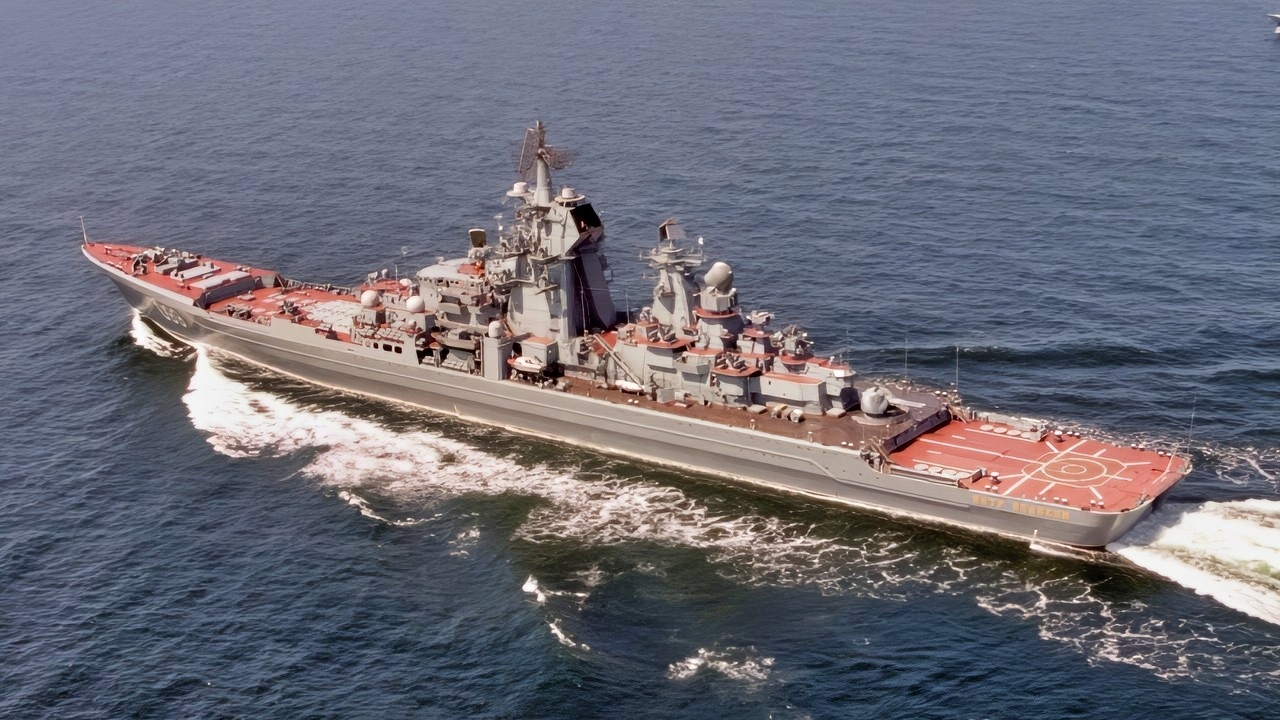
Admiral Nakhimov entered overhaul in 1999. It didn't leave dry dock under its own power again until August 2025. Somewhere in between, its reactors sat cold for so long that restarting them, in December 2024 and February 2025, was itself treated as a milestone. This week, the Russian Navy announced the ship has completed sea trials in the Barents Sea and is expected to formally re-enter service within weeks, closing out a refit that took longer than some of the sailors who'll crew it have been alive.

What Russia gets for that investment, estimated unofficially at around 200 billion rubles, roughly $5 billion, is genuinely staggering on paper. Nakhimov is a 28,000-ton Kirov-class nuclear battlecruiser, nearly three times the displacement of a U.S. Navy Arleigh Burke destroyer, powered by twin KN-3 reactors driving 140,000 shaft horsepower, enough to hit roughly 32 knots, faster than any carrier, cruiser, destroyer, or amphibious ship currently in U.S. Navy service. Its refit swapped out Cold War-era weapons for 80 universal vertical launch cells firing Kalibr cruise missiles, Oniks anti-ship missiles, and 3M22 Zircon hypersonics, backed by 96 more cells for long-range S-400-derived surface-to-air missiles, plus Pantsir-M and Paket-NK systems layered in for close-range air and undersea defense. By missile-cell count alone, it may be the most heavily armed surface warship afloat.

Set against Russian naval doctrine, that arsenal reads less like a traditional cruiser and more like a floating magazine. Analysts tracking the refit have increasingly described Nakhimov's actual role as an "arsenal ship," a platform built less for ship-to-ship duels than for launching massed long-range salvos against targets on land and at sea, extending the same standoff-strike logic Russia has leaned on throughout the war in Ukraine, where cruise missiles fired from well behind the front line have done far more work than direct naval engagement. Based out of Severomorsk, the Northern Fleet's command hub on the Kola Peninsula, the ship is expected to spend its service life protecting Russia's Arctic ballistic-missile-submarine bastions and projecting Kalibr and Zircon range across the North Atlantic.

Here's the tension nobody involved in celebrating this milestone is eager to name directly: the entire premise of concentrating this much firepower, and this much money, into a single irreplaceable hull runs against almost everything the past three years of war have actually demonstrated about naval survivability. Ukraine, with no navy to speak of, has spent this war sinking and damaging Russian Black Sea Fleet vessels using cheap drone boats costing a rounding error of Nakhimov's refit budget. The lesson most navies watching that campaign have drawn is toward distribution, more platforms, individually cheaper and more expendable, rather than fewer platforms carrying more value each. Nakhimov is the opposite bet: one ship holding a meaningful fraction of Russia's total naval strike capacity, in an era where a single successful strike, or even a single mechanical failure, now carries outsized strategic consequence precisely because there's no second Nakhimov waiting in reserve.

None of that makes the ship irrelevant. A genuinely fast, heavily armed, nuclear-powered missile platform still complicates planning for any adversary operating in the Arctic or North Atlantic, and 27 years of delay doesn't erase what's now, on paper, a formidable set of capabilities. But the more interesting question raised by Nakhimov's return isn't how powerful it is. It's whether a navy re-committing this heavily to the concentrated-firepower model, right as the rest of the world has spent three years learning why that model is risky, is making a considered strategic bet or simply finishing a project too expensive and too far along to abandon.

Why the Army Is Finally Rebuilding the Abrams From Scratch: 27 of 31 Are Gone


By early June 2025, Ukraine had lost 27 of the 31 Abrams tanks the United States had sent it. Eighty-seven percent, destroyed or captured, on a battlefield where cheap drones, thermobaric top-attack munitions, and mines have made the tank's traditional armor scheme look increasingly beside the point. That's the number sitting behind the U.S. Army's decision to hand its next-generation M1E3 Abrams prototype to the 1st Cavalry Division for testing this week, and it's worth keeping in view, because the Army's own public messaging tends to lead with "most revolutionary tank in 50 years" rather than "the current one kept dying."

The Army made the call to abandon incremental Abrams upgrades back in 2023, and the timing lines up: that's roughly when the pattern of Western tank losses in Ukraine, Abrams and Leopard 2A6 alike, had become impossible to wave off as bad luck or poor employment. Rather than bolt more armor onto a design that first entered service in 1980, the Army went back to the drawing board. The M1E3 is expected to drop from roughly 80 tons down to about 60, a weight cut that would have been unthinkable for a tank whose entire reputation was built on brute survivability through mass. To make up the difference, it leans harder on active protection systems designed to intercept incoming threats before they hit the hull at all, plus a hybrid powerplant reportedly targeting 40 percent better fuel efficiency than the current gas-turbine engine's notoriously poor consumption.

What's genuinely striking is how closely that design logic tracks China's Type 100, a tank Beijing confirmed entered service back in September. Lighter than its predecessors at around 40 tons, leaning on active protection rather than passive armor mass, running a hybrid drivetrain, the Type 100 and the M1E3 are converging on the same basic bet from opposite sides of the Pacific: that the era of winning through sheer armor thickness is over, and the tank that survives modern anti-tank weapons is the one that stops them before impact rather than absorbing the hit. Whether that's Beijing influencing Washington's design choices or both militaries independently reaching the same conclusion after watching Ukraine, the result is a rare moment where American and Chinese armor doctrine are visibly moving in lockstep.

Handing the prototype to the 1st Cavalry Division specifically matters beyond symbolism. It's one of the Army's storied armored formations, and testing a tank this early with an actual operational unit, rather than keeping it confined to a proving ground, is meant to surface the unglamorous problems that don't show up in engineering reviews: how it handles for a real crew, what breaks under sustained field use, whether the promised fuel savings hold up outside a lab. The Army is targeting a pre-prototype completion by the end of this year, an aggressive schedule for a tank this different from anything currently in the fleet.

None of this guarantees the M1E3 avoids the fate that forced this redesign in the first place. Active protection systems have to actually work against the specific mix of drones, loitering munitions, and top-attack weapons that did the damage in Ukraine, and a lighter hull built around intercepting threats rather than absorbing them is a fundamentally different bet than anything the Abrams program has made in 45 years of service. The Army is confident enough in that bet to hand it to a real division for testing. Whether it holds up is a question only years of trials, and eventually a real battlefield, can actually answer.

The Op-Ed Praising Germany's Lithuania Brigade Skips the Part Where It's 40% Empty


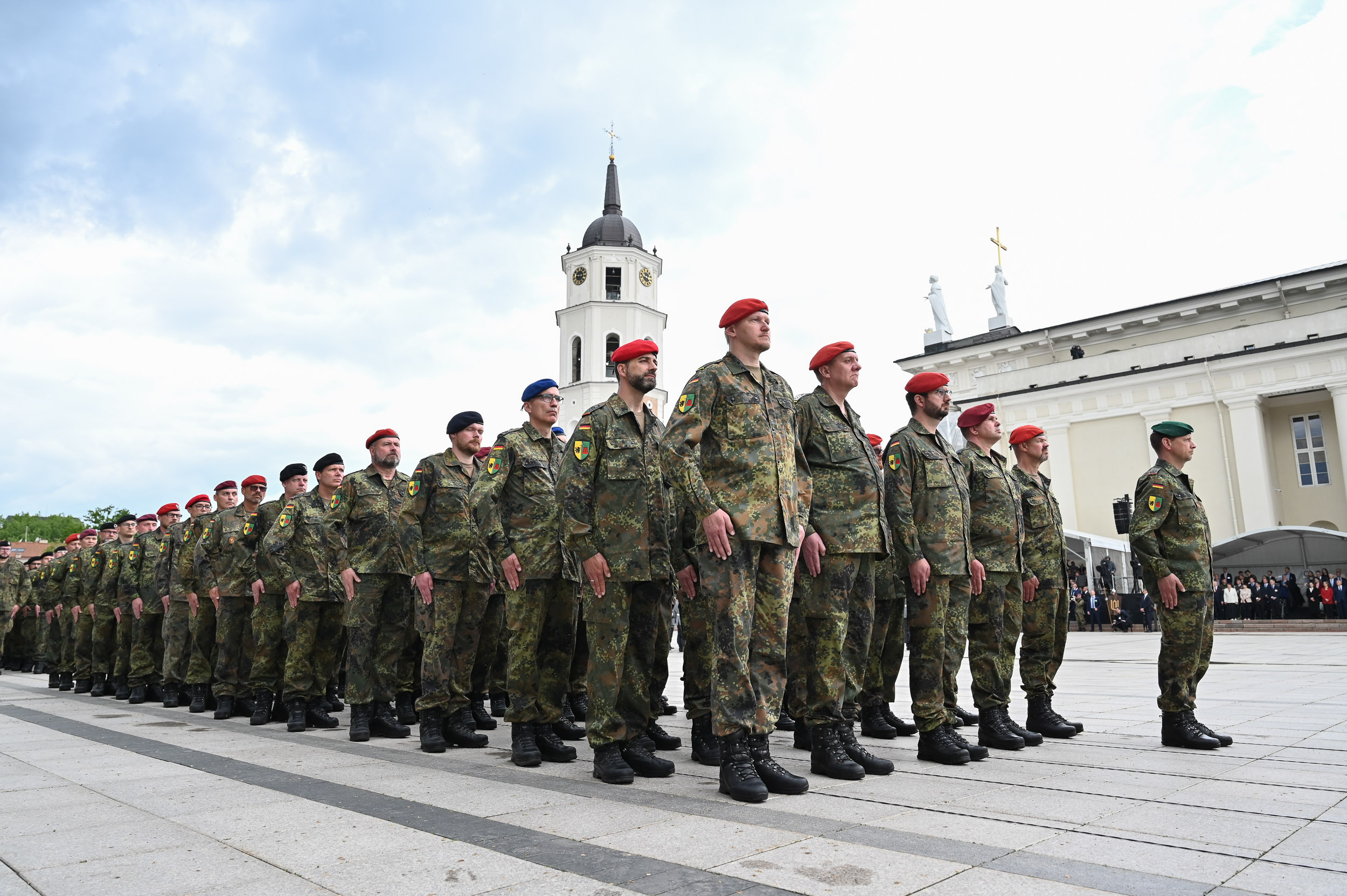
Two senior fellows at the Foundation for Defense of Democracies made the case in Defense News this week that Germany has become NATO's most important ally, pointing to a doubled defense budget, deepening industrial ties with American firms, and above all, the permanent stationing of a combat brigade in Lithuania, the first time Germany has forward-deployed troops abroad since World War II. It's an argument worth taking seriously; it's also missing a detail that changes how impressive that brigade actually is right now.

The budget numbers the piece cites check out. German defense spending has climbed from 1.43 percent of GDP in 2021 to an estimated 2.69 percent this year, with a pledge to reach €162 billion by 2029 and eventually 3.5 percent of GDP by 2035, a commitment made formal at last year's NATO Hague summit. The €100 billion special fund Berlin created in 2022 is real money that's genuinely reshaped procurement across German industry, and firms like Rheinmetall are indeed working on co-production deals with American companies covering 155mm artillery shells and ATACMS.

Where the piece runs into trouble is treating the 45th Armored Brigade in Lithuania as the clean, symbolic payoff of that transformation. It formally activated in April 2025 and is meant to reach full strength, 4,800 troops plus 200 civilian staff, by the end of 2027. As of this summer, it hadn't come close. German media reported in February that only 209 of the first 1,971 planned volunteer positions had actually been filled, roughly 10 percent, prompting Bundestag Defense Committee chair Thomas Röwekamp to say publicly that Germany may need to start assigning soldiers to Lithuania involuntarily if the shortfall continues. Army Inspector Lt. Gen. Christian Freuding confirmed in June that the "guiding principle of volunteering" would now be "supplemented with mandatory measures where necessary," about as direct an acknowledgment as a senior officer gets that the recruitment plan didn't work. The shortage is concentrated in enlisted ranks and technical specialties, logistics, IT, engineering, CBRN defense, while officers have been comparatively easy to find.

None of that means the brigade is a failure or that Germany isn't serious about it. Troop numbers on the ground have grown steadily, from roughly 400 in mid-2025 to about 1,700-1,800 by mid-2026, with a target of 2,000 by year's end, and Berlin has kept publicly reaffirming the brigade remains "on schedule." But "on schedule" and "adequately staffed" aren't the same claim, and a brigade running at 40 percent strength three years into a build-out that's supposed to hit full readiness in 2027 is a genuinely different story than "German soldiers standing guard on NATO's eastern flank," which is the phrase the op-ed uses to make its case that this, more than budget percentages, is what actually reassures Poland and the Baltics.

The op-ed's broader argument, that Washington should welcome German investment rather than treat it with suspicion, doesn't hinge on getting this one detail right. Germany's spending trajectory is real, its industrial partnerships with American firms are real, and a struggling recruitment drive doesn't erase either of those. But an argument built partly on Germany's forward troop commitment as tangible proof of intent deserves to grapple with the fact that the flagship unit embodying that commitment currently exists mostly on paper, staffed at a fraction of its planned strength, with the German army's own leadership now discussing conscription-adjacent measures to fill it. That's a harder, less triumphant story than "Germany is stepping up," even if the underlying direction of travel is genuine.

Japan's "Record" Defense Budget Isn't the Real Number Yet — On Purpose


Japan's Ministry of Defense put out its formal fiscal 2027 budget request on August 31: 8.9 trillion yen, about $55.5 billion. That figure is already a record. It's also, by the ministry's own account, not what Japan will actually spend. Around 160 separate line items in the request carry no dollar figure attached at all, filed as what Japanese budgeting calls "item requests," essentially placeholders that say "we're doing this" without committing to how much it costs. Those get priced during year-end negotiations, and once they are, the real total is widely expected to cross 10 trillion yen for the first time. This would be Japan's 15th consecutive annual defense increase and 13th consecutive record high.

Filing this way isn't an accounting oversight, it's a deliberate sequencing choice tied to something bigger: Japan is due to revise its three core security documents, the ones that set national defense strategy, by the end of the year. Locking in exact yen figures for a dozen major programs before that strategic review is finished would put the budget ahead of the policy it's supposed to fund. So the ministry names what it wants, submarine construction, new frigates, hypersonic missile development, and leaves the price tags for later, once the strategy that justifies them is actually settled.

What is priced, though, tells a fairly clear story about where Japan thinks its next fight is likely to happen. The ministry explicitly frames a chunk of this request around what it calls "Pacific sea-lane defense," citing rising Chinese carrier operations and more frequent Chinese and Russian bomber flights near Japan's Pacific-facing coast, the side of the country that's gotten comparatively less attention than the East China Sea and Taiwan Strait in most previous defense planning. Seventeen MQ-9B SeaGuardian drones, $1.83 billion worth, are earmarked specifically to extend surveillance across exactly that stretch of ocean.

The undersea half of the request is where Japan's ambitions get genuinely aggressive. Beyond continued construction of Taigei-class submarines, lithium-ion battery boats already replacing Japan's older fleet, the ministry filed a brand-new item request for an underwater-launched hypersonic guided missile, deliberately kept separate from the submarine-launched cruise missile program already funded for the Taigei class. Layer on a second new request for a stand-off missile-launch module fitted to unmanned underwater vehicles, plus research into UUV modules built for search, attack, and underwater networking, and Japan is sketching out a genuinely three-tiered undersea strike architecture: crewed submarines, uncrewed submersibles, and a hypersonic weapon fired from concealment rather than from a surface ship or aircraft that has to first survive being detected.

The surface fleet additions read more like steady accumulation than a single dramatic leap. Six more New FFM frigates, the upgraded Mogami design Japan already sold to Australia, on top of six already funded. Continued work on the two Aegis System Equipped Vessels, with the first due in service by the end of fiscal 2027. More Sakura-class offshore patrol vessels built to operate USVs and the same V-BAT drone the U.S. Navy has been fielding. And a small but symbolically loaded item: three more Aegis destroyers, Kongo, Ashigara, and Maya, getting Tomahawk launch capability, which would put all eight of Japan's existing Aegis destroyers on a Tomahawk-capable footing following the first live-fire test from JS Chokai this past July. Toyko's Izumo-class carriers are also getting a further tranche of funding to keep converting them for F-35B operations, with Izumo's own modification work scheduled to wrap in fiscal 2027.

None of the unpriced items are guaranteed to survive year-end negotiations at the scope currently proposed. Japan's own budget history over the past decade suggests they mostly will, this is the fifteenth straight year the number has only gone up, but the honest read on today's 8.9 trillion yen figure is that it's a floor, not the ceiling, and the real number won't be public until the strategic documents it's built to serve are finished first.

The Boring Part of Drone Boats Nobody Talks About: Getting Them Back On Board


In June 2025, a Navy unmanned surface vessel being towed out of Coronado harbor received a stray command that turned its engine on mid-tow. It accelerated, circled the towboat, and flipped it. The captain went into the water and, per the Navy's own account, declined medical treatment. Nobody died. But the incident, caused by what the Navy called operator error during a routine handling operation, is a small, concrete reminder of something the industry doesn't advertise nearly as much as autonomous sensors or AI targeting: getting an uncrewed boat safely on and off a larger ship remains a genuinely dangerous, unsolved mechanical problem.

Fairbanks Morse Defense and its Norwegian subsidiary Vestdavit think they've built a fix. AutoHook is, at its core, a small robotic connector that finds a moving USV's lifting point in open water, aligns itself using onboard thrusters and a vision system, and clips on, all without anyone standing near the connection point doing it by hand. That's the part worth pausing on: right now, recovering most USVs from a moving mothership means either a crew member physically reaching for a hook, a diver going into the water to make the connection, or bulky cage and ramp systems that add weight and require redesigning the ship. Every one of those options puts a person near a suspended load, a moving hull, and unpredictable sea states at the exact moment things are most likely to go wrong, which is more or less what happened off Coronado, just without a human anywhere near the actual connection.

The mechanics described in Fairbanks Morse's own release are straightforward enough: during recovery, AutoHook activates its vision system as the USV approaches, tracks the moving lifting point, uses air thrusters to hold position over it while a wire lowers from the davit, engages, and confirms the connection to the operator, who then hoists the boat home. A separate stabilizing line from Vestdavit's existing Floating Catching Device helps keep the daughter craft from drifting during the approach. None of the individual pieces, vision tracking, thruster-assisted stationkeeping, remote connector confirmation, is exotic technology on its own. What's new is packaging them into something light enough to bolt onto a standard davit rather than requiring a purpose-built recovery system.

That "works with what ships already have" framing is probably the more important sales pitch than the automation itself. Retrofitting a stern ramp or a full cage-recovery system onto an existing hull is expensive and disruptive; adding a compact connector to a davit a ship already carries is not. For a Navy trying to scale up unmanned surface fleets across destroyers, littoral combat ships, and whatever comes out of the current small-USV procurement push, without redesigning every ship in the process, that's a meaningfully lower bar to clear.

The company says an industrialized prototype will run open-water trials from a naval vessel with professional crews sometime in the fourth quarter of this year, rated to handle sea states up to roughly 8-foot waves. Until that happens, this is a manufacturer's account of its own product, not an independently verified capability, and it's worth reading it that way. But the underlying problem it's aimed at is real and, as the Coronado incident shows, not purely theoretical: a drone boat that can operate itself perfectly for a thousand miles is still only as useful as the ten minutes it takes to safely get it back aboard.