
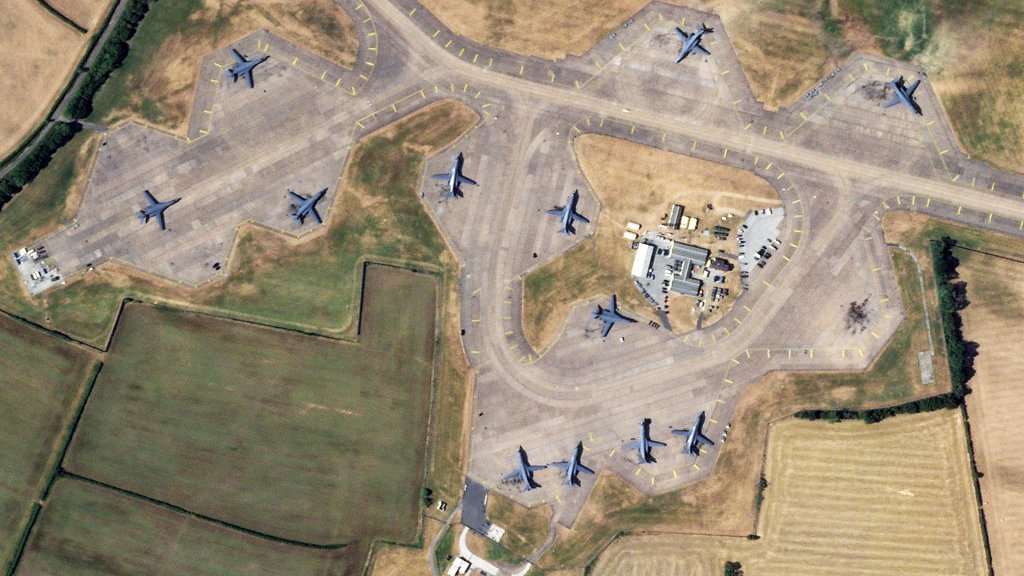
Over the weekend of October 3-4, 2026, U.S. Air Force B-1 Lancer bombers abruptly left RAF Fairford in the United Kingdom, and multiple reports say the reason was the threat of an Iranian-directed drone attack, as The War Zone (TWZ) reported on October 7. The bombers had been based there continuously since March, first in support of Operation Epic Fury against Iran, and the base has hosted B-52s, B-1s and other strategic aircraft. ITV News first reported the link to a possible attack along the lines of Ukraine's Operation Spiderweb, citing an unnamed source, and other outlets then reported similar details, all sourced to anonymous U.S. and British officials. The exact nature and imminence of the threat remain unconfirmed.
The official remarks suggest there was something behind the move without explaining what. President Trump said the bombers did not leave by accident and that there were some threats. Vice President J.D. Vance said Defense Secretary Pete Hegseth acted out of an abundance of caution to protect personnel, while Secretary of State Marco Rubio declined to tie the move directly to recent events and said all bases could theoretically be threatened at any moment. The Air Force said it would not discuss intelligence or specific force protection measures. One more detail is worth noting: on September 27, British police arrested five men on suspicion of driving bomb-laden vans toward the base. They were released on bail after no explosives were found in the vehicles, though officials have raised the possibility of an Iranian link.
What makes the scenario plausible is Operation Spiderweb, in which Ukraine used explosive-laden quadcopter-type drones to hit airbases across Russia, destroying at least 10 Russian bombers parked in the open. A Planet Labs satellite image from July 29 showed 12 B-1s parked relatively close together in open spaces at Fairford, and TWZ notes that the parking areas sit close to the perimeter, with photographers lining the fence in March. Low-cost drones with automated targeting can strike known parking spots using only map coordinates, so the barrier to entry is low. There are only 45 B-1s left in service, so losing a dozen at once would have major strategic consequences.
This is where the debate over hardened aircraft shelters comes in, and it is worth presenting both sides. TWZ argues the Pentagon has dragged its feet. The Air Force's top officer, Gen. Kenneth Wilsbach, takes the opposite view, arguing that shelters are costly and can be destroyed by precision weapons unless built deep underground, and that the economics favour active defences that stop incoming threats. That is a serious argument, since shelters are not invulnerable to missiles and building them is expensive. But the counterargument is that shelters force an adversary to spend better weapons and to treat every shelter as occupied. And even Wilsbach has endorsed cheap protective netting, which shows how much of the real choice lies in the middle ground between concrete bunkers and doing nothing.
That middle ground is where the more practical lessons sit. Shorter-range drone attacks tend to use small warheads, so even light or temporary cover could blunt them, and the Joint Interagency Task Force 401 (JIATF-401) has already issued guidance on netting and cables around bases. A contracting notice in March also pointed to plans for new hardened underground facilities at Al Udeid Air Base in Qatar. But there is still no department-wide push, while Russia, China, North Korea and Iran continue to build shelters, and Russia is now constructing large ones for its bomber force. Active defences have their own limits, since interceptors are expensive and stockpiles were strained by the conflict with Iran. By contrast, air forces in South Asia generally keep fighters in hardened shelters at many bases, which makes the U.S. approach look like an outlier.
Ultimately, the real lesson of Fairford is that a dozen bombers were moved out of a key forward base without an adversary firing a shot. Moving them is itself costly, as it takes aircraft, crews, weapons and fuel, and few bases can support sustained bomber operations. Three things will show whether anything changes: whether the Air Force funds shelters or cheaper protective measures beyond nets, whether the bombers return to Fairford or stay dispersed, and whether officials ever explain what the threat actually was. Until then, the safest conclusion is that the threat was serious enough to act on, while the details remain unverified.

