Wednesday, October 14, 2026

SAS Afghanistan Inquiry: Soldiers Refuse to Answer Questions, Explained


On October 12, 2026, Lord Justice Haddon-Cave, who chairs the Independent Inquiry relating to Afghanistan, told a public hearing that a high proportion of Special Air Service (SAS) personnel approached by the inquiry had said they would rely on their privilege against self-incrimination and refuse to answer questions. The inquiry, launched in 2023, is examining allegations of extrajudicial killings by British special forces in Afghanistan between 2010 and 2013. It is also looking at claims that unlawful activity was covered up and that Royal Military Police (RMP) investigations were inadequate. The judge said notices had been sent to SAS personnel about more than 50 cases of alleged summary killings.

The inquiry has its roots in a specific set of allegations. Ministers announced it after 54 cases of Afghans killed by one SAS unit in Helmand Province between 2010 and 2011 were flagged as suspicious and possible war crimes. The judge has since widened the period to 2010 to 2013, saying it captures the allegations now being made. At the centre are deliberate detention operations (DDOs), and the inquiry has sent written requests for information, known as rule 9 requests, to numerous SAS operators linked to them. It has the power to compel witnesses and is seeking evidence from Afghan families whose relatives died in detention. It has also heard extensive evidence about concerns raised by UK special forces personnel and others about how those operations were conducted.

The most striking new detail is documentary. Haddon-Cave said the inquiry had obtained about 10,000 high-resolution photographs taken during the DDOs, which do not appear to have formed part of earlier RMP investigations. That raises fresh questions about how complete the previous inquiries were. But photographs are evidence, not conclusions, and the inquiry has not said what they show.

It is important to be careful about what the refusals mean. The privilege against self-incrimination is a legal right, and relying on it is not an admission and does not establish guilt, and the judge has not suggested otherwise. A public inquiry also cannot determine criminal or civil liability, though what it finds can lead to further action. Military Watch acknowledges that these remain allegations under investigation rather than findings against individuals, but its headline refers to “severe war crimes”, which goes further than anything the inquiry has said. The practical effect of the refusals is that there will be fewer direct accounts from those involved, which puts more weight on documents, photographs and the testimony of others.

Military Watch also compares the case with Australia, and the comparison is relevant but needs care. The Brereton inquiry, whose report was published in 2020, found credible information that Australian special forces had unlawfully killed 39 people in 23 incidents, and described practices such as “blooding” new soldiers and planting weapons on the dead. That shows an official investigation can find serious wrongdoing, but it was a separate inquiry on different facts, and it tells us nothing about what the British inquiry will conclude. Treating one as a preview of the other would be prejudging the outcome.

Ultimately, the story is about accountability and whether the system can establish what happened. Three things will show how it develops: the testimony of Afghan families at upcoming hearings, what the 10,000 photographs reveal, and whether the inquiry’s eventual report makes findings or recommendations that lead to further action. Until then, the fair summary is that a judge-led inquiry has obtained significant new material, many of the people it wants to question are declining to speak, and no findings have been made.

Drones and Tanks on NATO’s Eastern Flank: Why Europe Wants Both


On October 14, 2026, Defense News reported from the Warsaw Security Forum that European governments are encouraging their defence industries to develop and produce unmanned systems jointly with Ukrainian companies, while warning that tanks and armoured vehicles must stay in the inventory to defend NATO’s eastern flank. Dutch Deputy Prime Minister and Defence Minister Dilan Yeşilgöz-Zegerius said on October 12 that Dutch forces are training daily with Ukrainian know-how, because Ukraine has the most innovative army in Europe. At the same time, she said, the Netherlands is investing in its own defence industry, which had weakened after years of low spending, a problem she said is common across Europe.

The mix of old and new is the central theme. Lithuanian Defence Minister Robertas Kaunas told Defense News that his country’s planned purchase of six-wheel-drive Patria armoured personnel carriers from Finland is an example of allies cooperating on major land-force purchases, with the vehicles intended for the National Division, Lithuania’s main combat unit. Lithuania wants to be involved in research and development as well as assembly. Kaunas said the division, working with allies including the United States, Germany and Poland, can block an adversary near the border and then use drones and modern weapons to break it, and he argued that combining the two is crucial, as Ukraine has shown by adding anti-drone protection to its tanks.

Dovilė Šakalienė, a Lithuanian lawmaker and former defence minister, made the sharpest point, about how contracts are written. She said Europe needs “smart contracts” that deliver the newest technology, and cited Lithuania’s 2024 deal for 44 Leopard 2A8 tanks, which she signed in office. It requires that the tanks receive the latest anti-drone defence systems available at the time of assembly, not those that existed when the contract was signed. For this kind of technology, she said, three years is an eternity. That is a practical lesson from Ukraine, where drone tactics change faster than procurement cycles, and it suggests contracts with built-in technology refreshes may matter as much as the platform itself.

The same logic runs through the argument that drones cannot replace armour. Šakalienė said massive land manoeuvres cannot be completed with drones alone, and the Defense News piece shows allies bordering Russia buying heavy equipment while expanding spending on drones and counter-drone systems. It is also an industrial story. Poland, which hosted the forum, is trying to shift from buyer to exporter, and foreign manufacturers are expanding there. Boeing’s Vince Logsdon said the company already has about 1,000 employees in the country and wants many more, and is pitching its CH-47 Chinook as a complement to the 96 AH-64E Apaches Poland ordered in a deal worth around $10 billion.

There are reasons to read the forum statements with some caution. These are political remarks and sales pitches, not procurement decisions, and the article gives no numbers on how many drones will be co-produced or how the money will be divided between unmanned systems and heavy armour. Budgets are finite, so the “both” answer glosses over the real trade-off. Boeing’s Chinook offer is a commercial pitch, and Kaunas’s description of Ukrainian experience is one minister’s account. That is my own framing of the limits, not the article’s.

Ultimately, the debate is less about drones versus tanks than about how fast militaries can adapt the equipment they already have. The same lesson appears in our posts on the Royal Navy’s new interceptor-drone launchers and the Pentagon’s counter-drone pilot, where cheap drones are forcing expensive platforms to change. Three things will show whether Europe gets it right: whether joint production with Ukrainian companies moves from statements to contracts, whether technology-refresh clauses like the Leopard 2A8 one become standard, and whether defence budgets stretch to cover both the new and the heavy. Until then, the safe conclusion is that nobody is giving up on tanks, and nobody expects them to survive without protection from drones.

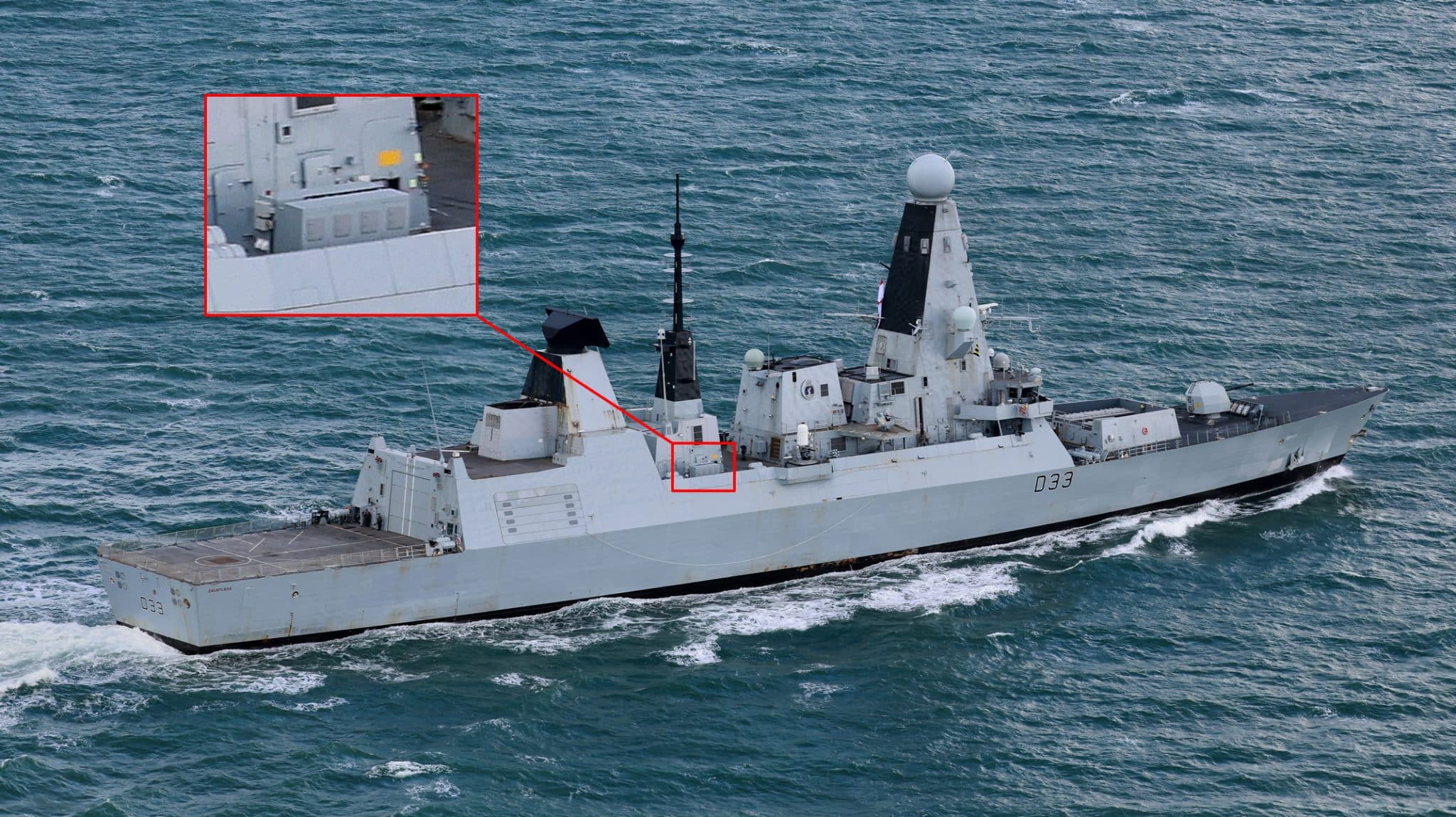
Royal Navy Type 45 Drone Interceptor Launchers Spotted on HMS Dauntless


On October 14, 2026, Naval News reported that new images released by the UK Ministry of Defence appear to show a counter-drone system fitted to the Royal Navy Type 45 destroyer HMS Dauntless (D33). The pictures, dated October 10, show the ship carrying out a passing exercise off the Isle of Wight with five Ukrainian minehunters, marking the end of Exercise Lion Protector. That exercise, which began in August, was designed to refine how the nations of the Joint Expeditionary Force protect Europe’s northern flank. The images show two mystery containers on the port and starboard sides of the destroyer’s main communications mast, and Naval News judges they are probably launchers for interceptor drones.

The reasoning behind that conclusion is worth following, because it is all inference. The containers look like purpose-built boxes rather than standard shipping containers, and measured against a nearby SOLAS life-raft canister they appear to be about two metres by one metre. Naval News suggests they house multi-cell vertical launch systems for interceptor drones, which typically need large boxes so they can fly out with their rotors spinning. The report also notes that no new sensors are visible, so the interceptors would presumably receive targeting data from the Type 45’s existing Sampson multi-function radar, the S1850M long-range radar and the electro-optical systems. If true, that would make it a mature, integrated capability rather than a quick fix. When approached, a Royal Navy spokesperson said that, due to operational sensitivities, it would not discuss the equipment fit.

The fitting also comes at a telling moment. The Royal Navy says Dauntless is preparing to escort the carrier HMS Prince of Wales when she resumes her Firecrest 2026 deployment to the High North. Sister ship HMS Dragon returned only last week from a seven-month deployment in the Mediterranean and Red Sea without the system being spotted, which suggests Dauntless may be the first Type 45 to trial it. The experience behind it is real. British ships such as HMS Diamond faced drone and missile attacks from Yemen in the Red Sea in 2024, and the Royal Navy and French Navy have since rehearsed drone swarm defence in exercises such as Sharpshooter and WildFire.

Those exercises exposed a basic problem, which is magazine depth. Naval News notes that the Type 45 and the French-Italian Horizon destroyers carry 48 vertical launch cells, and French air-defence FREMM frigates carry 32, and spending an expensive missile on every cheap drone is not sustainable. Before this, the Royal Navy had begun shifting toward other layers, including the DragonFire laser and Wildcat helicopters armed with Martlet missiles. Interceptor drones would add another layer between those two, and they let the crew match the response to the threat for much less money than a missile.

The same logic is driving counter-drone work elsewhere, as we noted in our piece on the Pentagon’s directed-energy pilot at U.S. bases. Both reflect the fact that drones have changed the economics of defence, since the attacker’s cost per shot is far lower than the defender’s. But there are limits to what can be said. We don’t know the interceptor type, its range, speed or warhead, whether it can handle fast, low-flying threats or only slow Shahed-style drones, or how many each ship will carry. An interceptor drone is also unlikely to answer a supersonic anti-ship missile, which still needs the destroyer’s long-range missiles. That last point is my own analysis rather than anything in the report.

Ultimately, this is a glimpse of a capability, not a confirmation of one. Three things would show how significant it is: an official statement from the Royal Navy on what the system is and who supplied it, evidence of whether other Type 45s receive it, and any live firing or use during the High North deployment. Until then, the fair summary is that the Royal Navy appears to be giving its most advanced air-defence destroyer a cheap answer to cheap drones.

B-52 to Carry LRASM: What the Navy’s Integration Plan Means


On October 7, 2026, the Naval Air Systems Command (NAVAIR) posted a notice that the U.S. Navy plans to negotiate a sole-source contract with Lockheed Martin Missiles and Fire Control to integrate the AGM-158C Long-Range Anti-Ship Missile (LRASM) on the Air Force’s B-52 Stratofortress, as reported by The Aviationist and Naval News. The cost-plus-fixed-fee deal covers missile software updates, associated testing, test asset repair and failure review boards, and the notice gives no timeline for fielding. It is also an intent to negotiate rather than a signed award. If completed, all three of the Air Force’s strategic bombers would be able to fire the missile, since the B-1B Lancer and B-2 Spirit already can.

The plan has been around longer than the notice suggests. Integration of the B-52 with LRASM was first discussed in 2019, then sat in limbo for several years, and The War Zone reports that the Air Force’s fiscal 2027 budget request revives it. The planned work includes folding the missiles’ software into the bomber’s baseline, validating safe separation from both wing stations and the internal launcher, updating armament interfaces and completing system-safety testing. The B-52 can carry up to 20 missiles of the AGM-158 family, 12 externally, as seen in March when B-52s left RAF Fairford loaded with JASSMs during Operation Epic Fury, and 8 on an internal rotary launcher. Naval News says an LRASM-equipped B-52 could take off with 20 of them.

The missile itself explains the interest. LRASM is derived from the JASSM-Extended Range, shares its general airframe, but is customised to strike ships in contested environments. NAVAIR says it reduces reliance on intelligence-gathering platforms, data links and GPS in an electronic warfare environment, because after launch it guides to an initial point and then uses onboard sensors to find and identify its target, with semi-autonomous algorithms. Naval News puts its range at more than 370 kilometres and notes that, before LRASM, American air-launched anti-ship strikes relied only on the Cold War-era Harpoon.

This also fits a broader pattern of showing off the weapon. LRASM was fired in at least four instances this summer around Hawaii and the Western Pacific, from bombers, maritime patrol aircraft and naval fighters, including a B-2 sinking exercise during Valiant Shield on June 27. Australia has also reached initial operating capability with LRASM and JASSM-ER on its Super Hornets, which we noted when discussing the AIM-260 on the Australian jet. According to a Tailhook 2026 presentation, the Navy plans a high-low mix of LRASM and the cheaper Blackbeard long-range strike weapon for its future carrier air wing.

The strategic logic is mass. The Aviationist argues that a group of B-52s firing a large volume of missiles from stand-off range could provide the critical mass needed to strike China’s expanding fleet and penetrate its anti-access/area-denial umbrella, and Naval News says the capability could prove crucial in a potential conflict with China. That is a fair reading of the weapon’s purpose, but there are limits. The B-52 is not stealthy, so it must survive long enough to launch, which depends on tankers, escorts and bases. The B-1B’s sudden retreat from RAF Fairford over drone threats, as we covered earlier, is a reminder that forward bases for bombers are themselves vulnerable. That last point is my analysis rather than from the reports.

Ultimately, the notice is an early step, and the real test lies in what follows. Three markers will show how far it goes: the signing of the contract and a published fielding schedule, the upgrade of the fleet to the B-52J standard, which the Aviationist says is meant to keep the bomber flying until at least 2050, and live-fire tests from a B-52 itself. Until then, the fair summary is that the Navy and Air Force are putting the pieces in place to let America’s oldest bomber join its newest ship-killing missile.