
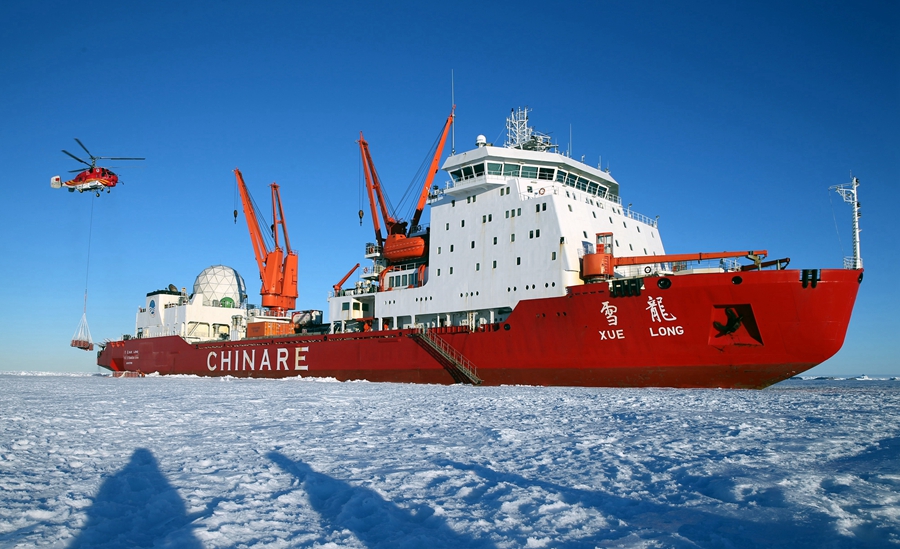
Four Chinese research vessels operated in US Arctic waters so far in 2026. Last year the total was five. By raw count, that's not an escalation, it's roughly flat, maybe even down slightly. Yet Rear Adm. Bob Little, commander of the Coast Guard's Arctic District, told Reuters this week that Washington is watching China's Arctic presence "very closely" out of genuine concern for homeland security. The apparent mismatch between a shrinking number and rising alarm is worth sitting with, because it says something real about what's actually driving the concern, and it isn't the vessel count.
What's actually bothering Little is where these ships go and how they behave once they're there. The vessels sailed through the maritime zones off Alaska, including the Aleutian Islands, into the Bering Strait, and as far north as the Pole itself, operating inside America's exclusive economic zone and over its extended continental shelf without notifying Washington through diplomatic channels first, the kind of advance notice that would be standard courtesy between nations operating near each other's sovereign waters. When Coast Guard assets challenge these ships and ask what they're doing, Little said the answer is consistently one of two lines: international waters, or scientific research. Whether that's the whole truth or a convenient answer is exactly the ambiguity that's impossible to resolve from the outside, and it's the same ambiguity this outlet has already covered in a different Arctic context, the demonstrated Russian submarine rehearsals near Svalbard that used ostensibly civilian-adjacent cover for what turned out to be a cable-sabotage exercise.
The dual-use nature of Arctic research vessels is precisely what makes this hard to dismiss either way. A ship mapping seafloor terrain or studying ice conditions can produce data with genuine scientific value and simultaneously generate exactly the kind of information a military would want before operating submarines or other assets in the same waters later. Little's own framing captured that tension without resolving it: legitimate research and quiet military reconnaissance can use identical equipment, identical routes, and identical public justifications, and there's no way to definitively separate the two categories from a distance based on the ship's own account of itself.
A separate, considerably more dramatic story adds real weight to why the Pentagon is paying attention regardless of this particular count staying flat. The War Zone reported NORAD and NORTHCOM are separately monitoring an unprecedented simultaneous deployment of five Chinese icebreaking vessels near Alaska, a fleet roughly two and a half times the size of the entire US Coast Guard's current icebreaker capacity in the whole Arctic region, with another Chinese icebreaker scheduled for commissioning imminently and plans underway for dozens more. That's the story that actually explains the anxiety in Little's comments better than the research-vessel count does on its own: China isn't just sending occasional research ships north, it's building the sustained icebreaking capacity to operate there year-round at a scale the United States currently can't match.
That capacity gap connects directly to the broader Arctic infrastructure asymmetry this outlet has already covered through Operation Polar Dagger, where CSIS documentation showed Russia had reopened dozens of Soviet-era Arctic bases while American permanent presence in the same region stayed comparatively minimal. China's own approach looks different, an icebreaker fleet and periodic research deployments rather than land-based military infrastructure, but it points toward the same underlying pattern: multiple US rivals building out genuine year-round Arctic operating capacity while America's own presence, in bases, icebreakers, or otherwise, continues to lag behind what either country is actually fielding. Little named Russia directly as his other Arctic neighbor worth watching closely for exactly this reason, and Moscow's own denial that its research vessels pose any threat is, notably, close to the identical language China uses to explain its own activity in the same waters.
