Friday, May 31, 2024

Ukraine Gets Green Light to Use F-16s for Strikes on Russian Territory


 Danish Foreign Minister Lars Løkke Rasmussen announced that Ukraine is authorized to use Danish-supplied F-16 fighter jets to strike military targets within Russian territory, provided these actions comply with the rules of war. Speaking on May 30 in Brussels, Rasmussen stressed that as long as the strikes focus on military installations, they remain within international law.

In July 2023, Denmark and the Netherlands formed a "fighter coalition" to support Ukraine, pledging to supply F-16s and offer essential training for Ukrainian pilots and technicians. This decision is part of a broader Western debate about removing restrictions on the use of Western weapons on Russian soil. Despite concerns from Washington and Berlin, Rasmussen emphasized that this initiative is not a "blank check" for indiscriminate attacks but aims to reduce Russia's offensive capabilities.

Russian Ambassador to Denmark, Vladimir Barbin, warned that using Danish weapons on Russian territory could escalate the conflict uncontrollably. Nonetheless, Denmark and several other nations advocate for lifting these restrictions, asserting that Ukraine must defend itself against assaults.

Currently, eleven Western countries, including France, the UK, the Netherlands, Poland, Sweden, Finland, the Czech Republic, Lithuania, Latvia, Estonia, and Canada, have agreed to permit Ukraine to target military installations within Russian territory using their arms. German Chancellor Olaf Scholz also endorsed this approach after discussions with French President Emmanuel Macron, allowing Ukraine to use Western weapons "within international law" against Russian military bases.

The Danish F-16s, acquired in the 1980s, are advanced multirole fighter jets known for their versatility and sophisticated avionics. They can carry various weapons, including air-to-air and air-to-ground missiles. The F-16s, powered by either Pratt & Whitney F100 or General Electric F110 turbofan engines, achieve speeds over Mach 2 and have a combat radius of about 340 miles with internal fuel, extendable with external tanks and aerial refueling.

Earlier this week, Belgium announced it would supply Ukraine with 30 F-16 fighter jets, with the first deliveries expected this year. This brings the total number of F-16s committed to Ukraine to 85, including contributions from the Netherlands, Denmark, and Norway. Ukrainian pilots are currently training in the USA, Denmark, and Romania to operate these jets.

Pentagon Secures $4 Billion to Aid Taiwan Amid Tensions with China


 Last fall, the Pentagon urged the House Armed Services Committee for assistance in supporting Taiwan, emphasizing the need for funding to replace its own stocks of military supplies. Previously, Congress authorized the Defense Department to send up to $1 billion annually from its own inventory to Taiwan, but without the necessary funding to replenish these supplies.

During the 2023 hearing, Ely Ratner, head of Pentagon policy for the Indo-Pacific region, highlighted the lack of financial resources. However, in April, Congress passed a $95 billion defense bill, allocating about $4 billion for potential Taiwan aid, with nearly half earmarked for replenishing donated stocks.

This week, U.S. Defense Secretary Lloyd Austin attended the Shangri-La Dialogue in Singapore, discussing regional security and meeting with his Chinese counterpart amid heightened military exercises around Taiwan by China. Meanwhile, the Pentagon's system for sending aid to Taiwan is processing another cycle, with a senior integration group formed by Deputy Defense Secretary Kathleen Hicks to accelerate the process.

Despite the new funding, there are challenges in delivering aid. The Pentagon's bureaucracy and concerns over U.S. military readiness have previously slowed the process. The Navy and Air Force, in particular, worried about depleting their own resources.

U.S. officials emphasize the urgency of arming Taiwan to deter potential aggression from China. The aid package, valued at $345 million, was signed by the president in spring but not announced until summer. The Pentagon now focuses on replacing stocks sent last year and prioritizes smaller-scale assistance like munitions, drones, and training.

The $4 billion aid package includes $2 billion for foreign military financing, helping Taiwan buy military equipment. However, logistical and strategic challenges remain. Taiwan's military capacity to absorb aid is limited, and Washington urges Taiwan to adopt an asymmetric defense strategy focused on denying China’s ability to invade.

Political tensions complicate the situation further. U.S.-China relations, strained after Nancy Pelosi's visit to Taiwan in 2022, remain fragile despite a recent summit between President Biden and Chinese leader Xi Jinping.

As the U.S. balances hardening Taiwan's defenses and managing relations with China, the urgency to support Taiwan's defense grows, reflecting the region's escalating tensions.

JF-17 Outshines LCA Tejas in Export Market: India and Pakistan Unveil Advanced Fighter Jets

 The skies over the Indian subcontinent are heating up as India and Pakistan introduce their latest supersonic fighter jets, the Tejas Mk 1A and the JF-17 Block III, both competing for regional air supremacy and a share in the global market for cost-effective combat jets.


India and Pakistan's New Fighter Jets

The Indian Air Force (IAF) is set to receive the upgraded Tejas Mk 1A by July, while the Pakistan Air Force (PAF) recently incorporated the JF-17 Block III in December 2023. These aircraft represent advanced iterations of their predecessors and are designed for a variety of military missions.

Production and Evolution

The Tejas, developed by India’s Aeronautical Development Agency (ADA) and Hindustan Aeronautics Limited (HAL), and the JF-17, a product of the Sino-Pakistani partnership between the Pakistan Aeronautical Complex (PAC) and China’s Chengdu Aircraft Industry Complex (CAC), are both classified as 4.5-generation aircraft, with the JF-17 Block III described as “fourth-generation plus.”

Budget-Friendly Powerhouses

Both the Tejas Mk 1A and the JF-17 Block III are single-engine, lightweight, multirole fighters designed to replace aging fleets—India’s MiG-21 and Pakistan’s assortment of Chinese and French jets. The Tejas Mk 1A completed its first test flight on March 28, 2024, while the JF-17 Block III had its inaugural flight on December 15, 2019.

Specifications and Features

The Tejas Mk 1A boasts advanced technology, including new electronics, processors, and fly-by-wire hardware, with approximately nine hard points for various weaponry. The JF-17 Block III features superior maneuverability, extended range, advanced electronics, and the NRIET/CETC KLJ-7A AESA radar.

Cost and Export Potential

The Tejas Mk 1A development has a reported budget of $5.9 billion, while the JF-17 Block III costs around $55 million per unit, as indicated by Iraq’s interest in purchasing 12 units for $664 million. The JF-17 has been exported to countries like Nigeria and Myanmar, with potential deals with Azerbaijan and Iraq. Meanwhile, despite negotiations with Malaysia and Argentina, the Tejas has yet to secure export orders.


Future Developments

The PAF plans to develop the JF-17 PFX, continuing the evolution of the JF-17 series. India aims to expedite the delivery of the Tejas Mk 1A to pave the way for the LCA Mk 2, featuring more capable engines and extended flight duration. The first squadron of Tejas Mk 1A is planned for deployment at the Nal air base in Rajasthan’s Bikaner district.

As these advanced fighter jets take to the skies, the rivalry between India and Pakistan intensifies, setting the stage for an electrifying aerial showdown.

China Deploys Stealth J-20 Fighters Near Indian Border, Sparking Concerns


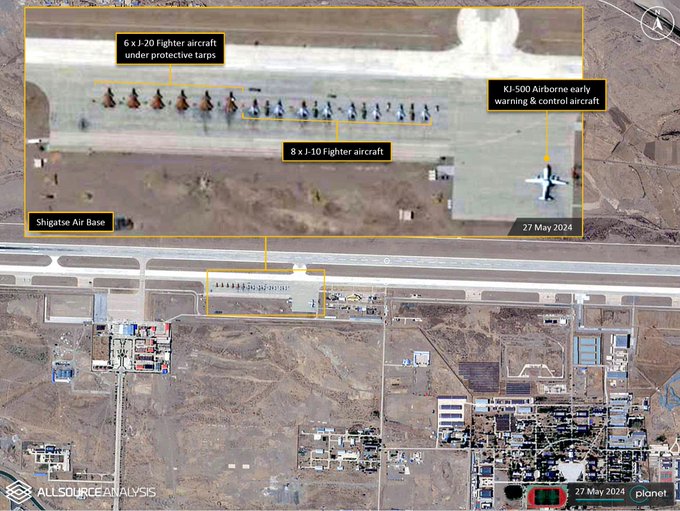
China's People's Liberation Army Air Force (PLAAF) has deployed J-20 and J-10 fighters at the Shigatse Air Base, just 150 kilometers from the Indian border, also known as the Line of Actual Control (LAC). Satellite images obtained by All Source Analysis reveal six J-20 stealth fighters, eight J-10 aircraft, and one KJ-500 airborne early warning and control aircraft at the high-altitude, dual-use airport.

This significant deployment puts the J-20s less than 300 kilometers from India’s Hasimara Air Base in West Bengal, where the Indian Air Force (IAF) has stationed its Rafale jets. This proximity has raised alarms among Indian military bloggers, highlighting the disparity between the two air forces. Unlike China, India does not have a fifth-generation aircraft.

The IAF's Rafales, considered one of its strongest defenses against the Chinese threat, are strategically positioned at Hasimara for quick deployment in case of a border threat. During the 2020 standoff, China deployed five times more J-20 fighters compared to India’s Rafales. This recent deployment at Shigatse is one of the largest near the Indian border in recent memory, following previous sightings at the Hotan airbase in Xinjiang.

China first positioned J-20s near the Indian border during the 2020 conflict, responding to the perceived threat from India’s Rafale jets. In June 2022, the PLAAF stationed about two dozen combat aircraft, including J-20s, at Hotan.

The J-20s have become a symbol of China’s military prowess. Recently, the PLA Eastern Command showcased the J-20s' capabilities in a video emphasizing their “cross-strait” lethality. This display followed military drills in response to Taiwan President Lai Ching-te's speech on independence. By 2026, each of China’s five theatre commands will have one to two J-20 brigades.

The J-20, featuring advanced electronics and sensors, is designed for “intelligentized combat,” functioning as a “sniper” by targeting vulnerable assets like airborne early warning planes with near-invisibility. Chinese media claims the J-20 is superior to the Rafale due to its stealth capabilities, though analysts argue the two jets are designed for different roles.

In a 2020 simulation drill, Chinese pilots claimed to have shot down 17 Rafale fighters using J-20s. Despite these claims, Indian officials and experts maintain that the Rafale’s combat history in various conflicts puts it above the still-developing J-20. Ironically, while Chinese J-20s are near the Indian border, Indian Rafales are in the US for the Red Flag military exercises to enhance their combat skills.