

After Russia blamed the United States for a Ukrainian ATACMS missile strike on Crimea, which resulted in civilian casualties, claims emerged on social media suggesting that Russian forces had shot down a US RQ-4B Global Hawk Unmanned Aerial Vehicle (UAV) over the Black Sea.
Prominent Russian military bloggers, including Fighterbomber, which reportedly has close Kremlin ties, shared these claims. They asserted on Telegram that a Russian MiG-31 interceptor had downed a US RQ-4B UAV over the Black Sea. Some bloggers even mentioned that Russian President Vladimir Putin praised the pilot responsible for the mission.
The Fighterbomber channel stated, “If [the Americans] fly again, it means they are prepared for the loss of a Global Hawk (or even more than one).”
However, these claims lack concrete evidence. The Kremlin has not acknowledged the rumors, and neither the Ukrainian Armed Forces nor the US military has commented on them.
The claims have generated significant discussion among Ukrainian military bloggers and open-source intelligence accounts tracking the ongoing conflict. A popular account expressed skepticism, noting, “If an interception or attack on a Global Hawk happened, we would likely see a video from the Russian Ministry of Defense.”
Kyiv-based security analyst Jimmy Rushton wrote on X (formerly Twitter) that no such incident occurred over the Black Sea and that the pro-Russian accounts’ claims were fake news. As of this report, the US Department of Defense (DoD) had not commented on these developments.
Meanwhile, Ukrainian military bloggers reported that the drone in question returned to its base unharmed.
These claims followed the Kremlin's accusation that the United States was responsible for a Ukrainian ATACMS missile attack on Crimea, which resulted in at least four deaths and 151 injuries. Moscow officially warned the American ambassador of impending retaliation.
The Russian Defense Ministry stated, “All flight missions for the American ATACMS operational-tactical missiles are planned by American specialists using US satellite reconnaissance data. Therefore, responsibility for the deliberate missile attack on civilians in Sevastopol primarily lies with Washington, which supplied these weapons to Ukraine, as well as the Kyiv regime, from whose territory this attack was launched.”
While the Russian MoD did not directly link the ATACMS attack to the RQ-4B UAV, Russian media suggested that the US reconnaissance drone circled over the Black Sea during the Ukrainian attack on Sevastopol. These reports, based on Flightradar flight tracking data, indicated that the Global Hawk might have supported Ukrainian troops during the attack, raising fears of escalating tensions between the Cold War rivals.
The incident echoes a previous event where Russian fighter jets dumped fuel over an MQ-9 Reaper drone over the Black Sea, causing it to lose control and crash into the sea.
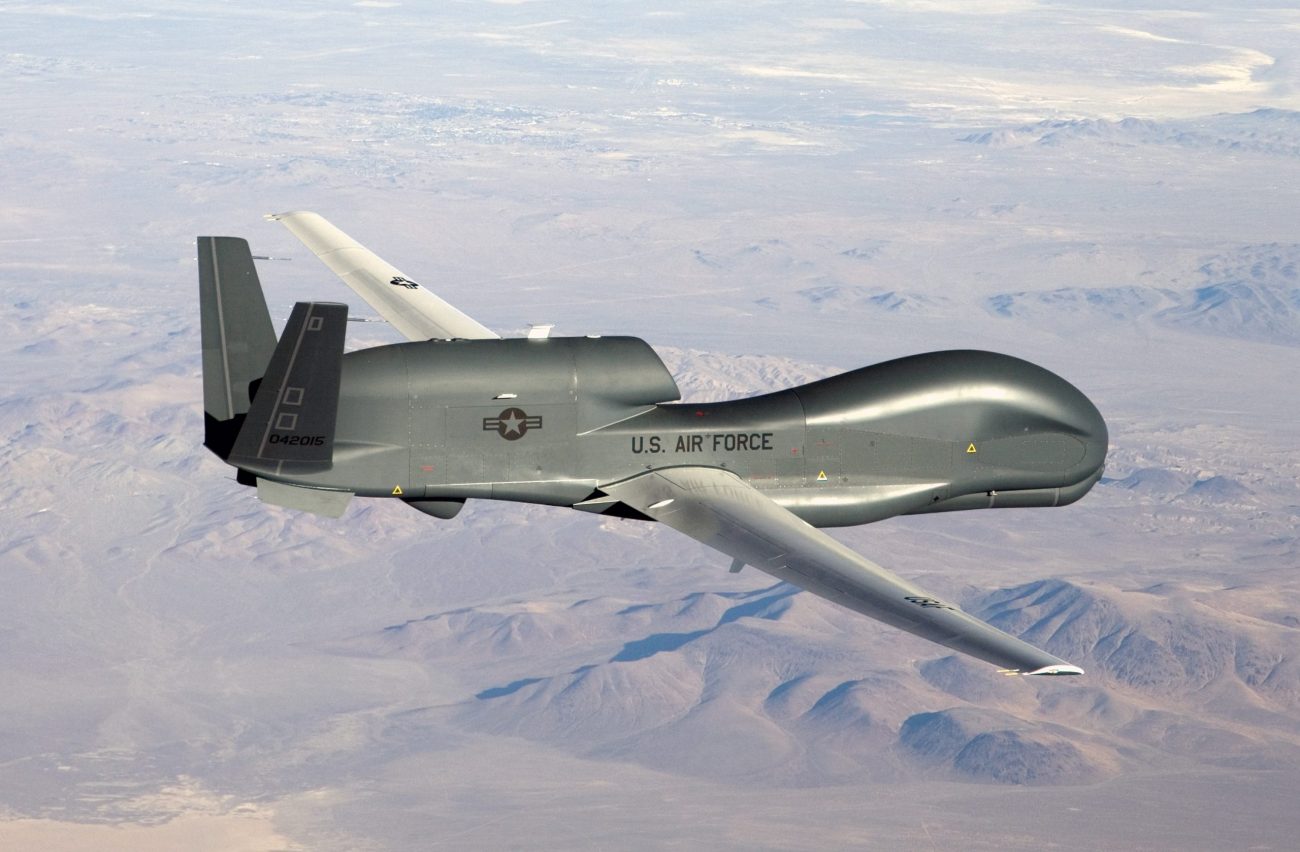
The Global Hawk is an advanced aerial reconnaissance system that operates at high altitudes for extended periods, controlled remotely without an onboard crew and unarmed. It has a history of numerous missions across various conflict zones. Equipped with integrated sensors and cameras, it can continuously capture high-resolution images of large areas, day or night, and in all weather conditions. According to manufacturer Northrop Grumman, the Global Hawk can detect targets over 340 miles away from its 60,000-foot operating altitude.
The drone complements manned and space reconnaissance systems by providing continuous, near-real-time coverage using imagery intelligence (IMINT) and signals intelligence (SIGINT) sensors. The precise range of its cameras and sensors remains classified.
The MQ-4A variant of the Global Hawk was shot down by Iranian forces in June 2023 while flying over the Strait of Hormuz, leading to a statement from Iran’s Islamic Revolution Guards Corps (IRGC) that the UAV had breached Iranian airspace, sending a “clear message to America.”
The Global Hawk has been extensively used by US forces for sophisticated military operations and has been sold to countries like South Korea and Japan for enhanced surveillance and reconnaissance.
The drone played a critical role in Operation ‘Inherent Resolve’ against the Islamic State of Iraq and the Levant (ISIL), providing real-time imagery and signals intelligence to help commanders make crucial decisions, distinguish between friendly and enemy forces, identify long-term targets, and monitor hostile equipment movements.
Recently, the US Air Force deployed RQ-4 Global Hawks to a base in Japan as part of a rotational deployment strategy to support sustained operations in the region and maintain a “free and open Indo-Pacific region.”
Russia has frequently noted how NATO and US aircraft, such as the RC-135 Rivet, RQ-4B Global Hawk drone, and the E-8 Joint STARS reconnaissance aircraft, fly around Ukraine’s coast and the Black Sea to support Kyiv’s military operations.
The Global Hawk was reportedly involved in the October 2022 maritime drone strike on the Russian Navy’s Black Sea Fleet in Crimea’s Sevastopol. Russian forces have cited the drone's involvement in several such Ukrainian operations.
Moscow is using the ATACMS attack to strengthen its argument that it is fighting a proxy war against the West, questioning Washington’s intentions.

