Thursday, June 20, 2024

US-India Stryker Partnership: A Game Changer for Indian Defense and China Containment


 As of November 2023, it has been disclosed that the US plans to start manufacturing Stryker armored vehicles in India. This initiative could mark the first time these vehicles are produced outside the US and play a significant role in countering China. Additionally, the US is attempting to push Russia out of the Indian air defense market by offering a license for the advanced Stryker M-SHORAD.

On June 19, Indian media reported that discussions have progressed, with India's Ministry of Defense now considering a three-phase cooperation plan with the US for producing Stryker vehicles. However, there are still various details and requests from the Indian side that need to be addressed.

The acquisition of Stryker armored vehicles depends on their ability to meet the specific needs of motorized rifle battalions. Recently, the US proposed a demonstration to showcase these vehicles' mobility and firepower in India's mountainous regions, indicating the Indian Army's requirement for vehicles adapted to challenging terrains like Eastern Ladakh and Sikkim.

One crucial demand from India is a high degree of production localization, including the transfer of critical technologies to a participating company, whether private or state-owned.

If India proceeds with the Stryker acquisition, it will follow a phased approach: starting with a limited purchase through the Foreign Military Sales (FMS) program, moving to joint production in India, and eventually developing a futuristic version of the armored vehicle. Specific details of this version are yet to be disclosed.

While these ambitious plans with the US are underway, India is also pursuing its initiatives for wheeled and tracked armored vehicles to replace its fleet of over 2,000 BMP-2s.

The Stryker Armored Fighting Vehicle (AFV) is a family of eight-wheeled armored combat vehicles produced by General Dynamics Land Systems for the US Army. Designed for versatility, the Stryker provides infantry transport, reconnaissance, and direct fire support. It measures approximately 22.92 feet in length, 8.96 feet in width, and 8.92 feet in height, with a weight ranging from 16.47 to 20.8 tons, depending on the configuration.

Powered by a Caterpillar C7 diesel engine delivering about 350 horsepower, the Stryker can reach speeds up to 60 miles per hour and has a range of around 330 miles on a full tank. Its eight-wheel drive (8×8) configuration enhances mobility across various terrains, and it is equipped with run-flat tires and a central tire inflation system for sustained operational capability even after wheel damage.

The Stryker offers advanced armor protection against small arms fire, artillery fragments, and improvised explosive devices (IEDs). It features modern communication and navigation systems to enhance situational awareness and command-and-control capabilities.

The Stryker family includes various variants, such as the Infantry Carrier Vehicle (ICV), Mobile Gun System (MGS), Reconnaissance Vehicle (RV), Commander's Vehicle (CV), Fire Support Vehicle (FSV), Engineer Squad Vehicle (ESV), Medical Evacuation Vehicle (MEV), and Anti-Tank Guided Missile Vehicle (ATGMV).

Weaponry on the Stryker AFV varies by variant, with common armaments including the M2 .50 caliber machine gun, Mk 19 40mm automatic grenade launcher, and M240 7.62mm machine gun. The MGS variant features a 105mm tank gun, while the ATGMV is equipped with TOW missile launchers.

The Stryker AFV's primary purpose is to provide a highly mobile, protected platform for transporting infantry and conducting various combat operations. Its versatility allows it to perform a wide range of missions, making it a crucial asset in modern military engagements.

Fully Funded NATO: A Powerful Deterrent Against Russian Aggression, Report by Dr. Warren K. Christolon


The dream of achieving peace and security across Europe is within reach, provided the ongoing issue within NATO is resolved. NATO, originally based on shared responsibility, has shifted to a model where 21 out of its 32 members are not meeting their 2% GDP defense spending obligation. This failure is especially concerning amid the ongoing war between Ukraine and Russia, affecting both NATO and non-NATO European countries, particularly Ukraine.

Despite the requirement for NATO countries to allocate 2% of their GDP to defense, many have not done so. Only 10 out of the 30 European NATO members met this goal in 2023. These "Honorable 10" are Poland, Greece, Estonia, Lithuania, Finland, Romania, Hungary, Latvia, the UK, and the Slovak Republic. The US and Canada also contribute, with the US spending 3.49% of its GDP on defense.

A decade ago, the Obama Administration highlighted that NATO countries were not meeting their funding commitments, and the Trump Administration called for "burden sharing." However, there has been no significant improvement. As European countries expand their welfare states, their defense spending has decreased, failing to recognize the global security threats beyond Europe and the impracticality of relying solely on the US for protection.

The US, overextended both militarily and economically, has shifted its focus to other strategic regions like the Indo-Pacific and the Middle East, reducing its defense resources in Europe. European NATO members must now face reality and take corrective action.

The non-compliant NATO countries must be encouraged to contribute their fair share, moving away from their "NATO Welfare Cocoon." A fully funded European NATO would vastly outmatch Russia in military and economic power. With NATO Europe’s population of one billion versus Russia’s 144 million, Europe would have undeniable deterrence supremacy, ensuring protection for all like-minded European countries and neutralizing Russia as a credible threat.

To address this security deficiency, it is crucial to end the exploitation by the non-paying NATO countries. A new Secretary General from one of the ten compliant countries should be appointed to reshape NATO leadership and enforce the 2% GDP defense spending rule.

Qualified leaders from the compliant countries are ready to lead NATO and ensure all members meet their financial obligations, creating a credible deterrence force in Europe. This new leadership will reorient NATO’s principles, emphasizing that Europe must take primary responsibility for its defense, acknowledging the US's global commitments, and ensuring all European members contribute their fair share.

A fully funded NATO would emerge as the dominant defensive power in Europe, securing peace and stability. This reformed NATO, with its enhanced capabilities, would deter Russia and strengthen ties with non-NATO European countries, promoting peace and security across the continent.

South Korea Weighs Arming Ukraine Amid Growing Russia-North Korea Military Ties


Triggered by the recent defense agreement between North Korea and Russia, South Korea is considering the possibility of arming Ukraine, according to a report from Yonhap News on June 20. An unnamed official indicated that this reevaluation follows the commitment between North Korean and Russian leaders to support each other in case of conflict.

Though not officially confirmed by the South Korean government, these reports follow Seoul's condemnation of the strategic partnership deal signed by North Korea and Russia. South Korea's government stated that the partnership violated UN sanctions, emphasizing that any cooperation that enhances North Korea's military capabilities breaches UN Security Council resolutions and is subject to international monitoring and sanctions.

In a recent statement, Russian President Vladimir Putin praised South Korea for not directly supplying arms to Ukraine, which was perceived as an olive branch to Seoul, dissatisfied with Moscow's growing military ties with Pyongyang.

Historically, South Korea has been hesitant to send arms to Ukraine due to its policy of not arming countries involved in active conflicts. Despite pressure from NATO allies, Seoul has maintained its stance, although it has indirectly supplied 155mm artillery shells to Ukraine via the United States.

Reports suggest that the two Koreas are engaging in a proxy war, with South Korea indirectly aiding Ukraine and North Korea allegedly supplying weapons to Russia. Chris Park from the Center for Strategic and International Studies noted that this situation effectively places the Koreas in opposition through their support of different sides in the Ukraine conflict.

The new defense cooperation agreements between North Korea and Russia, described as the most significant since the Cold War, have escalated tensions with South Korea. Pyongyang has recently launched provocations, including sending waste-filled balloons and soldiers crossing the border, prompting South Korea to fire warning shots.

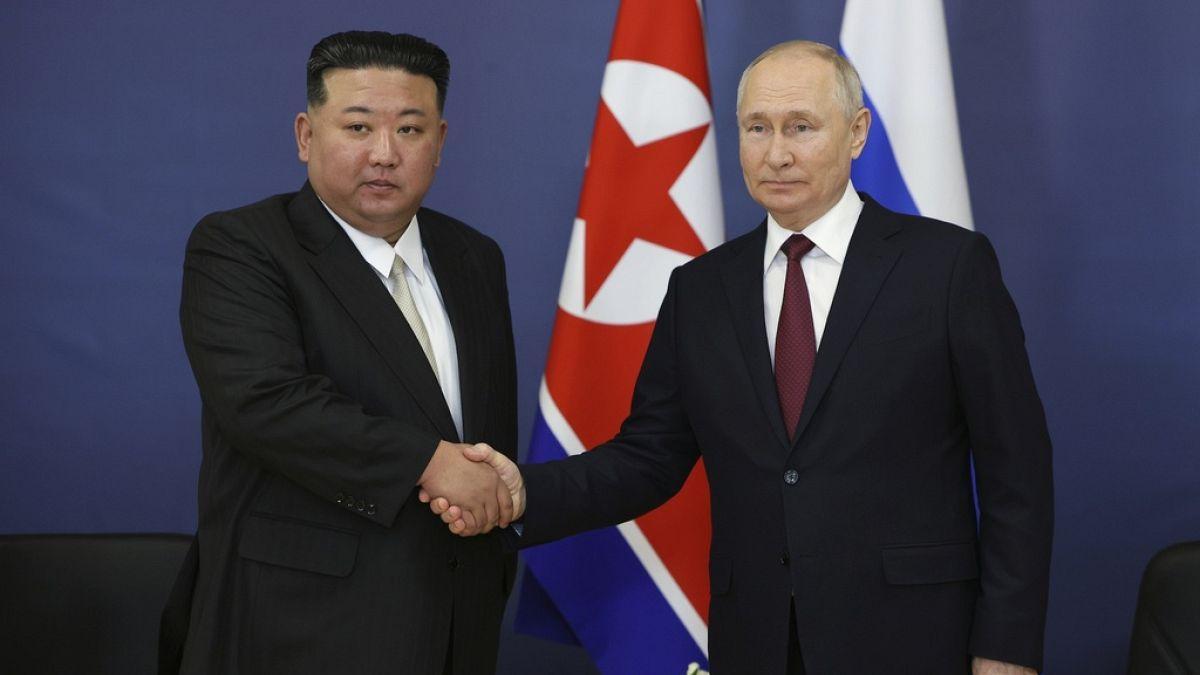
Concerns are rising in Seoul about North Korea potentially receiving Russian support for its missile program in return for its military backing. The strategic agreement signed by Russian President Vladimir Putin and North Korean leader Kim Jong Un guarantees mutual assistance in case of aggression.

Although it is unclear if the new agreement offers the same level of protection as the Cold War-era pact, it marks a significant step towards a closer relationship between the two nations. The agreement obliges each party to use all available means to assist the other in case of an attack, in compliance with national laws and Article 51 of the United Nations Charter, which upholds the right to self-defense.

Both leaders have characterized the deal as a breakthrough, enhancing cooperation in security, trade, investment, culture, and humanitarianism. Kim Jong Un declared the agreement as the "strongest ever treaty," signaling a solid alliance and full support for Russia’s actions in Ukraine. Putin referred to it as a significant advancement in their bilateral relations.

ROK Navy Strengthens Maritime Defense with Arrival of New P-8A Poseidon Aircraft


On June 19th, the Republic of Korea (ROK) Navy welcomed the first three P-8A Poseidon maritime patrol aircraft at their Naval Air Command in Pohang. These aircraft, renowned as the world's premier "submarine hunters," are part of an acquisition plan initiated in September 2018, with Boeing producing six units by 2023. After completion of operational training overseas, the aircraft were delivered to South Korea.

To celebrate the arrival, a synchronized flight was conducted with a P-3 maritime patrol aircraft, symbolizing the safe delivery of the P-8A and the commitment to robustly defend Korean waters from the air. P-3 pilots welcomed the P-8A pilots over operational waters, who in turn expressed their dedication to achieving top combat readiness and executing their maritime defense mission through future force integration.

The P-8A Poseidon is the latest maritime patrol aircraft capable of missions such as anti-submarine warfare (ASW), anti-surface warfare (ASuW), and general maritime patrol operations. Compared to the ROK Navy’s P-3 aircraft, the P-8A offers a higher maximum speed and a longer operational range. It is equipped with advanced surveillance and reconnaissance tools, including a long-range X-band radar for detecting sea targets hundreds of kilometers away, digital electro-optical (EO) and infrared (IR) equipment for high-resolution imaging and target detection within tens of kilometers, as well as electronic warfare systems.

Additionally, the P-8A carries air-to-surface missiles for striking maritime targets with precision and torpedoes for engaging submarines. It can deploy over 120 sonobuoys for detecting, identifying, and tracking enemy submarine signals.

The introduction of the P-8A will significantly enhance the ROK Navy's aerial anti-submarine warfare capabilities against North Korean submarines, improve rapid response capabilities in future maritime operations, and extend surveillance over Korean waters. Operating the same type of aircraft as the U.S. Navy will also facilitate seamless joint maritime aviation operations, boosting interoperability.

Three more P-8As are set to arrive on June 30th, with a delivery ceremony planned at the Naval Air Command on July 4. Following a year of force integration training and capability assessments, these aircraft are expected to be operational by mid-2025.