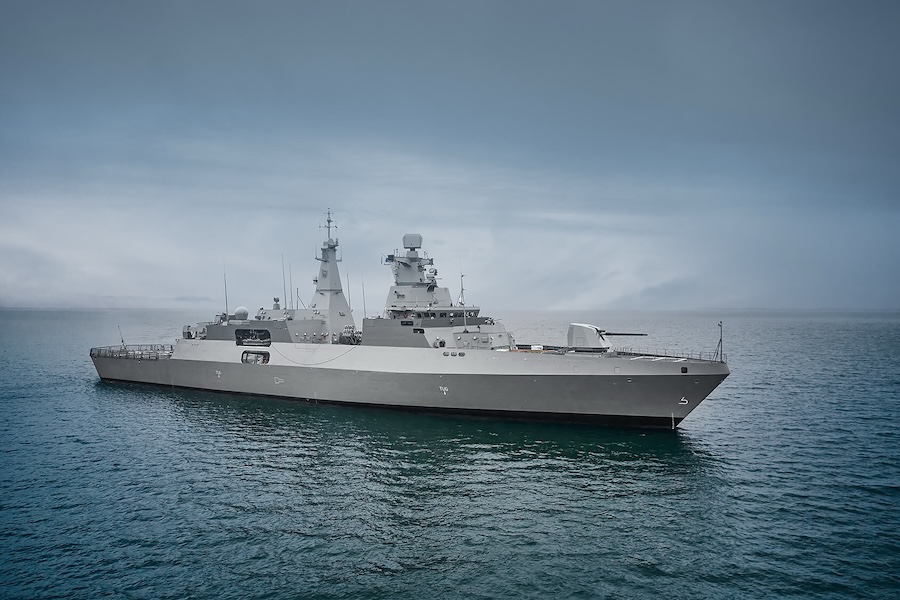
TKMS CEO Oliver Burkhard confirmed this week that the German shipbuilder is open, in principle, to involving Rheinmetall's naval division in building the second batch of four MEKO A-200 frigates for the German Navy's new F128 program, with a supplier day planned to work out details and a bid formally requested from Rheinmetall Naval Systems, the former NVL yard Rheinmetall acquired outright in March. Burkhard was careful to frame this as compliance with guidelines encouraging TKMS to involve companies excluded from the F126 program rather than a firm commitment, adding pointedly that "it's not mandatory" and that economic viability still has to be demonstrated. The first four ships already have signed contracts and production underway at the Heinrich Rönner Group's Bremerhaven yard; the €25 million framework for a second batch of four remains pending, with Burkhard expecting a decision after Germany's summer recess.
That single sentence about "companies not selected for the F126 class" is doing a lot of unstated work, and understanding why requires the collapse this announcement is actually a consequence of. Germany formally cancelled its F126 anti-submarine frigate program on June 24, 2026, after original contractor Damen Schelde Naval Shipbuilding notified Berlin it could not deliver the six originally planned frigates on schedule or budget, a project whose projected cost had ballooned from roughly €10 billion at its 2020 launch to an estimated €18 billion had Berlin tried to salvage it by transferring lead contractor status to Rheinmetall's newly acquired NVL yard instead. Defence Minister Boris Pistorius killed the program outright rather than absorb that overrun, writing off roughly €2.3-2.6 billion already spent, and pivoted immediately to procuring up to eight smaller, simpler MEKO A-200 DEU frigates from TKMS instead, a "bridge solution" that had actually been under discussion since March as a hedge in case the F126 rescue attempt failed.
The market reaction to that cancellation makes clear how much was riding on it for both companies. Rheinmetall's shares fell as much as 18-20 percent, wiping out roughly €8-11 billion in market value in a single trading session, as the F126 transfer had been the anchor program justifying its roughly €1.5 billion acquisition of NVL only months earlier; TKMS shares rose 9-13 percent in the same window, having effectively inherited Germany's entire near-term frigate budget by default. Rheinmetall now projects a €346 million naval-segment sales loss for the current fiscal year directly attributable to the cancellation, a genuinely painful outcome for a division the company had only just carved out as a standalone reporting segment weeks earlier, built around a modest €334 million in first-nine-months revenue from existing programs like the K130 corvettes and FDB424 intelligence ships.
Read against that backdrop, TKMS's openness to Rheinmetall's participation in the second MEKO batch looks less like collegial industrial cooperation and more like a face-saving mechanism built into the F128 program's own procurement guidelines, an explicit expectation that companies frozen out of the F126 wreckage, Rheinmetall chief among them, get some path back into Germany's naval rearmament spending rather than being shut out entirely after a program collapse that wasn't really their fault. That framing matters because Rheinmetall's naval ambitions were never really about MEKO frigates in the first place; they were a bet on becoming Germany's prime naval contractor at scale, and the F126 collapse, however TKMS chooses to include or exclude Rheinmetall going forward, has already denied Rheinmetall that role for this budget cycle regardless of what a second-batch subcontract might offer.
The bigger picture this single supplier dispute sits inside is Germany's newly urgent, newly well-funded naval rearmament drive running considerably hotter than its shipbuilding industry's execution track record can currently support. TKMS itself is simultaneously juggling a €20.1 billion order backlog, a potential €15 billion, 12-submarine contract with Canada expected to be signed by year's end, and a P-75I submarine deal with India Burkhard called "quite realistic" for the same timeframe, on top of absorbing Germany's entire post-F126 frigate program. A shipbuilding sector this stretched, following one program that grew from €10 billion to a projected €18 billion before Berlin pulled the plug entirely, is a reasonable thing to watch closely rather than assume will execute smoothly a second time, and whether Rheinmetall ends up meaningfully involved in F128's second batch may say less about industrial cooperation than about how much slack, if any, TKMS actually has left to share.