
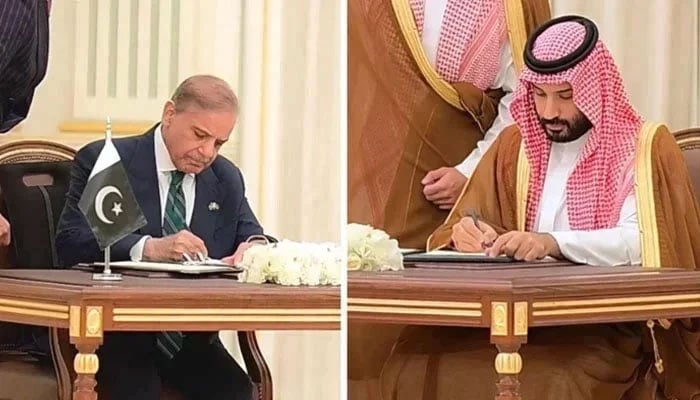
When Saudi Arabia, Pakistan, and Turkey signed the Mecca Joint Defence Agreement on August 7, formalizing a commitment that an armed attack on any one signatory constitutes an attack on all three, the immediate coverage focused on troop numbers and combined firepower: nearly 1.4 million active personnel, 3,400 aircraft, 6,000 tanks, and a combined defense budget around $124.4 billion across the three countries. Israeli strategic analyst Shay Gal, writing in EurAsian Times, has argued the more consequential story isn't the pact's military weight but its geometry: by formally binding itself to Pakistan's security, Saudi Arabia has pulled the India-Pakistan rivalry into the center of a corridor project the West is counting on as a genuine alternative to Chinese-controlled trade infrastructure, the India-Middle East-Europe Economic Corridor (IMEC).
The pact itself builds on groundwork laid nearly a year earlier rather than emerging from nowhere. Saudi Arabia and Pakistan signed a bilateral Strategic Mutual Defence Agreement in September 2025, itself explicitly linked at the time to Israel's strike on Doha and long-standing, unconfirmed speculation that Riyadh had quietly funded Pakistan's nuclear weapons program decades ago and might sit under its nuclear umbrella. The Mecca Pact extends that same collective-defense logic to a third partner, and Pakistani officials have been careful to frame it as "purely defensive" and not directed at any specific country, with one Islamabad-based analyst explicitly cautioning against reading it as directed against Iran. Gal's argument doesn't require reading hostile intent into the pact to make its point, though: it's the structural ambiguity itself, unspecified activation triggers and no clarity on who determines when an attack qualifies, that he argues creates the exposure, since New Delhi has no way to know in advance whether a future India-Pakistan flare-up would draw Saudi Arabia in as a treaty obligation rather than a bystander.
What Gal's piece doesn't quantify, and where the actual economic weight of his argument sits, is just how much capital IMEC represents and how exposed it already is. The corridor was launched with considerable fanfare at the 2023 G20 summit as a rail-and-shipping alternative connecting India to Europe via UAE, Saudi Arabia, Jordan, and Israel, explicitly positioned as a counterweight to China's Belt and Road Initiative. Progress on the ground has been considerably slower than the initial announcement suggested, hampered first by the Gaza war disrupting the corridor's planned route through Israeli territory and, as Gal's piece implicitly argues, now facing a second structural risk in Saudi Arabia's deepening formal commitment to Pakistan's security. A corridor still in early planning and infrastructure stages, rather than one with capital already sunk into rail lines and ports, is precisely the kind of investment most sensitive to a signal that one of its central nodes has taken on new geopolitical risk.
Gal's prescription, that India should respond by "pricing" its relationships with Riyadh rather than rupturing them, using energy contracts, market access, and investment terms as leverage, is worth reading alongside evidence that India has already begun doing exactly this independent of the Mecca Pact. The UAE overtook Saudi Arabia as India's second-largest oil supplier in May 2026, and the two countries separately established a strategic defense partnership that same month covering advanced technology, maritime security, and secure communications, a hedge Gal cites as part of what he calls India's "redundancy arc" of alternative partners stretching from the Indian Ocean to the Eastern Mediterranean. Whether that diversification was accelerated by the Mecca Pact specifically or reflects a longer-running Indian strategy of avoiding overdependence on any single Gulf partner is difficult to disentangle from the public record, but the direction of travel Gal describes is at minimum consistent with India's recent moves.
It's worth flagging, as with any single-analyst opinion piece, that Gal writes from a specifically Israeli strategic vantage point, as a former Israel Aerospace Industries executive now advising on regional strategy, and his framing of the pact as fundamentally reshaping Gulf security architecture is one interpretation among several; Pakistani and Turkish officials have both explicitly downplayed the agreement's scope, and other regional analysts have described it more modestly as a framework for coordination rather than a NATO-style alliance. What isn't in dispute is the underlying structural fact his argument rests on: IMEC's viability depends on trust in Saudi Arabia as a stable transit node, and the Mecca Pact, whatever its practical military substance, has genuinely added a new variable to that trust calculation that didn't exist a year ago.

No comments:
Post a Comment