
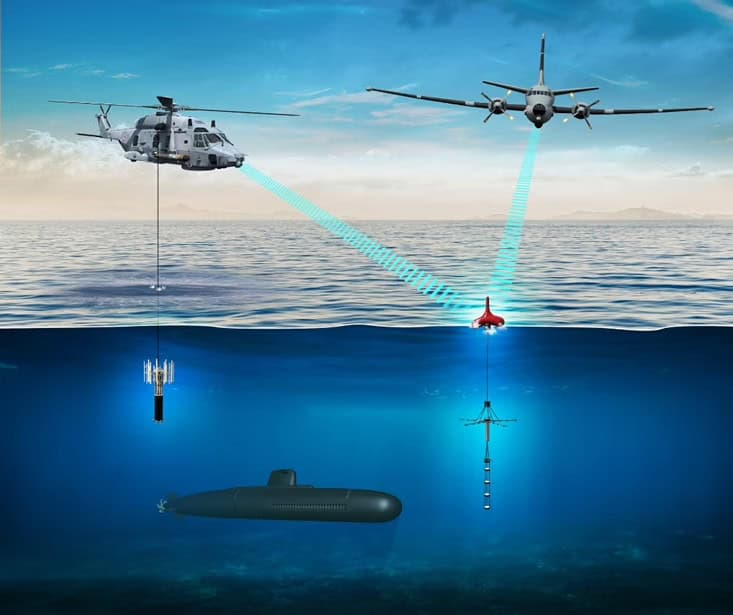
Ultra Maritime announced this week that it successfully demonstrated an integrated active-passive sonar system during the U.S. Navy's Lanternfish 2026 exercise, pairing its Sea Spear deployable passive array with a newly developed SSQ-125B active sonobuoy to detect and localize unmanned underwater vehicles (UUVs). The company frames the result as validation of its "Ocean of Things" concept, a distributed network of autonomous underwater sensors deployable from manned and unmanned platforms alike, designed to build a persistent, real-time picture of contested undersea environments, from port protection to chokepoint security to long-duration surveillance of strategic waterways. Taken purely as a press release, this is a modest technical milestone. Taken in the context of what's actually been happening beneath European and Indo-Pacific waters over the past two years, it's a fairly direct response to a problem that has gone from theoretical to expensive in a hurry.
That problem is the sustained wave of suspected sabotage against undersea cables and pipelines in the Baltic Sea, a pattern serious enough that Finnish authorities boarded and detained the tanker Eagle S in December 2024 after it dragged its anchor across the Estlink 2 power cable, and that NATO has since stood up a dedicated Baltic Sentry mission specifically to monitor and deter further incidents. The list of confirmed or suspected incidents runs well beyond a single ship: the Balticconnector gas pipeline linking Finland and Estonia was damaged in October 2023 by the Chinese vessel Newnew Polar Bear, two more communication cables were severed in November 2024 by the Chinese bulk carrier Yi Peng 3, and a Helsinki-to-Tallinn fiber-optic line was disrupted again on the final day of 2025. Finland's own intelligence service has since urged caution against automatically attributing every incident to coordinated Russian sabotage, noting some damage may result from ordinary anchor-dragging rather than deliberate hybrid warfare, but the security response has proceeded on a worst-case basis regardless of that ambiguity, because the strategic cost of being wrong in the other direction is considerably higher.
What existing NATO countermeasures have struggled with, and where a system like Ultra Maritime's is actually aimed, is the detection gap beneath the surface rather than on it. Analysts examining the Baltic Sentry program have pointed out that surface patrol vessels can shadow and monitor suspicious ships, but they generally cannot detect a small UUV or a diver operating below the waterline, because naval sonar has traditionally been optimized to find large, loud targets like submarines rather than the comparatively quiet, small autonomous vehicles increasingly implicated in seabed sabotage concerns. The U.S. Navy has already begun addressing that specific gap operationally, deploying Iver3 UUVs from its dedicated Unmanned Undersea Vehicle Group during NATO's BALTOPS 2026 exercise near Latvia specifically to improve seabed awareness, alongside allied efforts to reroute and diversify cable paths so a single cut can't isolate an entire country's connectivity.
Ultra Maritime's demonstration adds a specific missing piece to that broader effort: most existing undersea surveillance is built around finding submarines, which are relatively large, mechanically loud, and comparatively easy to detect passively over long ranges. A UUV built for cable sabotage or seabed reconnaissance is a different, harder target, small, potentially near-silent, and able to loiter close to infrastructure for extended periods, which is exactly the detection profile the Sea Spear-and-SSQ-125B pairing is designed against, combining passive listening for persistence with active sonar for precise localization once something is flagged. That's a materially different engineering problem than legacy ASW, and it's telling that Ultra Maritime is marketing the system explicitly around "port and critical infrastructure protection" and "maritime choke point security" rather than traditional blue-water submarine hunting.
This also connects to a broader pattern this blog has tracked in how quickly UUVs have moved from a niche capability to a genuine offensive and defensive priority across multiple theaters simultaneously, from CENTCOM's newly announced Task Force Falcon Strike explicitly adding uncrewed underwater vehicles to its one-way attack drone doctrine, to Ukraine's own claimed UUV strike on a Russian Improved Kilo-class submarine at Novorossiysk in December 2025. The same technology proliferating as an offensive weapon in the Black Sea and the Gulf is precisely what NATO now needs a reliable detection layer against in the Baltic, and a sonobuoy test in Braintree, Massachusetts, however unglamorous it looks in a corporate press release, is a direct piece of the same undersea arms race this blog has been documenting from the other, more visibly combative end.

No comments:
Post a Comment