
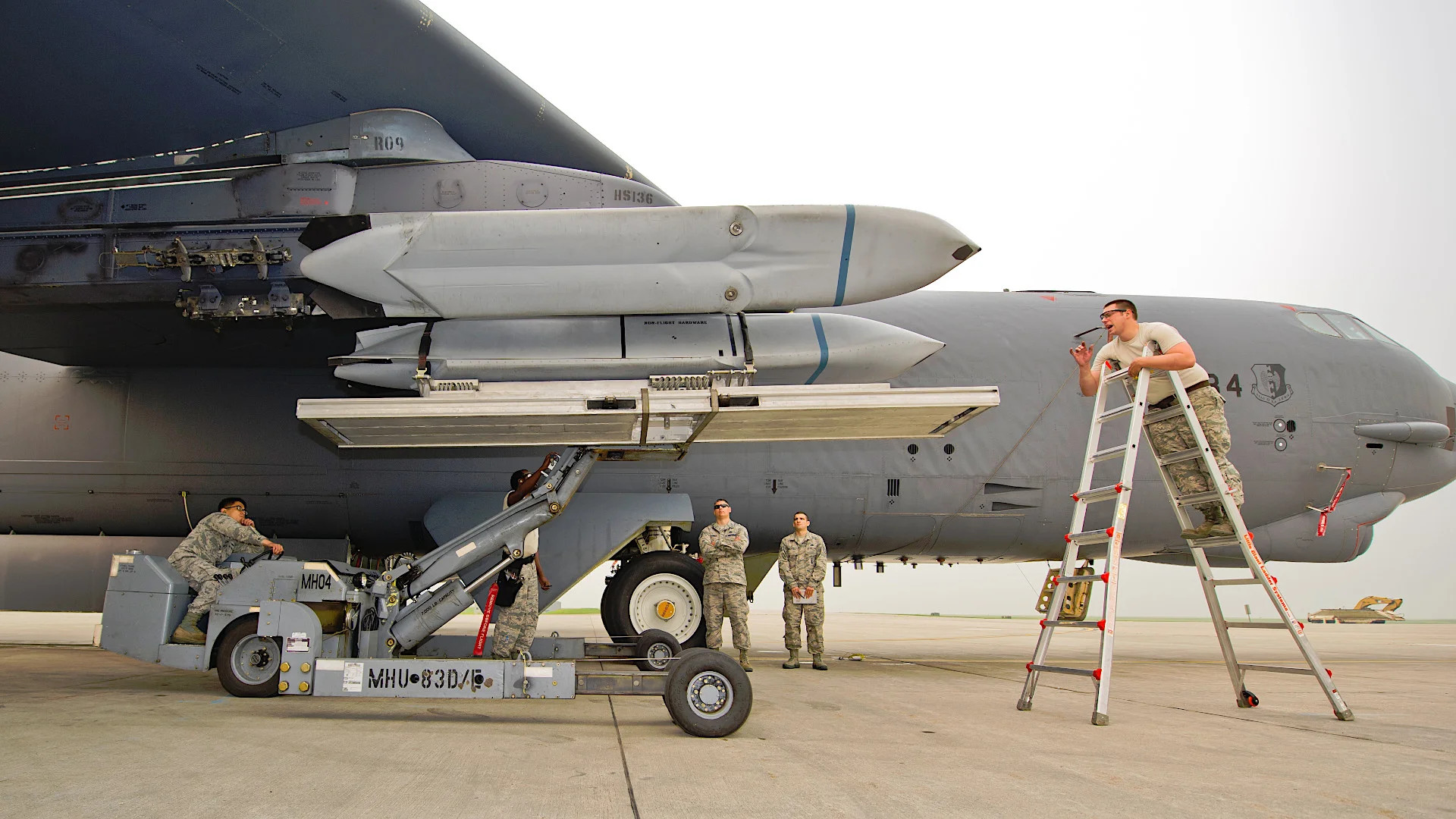
On October 7, 2026, the Naval Air Systems Command (NAVAIR) posted a notice that the U.S. Navy plans to negotiate a sole-source contract with Lockheed Martin Missiles and Fire Control to integrate the AGM-158C Long-Range Anti-Ship Missile (LRASM) on the Air Force’s B-52 Stratofortress, as reported by The Aviationist and Naval News. The cost-plus-fixed-fee deal covers missile software updates, associated testing, test asset repair and failure review boards, and the notice gives no timeline for fielding. It is also an intent to negotiate rather than a signed award. If completed, all three of the Air Force’s strategic bombers would be able to fire the missile, since the B-1B Lancer and B-2 Spirit already can.
The plan has been around longer than the notice suggests. Integration of the B-52 with LRASM was first discussed in 2019, then sat in limbo for several years, and The War Zone reports that the Air Force’s fiscal 2027 budget request revives it. The planned work includes folding the missiles’ software into the bomber’s baseline, validating safe separation from both wing stations and the internal launcher, updating armament interfaces and completing system-safety testing. The B-52 can carry up to 20 missiles of the AGM-158 family, 12 externally, as seen in March when B-52s left RAF Fairford loaded with JASSMs during Operation Epic Fury, and 8 on an internal rotary launcher. Naval News says an LRASM-equipped B-52 could take off with 20 of them.
The missile itself explains the interest. LRASM is derived from the JASSM-Extended Range, shares its general airframe, but is customised to strike ships in contested environments. NAVAIR says it reduces reliance on intelligence-gathering platforms, data links and GPS in an electronic warfare environment, because after launch it guides to an initial point and then uses onboard sensors to find and identify its target, with semi-autonomous algorithms. Naval News puts its range at more than 370 kilometres and notes that, before LRASM, American air-launched anti-ship strikes relied only on the Cold War-era Harpoon.
This also fits a broader pattern of showing off the weapon. LRASM was fired in at least four instances this summer around Hawaii and the Western Pacific, from bombers, maritime patrol aircraft and naval fighters, including a B-2 sinking exercise during Valiant Shield on June 27. Australia has also reached initial operating capability with LRASM and JASSM-ER on its Super Hornets, which we noted when discussing the AIM-260 on the Australian jet. According to a Tailhook 2026 presentation, the Navy plans a high-low mix of LRASM and the cheaper Blackbeard long-range strike weapon for its future carrier air wing.
The strategic logic is mass. The Aviationist argues that a group of B-52s firing a large volume of missiles from stand-off range could provide the critical mass needed to strike China’s expanding fleet and penetrate its anti-access/area-denial umbrella, and Naval News says the capability could prove crucial in a potential conflict with China. That is a fair reading of the weapon’s purpose, but there are limits. The B-52 is not stealthy, so it must survive long enough to launch, which depends on tankers, escorts and bases. The B-1B’s sudden retreat from RAF Fairford over drone threats, as we covered earlier, is a reminder that forward bases for bombers are themselves vulnerable. That last point is my analysis rather than from the reports.
Ultimately, the notice is an early step, and the real test lies in what follows. Three markers will show how far it goes: the signing of the contract and a published fielding schedule, the upgrade of the fleet to the B-52J standard, which the Aviationist says is meant to keep the bomber flying until at least 2050, and live-fire tests from a B-52 itself. Until then, the fair summary is that the Navy and Air Force are putting the pieces in place to let America’s oldest bomber join its newest ship-killing missile.

No comments:
Post a Comment