
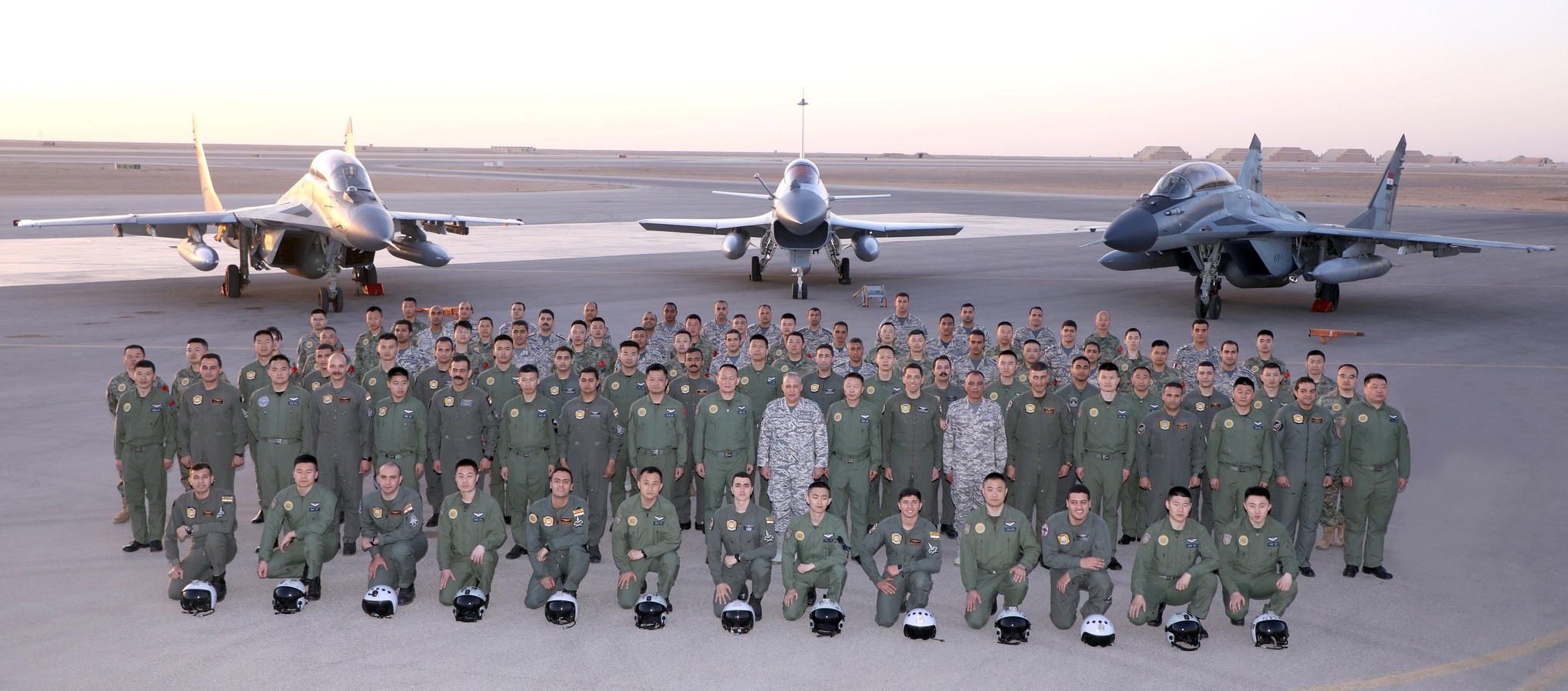
On October 12, 2026, Military Watch Magazine reported on comments by a Chinese pilot who took part in Eagles of Civilization 2026, the joint air exercise with Egypt, drawing on a report by state broadcaster CCTV. The pilot said Egyptian personnel were especially interested in China’s electronic warfare capabilities and long-range air-to-air missiles, and also commented on the Egyptian Rafale. The exercise ran from mid-August to early September, marked the first deployment of Chinese J-16 fighters to Africa and included the first J-16 versus Rafale training engagements. It followed an initial 2025 edition that paired lighter J-10C fighters with Egyptian aircraft.
The Chinese contingent was more than a fighter detachment. It included J-16s, a KJ-500 airborne early-warning aircraft, an electronic warfare variant of the Y-9 transport, a YY-20A tanker, Y-20A transports and Z-20 helicopters. The mission set covered air combat tactics, air superiority operations and search-and-rescue, with training progressing from one-versus-one and two-versus-two engagements to system-level operations. Chinese state media said that on the third day the drills reached a four-versus-six beyond-visual-range scenario, in which airborne surveillance and electronic jamming played major roles. The Egyptian Ministry of Defense also confirmed that the Chinese tanker refuelled Egyptian Rafales, which says as much about interoperability and logistics as about combat.
The detail that stands out comes from the same CCTV coverage. According to the Global Times, PLA Air Force pilot Wei Yuexin, who served as tower command on the first day, said the Egyptian fighters showed stronger close-combat manoeuvrability than their Chinese counterparts that day. A Chinese expert quoted in the same report said the Egyptian jets’ dogfighting edge is roughly on par with the J-10C, and Defence Security Asia headlined it as Chinese pilots acknowledging a Rafale edge in close combat. Military Watch says the pilot “praised” the Rafale’s manoeuvrability but also says the J-16 was expected to demonstrate “vast superiority”, and it describes the Rafale’s agility as far from exemplary. The Chinese side’s own account sits uneasily with that framing, and it deserves more weight than an editorial expectation.
It is also worth being careful about what an exercise like this can prove. Military Africa notes that any comparison drawn from the Egypt drills is limited by the rules of engagement, starting positions and crew experience, and Defence Security Asia says the exercise does not quantify combat effectiveness or show that the expanded detachment could operate independently in a prolonged fight abroad. Military Watch’s wider claims, that the Rafale has the world’s weakest production fighter engines, a far weaker radar and electronic warfare suite, and that China leads the world in sixth-generation fighters with service entry around 2030, are assertions without sources in the article. It also repeats that one to four Rafales were lost in May 2025 and cites a result against Qatari Eurofighters that rests on its own earlier reporting, which I could not independently verify.
What the exercise does show is more subtle, and arguably more important. China is stressing the system around the airframe. The Chinese account credits the KJ-500 and electronic warfare aircraft with offsetting the disadvantage of being outnumbered, which fits the wider story of how the J-10C and PL-15 pairing earned its reputation in May 2025, as we noted in our posts on the Indonesia and Azerbaijan deals. The pilot says Egyptian personnel admired the J-16 and the PL-15, and that matters commercially, since a customer that has flown against these aircraft and seen the network behind them is a customer for more than a jet. No Egyptian purchase of Chinese fighters has been announced in the reports I found, so that remains speculation.
Ultimately, the fair reading is that a Rafale pilot probably did well in a dogfight, and a networked Chinese package did well beyond visual range, which is how the two sides described it themselves. Three things will show whether it means more: whether Egypt announces any purchase of Chinese aircraft or weapons, whether further exercise details are released, and whether the PLA Air Force returns for a third edition. Until then, Eagles of Civilization is best seen as a demonstration of reach and networking, and not a verdict on which fighter is better.

No comments:
Post a Comment