Chinese and Belarusian airborne troops opened the fourth iteration of Swift Eagle joint training on August 12 at a PLA Air Force training center in Hubei Province, running through August 24 under the official theme of "joint counter-terrorism operations in urban terrain." Chinese Ministry of National Defense spokesperson Chen Xi described a training menu of surveillance and counter-surveillance, seizure-and-control, and elimination and defense, alongside seminars, friendly football matches, and cultural exchange activities, the kind of program that reads, almost deliberately, as low-stakes and routine. Wang Yanan, editor-in-chief of Beijing's Aerospace Knowledge magazine, told Global Times that Belarus will likely stick to its traditional low-altitude, small-scale airborne approach using Il-76 transports, while China may deploy Y-9 or Y-20 aircraft for low-altitude delivery, and even noted that Chinese airborne forces are rarely used domestically for actual counter-terrorism work since police and paramilitary units generally handle that mission already.
That last detail is worth pausing on, because it quietly undercuts the drill's own stated purpose. If Chinese airborne troops aren't really needed for domestic counter-terrorism, and this is explicitly framed as a training exercise rather than an operational deployment, then "counter-terrorism" is functioning here more as a politically low-temperature label than a genuine tactical priority, the kind of framing two governments choose specifically because it invites less scrutiny than "joint military exercise" would from either country's neighbors or Western observers. This is also the fourth iteration of Swift Eagle going back to 2011 and 2012, with the most recent prior round in 2015, meaning the relationship itself is over a decade old and considerably more institutionalized than the modest training-and-football-matches framing suggests.
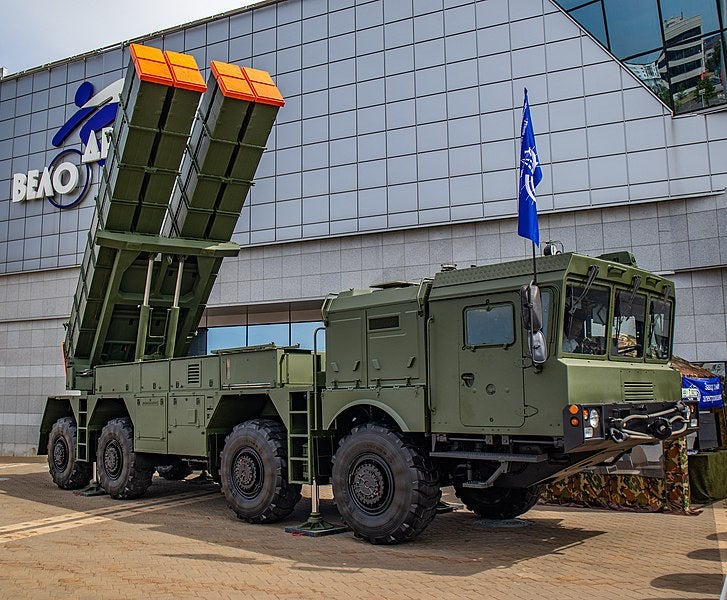
What actually explains the durability of this relationship, and what the source coverage largely leaves for readers to infer, is a genuine technology-and-capability exchange that predates and outlasts any individual exercise. Belarus and China signed a memorandum in August 2025 to expand cooperation in military technology, joint research and development, and weapons modernization, building on a partnership whose most tangible product to date is the Polonez multiple-launch rocket system, which combines Belarusian expertise in heavy wheeled vehicle platforms, a genuine Soviet-era engineering legacy Minsk retains, with Chinese-supplied missile technology. That's a materially different relationship than a routine bilateral friendship exercise; it's two countries with complementary industrial gaps filling them for each other, China getting access to mature wheeled-platform and legacy Soviet engineering expertise it doesn't have domestically, Belarus getting missile technology and a defense-export relationship that gives Minsk options beyond its near-total dependence on Russia.
The strategic stakes of that relationship extend well past the two countries involved. Belarus sits on NATO's eastern flank, bordering Poland, Lithuania, and Latvia, and remains a core participant in China's Belt and Road Initiative along its western overland route into Europe, meaning Beijing's defense-technology relationship with Minsk isn't purely bilateral, it's a foothold that puts Chinese military-technical influence directly adjacent to NATO territory through a partner Western sanctions have already isolated from most other international defense relationships. For Minsk, deepening ties with Beijing functions as a hedge, evidence, as regional analysts have noted, that Belarus retains room to maneuver internationally even under sustained Western pressure, without necessarily deepening its already near-total security dependence on Moscow any further than it already has.
None of this means Swift Eagle 2026 itself represents anything more than what it's described as, a modest airborne training exercise focused on urban counter-terrorism tactics between two militaries with a long-standing but limited cooperative history. But the more interesting story sitting underneath the football matches and cultural exchange programming is the slower-moving, considerably more consequential relationship the drill is a visible expression of: a Chinese-Belarusian defense-industrial partnership building real hardware like the Polonez system, institutionalized through a formal 2025 cooperation memorandum, and positioned geographically in a way that gives Beijing a quiet foothold on the doorstep of NATO's eastern border, all conducted under a label unlikely to draw the same attention a more explicitly framed strategic partnership would.