
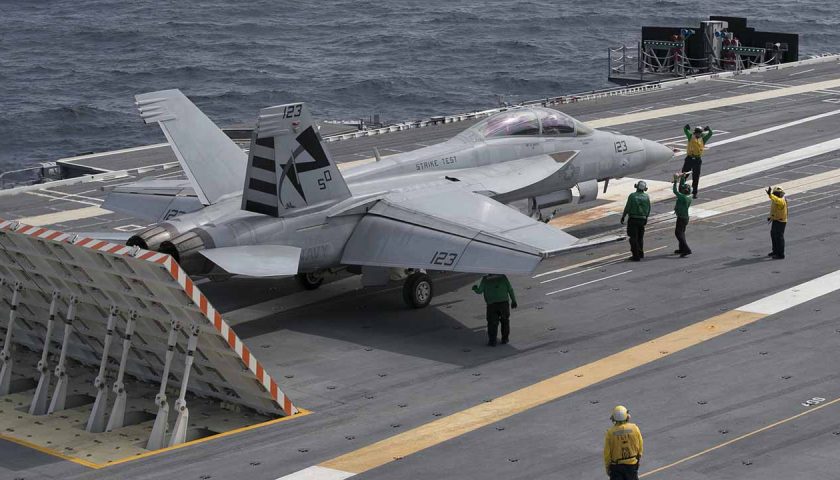
President Trump has formalized, via national security presidential memorandum, a demand he's been making on and off since 2017: future Ford-class aircraft carriers should abandon the Electromagnetic Aircraft Launch System (EMALS) in favor of the steam catapults the Navy used for nearly fifty years before EMALS entered service. The first ship affected would be USS Doris Miller (CVN-81), the fourth Ford-class carrier, currently projected for delivery in 2034, with Trump also directing a reversion from EMALS's electromagnetic arresting gear to hydraulic elevators. General Atomics, which holds the contract to build Doris Miller's electromagnetic catapults, said in response only that the decision "warrants careful reconsideration," while defense analysts cited by the Wall Street Journal estimate the switch could cost billions of dollars and require a larger crew to operate steam systems that EMALS was specifically designed to reduce.
Trump's underlying criticism isn't fabricated; it's grounded in a genuinely rough operational record. A 2019 Pentagon test report found EMALS suffered 10 "critical failures" across 747 launches during at-sea trials aboard USS Gerald R. Ford, a rate nine times the Navy's own target, while the Advanced Arresting Gear logged 10 operational mission failures across 763 landing attempts in the same window. A more recent Director of Operational Test and Evaluation report found reliability "has not appreciably changed from prior years" despite software and hardware upgrades, and separately flagged the carrier's Advanced Weapons Elevators for the same kind of persistent breakdown pattern this blog has already covered in the context of CVN-79 Kennedy's own delayed acceptance trials. Those are real, documented engineering problems on a $13 billion ship, not political exaggeration.
What Trump's framing leaves out, though, is the second carrier operating this exact technology and what it's currently proving about EMALS's actual value proposition. USS Gerald R. Ford and China's Fujian remain, as of this reporting, the only two carriers in the world equipped with electromagnetic launch systems, and Fujian's commissioning in November 2025 wasn't just a symbolic milestone, it demonstrated precisely the capability EMALS exists to unlock: the ability to launch heavier, less-robust airframes that a steam catapult's higher peak stress would either damage or simply couldn't accommodate at all. This blog's earlier coverage of Fujian noted its launch and recovery trials already include the KJ-600 fixed-wing airborne early warning aircraft, a genuinely heavy, delicate platform that meaningfully closes a surveillance gap China's ski-jump carriers never could support, precisely because those carriers lack EMALS's finer launch-power control. If China's answer to America's own EMALS reliability struggles is refining the same technology rather than abandoning it, reverting to steam on the very carrier meant to counter Fujian's growing capability edge is a strategically uncomfortable moment to make that choice.
That tension is really the crux of the decision, and it's one the source coverage doesn't fully draw out: this isn't simply "old reliable technology versus new unreliable technology," it's a question of whether the Navy addresses EMALS's genuine reliability problems through further engineering investment, the NAVAIR software and sensor upgrades the DOT&E report describes as ongoing, or abandons the capability advantage EMALS was built to provide in the first place. Steam catapults are proven precisely because they're a mature, well-understood technology, but "proven" and "capable of matching what a peer competitor's EMALS-equipped carrier can now do" are not the same claim, and reverting Doris Miller specifically, a carrier not expected to enter service until 2034, locks in that capability gap for a ship that will still be operating well past mid-century, long after whatever reliability issues EMALS has today would plausibly have been resolved through the kind of sustained engineering effort the Navy has already been applying.
Whether Trump actually follows through with the formal executive order, as opposed to previous instances where similar threats went unrealized during his first term, remains genuinely uncertain, and General Atomics' carefully diplomatic non-objection suggests the industrial side of this fight is far from settled. But the more consequential question this decision raises isn't really about hammers and blowtorches versus MIT engineers, it's whether the U.S. Navy is willing to keep paying EMALS's reliability costs now in exchange for a capability edge that China's own carrier program has just spent the past year demonstrating is worth having.

No comments:
Post a Comment