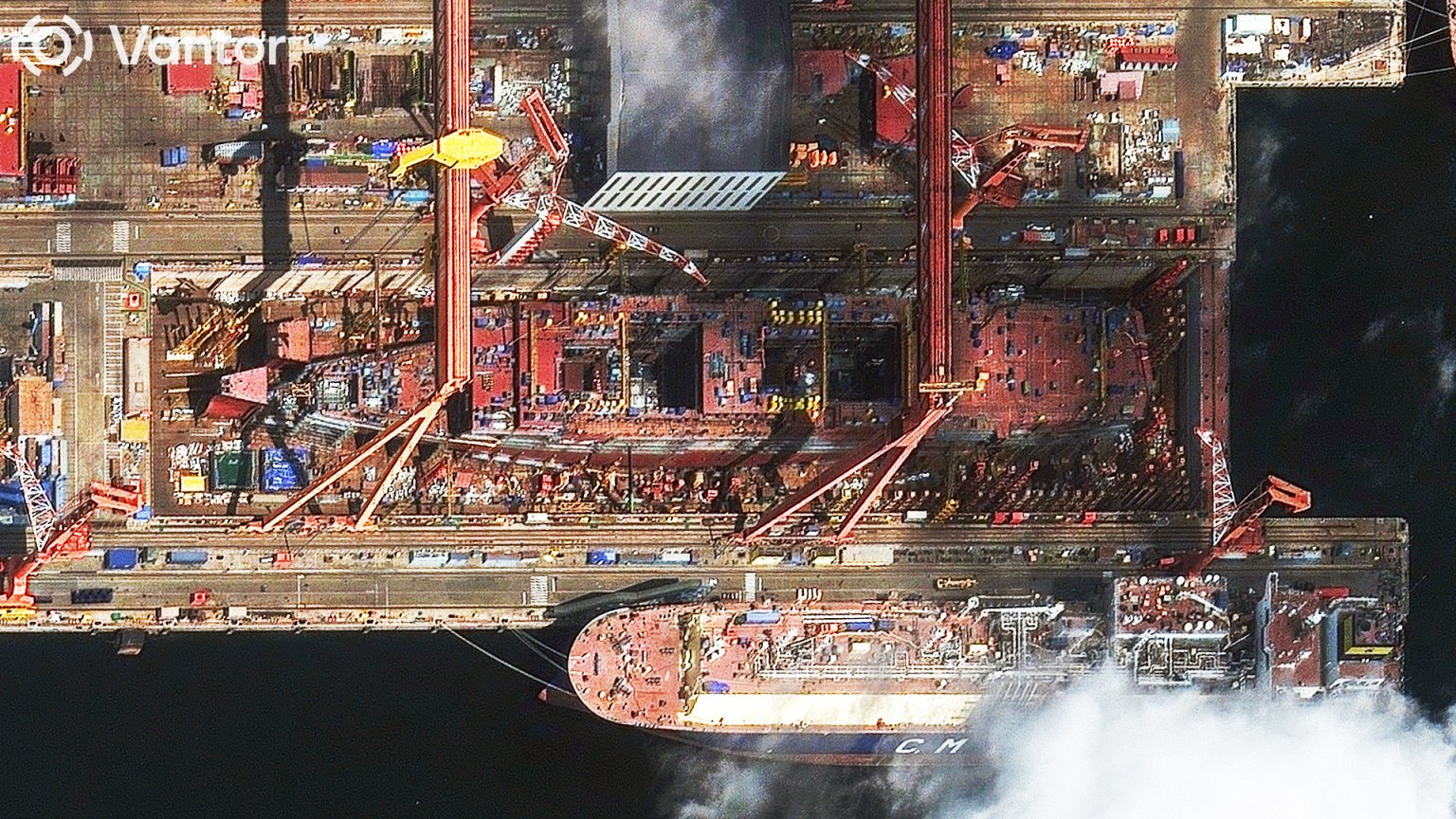
Satellite imagery obtained by TWZ from Vantor shows China's fourth aircraft carrier, the Type 004, developing an increasingly complete bow at Dalian Shipyard, with the hull now measuring roughly 1,050 feet long and 151 feet at the beam, dimensions that will only grow as construction progresses toward the waterline and flight deck. The ship is being built in the same dry dock that produced Liaoning and Shandong, China's first two carriers, but represents a generational leap past both: strong satellite evidence points to two distinct reactor containment structures broadly consistent with American nuclear carrier design, meaning the Type 004 is likely to be China's first nuclear-powered flattop, a capability that would give it functionally unlimited range and, per TWZ's own reporting, the substantial power generation headroom a modern carrier packed with advanced weapons and sensors increasingly needs.
The timing here connects directly to this blog's own EMALS coverage in a way genuinely worth sitting with. This blog documented Trump's order to revert future Ford-class carriers to steam catapults, starting with USS Doris Miller, arguing the decision landed at an awkward moment given Fujian's own EMALS-equipped KJ-600 trials were actively demonstrating the exact capability edge electromagnetic launch systems exist to provide. The Type 004 story adds a new layer to that same tension: TWZ's own reporting notes the ship is expected to carry over EMALS from Fujian, meaning even as Washington debates whether electromagnetic catapults are worth their documented reliability problems, Beijing is doubling down on the same technology for its next carrier and pairing it with nuclear propulsion for the first time, a combination no PLAN carrier has previously attempted and one American nuclear carriers have relied on for decades.
The size comparison TWZ's own reporting draws out is worth stating plainly rather than letting the raw dimensions speak for themselves. At its current stage, the Type 004's hull already approaches Fujian's roughly 994-foot waterline length, and hull dimensions typically expand further as a carrier nears completion, suggesting China's fourth carrier could end up genuinely comparable in scale to USS Gerald R. Ford's 1,106-foot overall length. That's a considerably different trajectory than Liaoning and Shandong's ski-jump, non-catapult STOBAR configuration represented, and it confirms Fujian wasn't a one-off technological showcase, it's the template China is now building its entire next-generation carrier program around.
This blog's coverage of the ten-carrier Pacific gap and the broader shipbuilding capacity disparity, the roughly 200-times gap between American and Chinese naval production this blog has cited from ONI assessments, gives this satellite-imagery story its real weight. TWZ's own reporting places the Type 004's steady construction progress directly alongside that same capacity gap, and notes unconfirmed reports that a second, conventionally powered carrier may already be under construction elsewhere in China simultaneously, against a Pentagon assessment that the PLAN is targeting nine total carriers by 2035. Read against this blog's own coverage of USS Kennedy's five-year delivery delay and the broader Finland Model policy opening foreign shipyards to American warship construction, the juxtaposition is genuinely stark: China is building its fourth carrier, potentially its first nuclear-powered one, fast enough to be visible in monthly satellite tracking, while the U.S. Navy's own newest carrier remains months from even preliminary acceptance after a already-multi-year delay.
None of this means the Type 004 is a finished, proven capability, TWZ's own reporting is careful to flag that nuclear propulsion remains unconfirmed rather than certain, and a hull taking shape in a dry dock is still years from sea trials, let alone the kind of sustained operational deployment history that actually validates a carrier's combat value. Fujian itself only recently completed its own maiden sea trials, and this blog's earlier Fujian coverage already noted China's own carrier aviation program is still working through basic KJ-600 integration. But the pace of visible progress, a nuclear nuclear-powered, EMALS-equipped carrier approaching Ford-class dimensions, becoming trackable in commercial satellite imagery within roughly two years of first breaking ground, is precisely the kind of production tempo this blog's summer of shipbuilding coverage has consistently found the American side struggling to match, regardless of which individual program gets examined.