
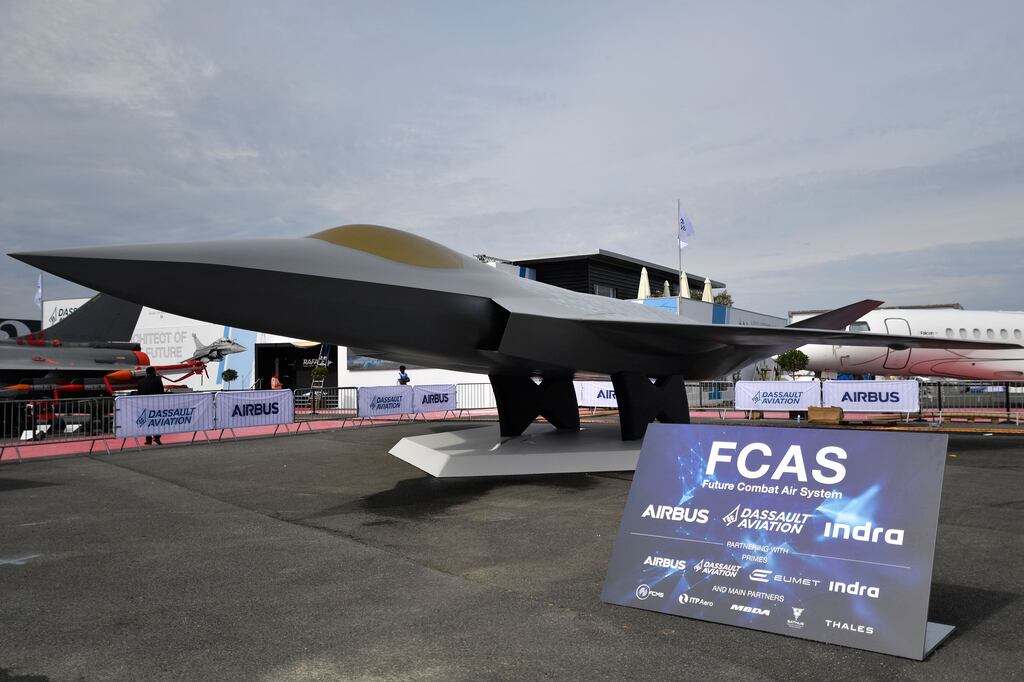
India has formally opened talks with France on joining the Future Combat Air System after Germany walked away from the program in June, with India's Defense Ministry telling parliament this month it had "initiated efforts in a concerted manner to co-join" the effort. A parliamentary committee's August 9 report went further, recommending the ministry accelerate its sixth-generation planning process entirely. Retired Air Marshal Anil Chopra's framing to Defense News captures the underlying logic plainly: India hasn't finished its fifth-generation transition and is trying to start a parallel sixth-generation track anyway, specifically to avoid falling a full technology cycle behind before AMCA even reaches service.
This blog has already covered exactly the technology gap driving that urgency, and covered it from the same source. Chopra's own AMCA engine op-ed, engaged with critically in this blog's earlier coverage, argued China's 1986-launched aero-engine program succeeded through decades of patient, consistently funded state investment while India's comparable Kaveri effort stalled on turbine-blade metallurgy and institutional fragmentation. This FCAS pitch is the same diagnosis restated for the next fighter generation: India lacks indigenous engine and radar technology mature enough to build a competitive sixth-generation aircraft alone, so it's trying to buy access to French expertise rather than wait out its own multi-decade catch-up curve. Chopra's own quote to Defense News makes the connection explicit, sixth-generation technology acquired through France "might also be helpful as we develop our fifth generation program," an admission that AMCA's own indigenous engine problem is precisely what this new French outreach is meant to help solve.
The timing detail worth adding is that India isn't approaching a settled, thriving program, it's approaching one that just lost half its founding partnership. This blog's earlier coverage of Germany's F-35A stealth-coating milestone documented FCAS's actual June 2026 collapse in detail, Dassault and Airbus Defence and Space's industrial dispute proving irreconcilable after nearly a decade and a planned €100 billion joint investment. France retaining sole ownership of FCAS's future direction is precisely why Indian entry is even possible now, a three-nation consortium had no obvious seat for a fourth partner, but Dassault CEO Eric Trappier's own repeated public statements that France can develop a next-generation fighter independently suggest Paris may not need India's participation nearly as much as India needs France's, a leverage imbalance this reporting's own note about France's strained public finances, among the EU's highest debt burdens, only partially offsets.
Harsh Pant's assessment that India "tends to lag almost one or two cycles behind" is the same institutional pattern this blog's Virupaksha radar coverage already traced through DRDO's fourteen-year Uttam AESA timeline, and it reframes what's actually being negotiated here. India isn't just buying components or co-production rights, per Chopra's own account, engine and radar technology will have to originate from French companies regardless of the partnership structure, it's trying to buy the one thing indigenous programs can't shortcut: time. Whether France proves as genuinely open to sharing that technology as Chopra suggests, rather than treating India as a funding source for a program it can technically build alone, is the real question this exploratory phase leaves unanswered.
None of this guarantees India secures a meaningful role, exploratory talks are a long way from signed industrial-workshare agreements, and this blog's own coverage of DRDO's chronic timeline slippage suggests even a successful FCAS partnership wouldn't fully insulate India's sixth-generation ambitions from the same execution risk that has dogged Virupaksha and the AMCA engine race. But the strategic logic is coherent on its own terms: rather than repeat the pattern Chopra's own writing has diagnosed twice now, watching China build a generational lead through patient indigenous investment while India's comparable effort stalls, New Delhi is betting that borrowed expertise now is worth more than indigenous pride later, a bet this blog's coverage suggests India has made, and struggled to fully collect on, more than once before.

Deus caritas est!
ReplyDelete