
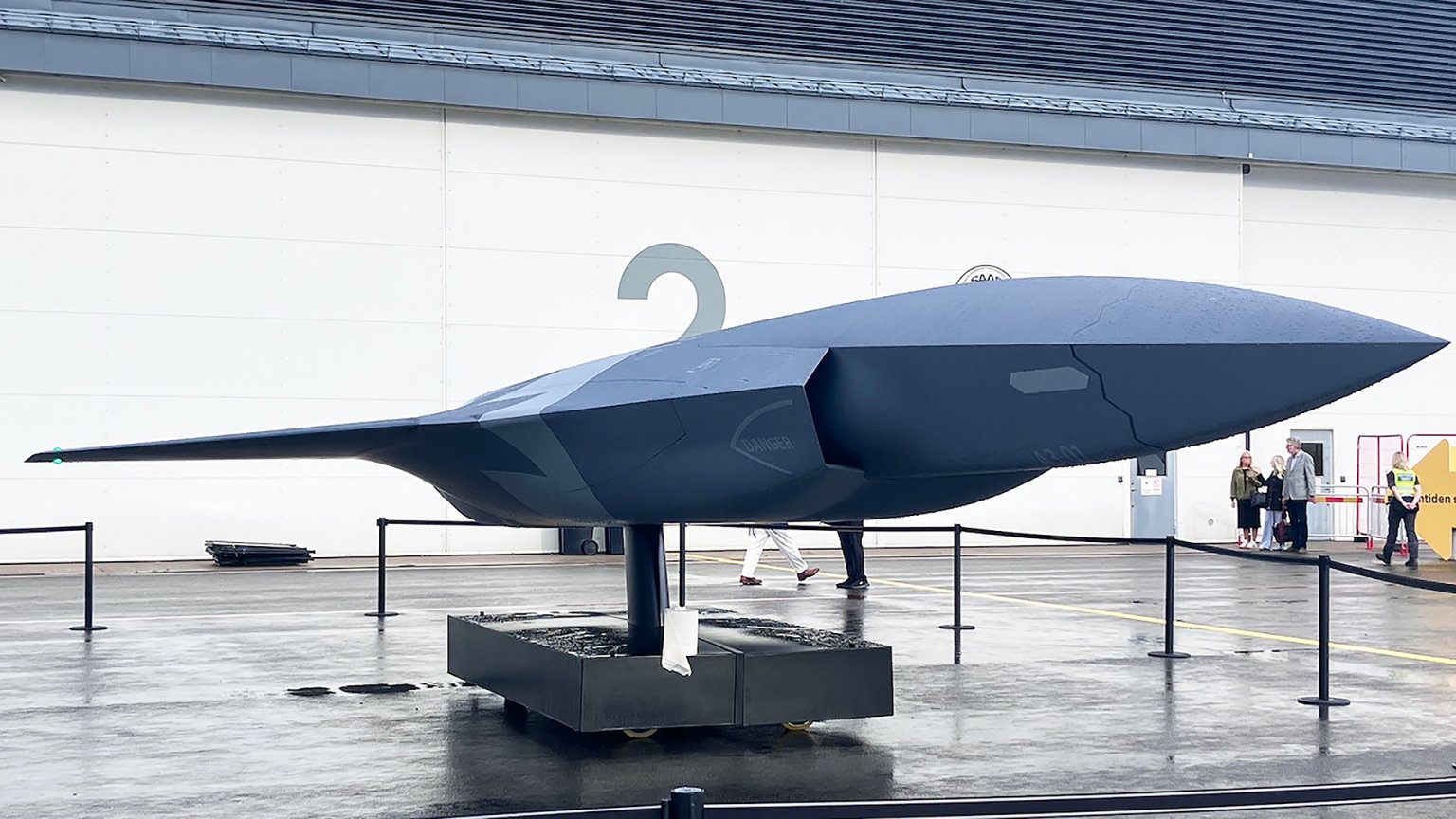
Saab unveiled its roadmap for the Autonomous Collaborative Platform program at Malmen Air Base this week, presenting a full-scale mock-up of "aircraft A3," a stealthy, supersonic, tailless drone concept the company describes as a high-end loyal-wingman companion to the Gripen E, with initial operational capability targeted for the mid-2030s if Sweden commits to a development contract. The program actually runs on two parallel demonstrator tracks feeding into that eventual production concept: aircraft A1, expected to fly within 15 months on the same GE F414 engine that powers the Gripen E, focused purely on proving Saab can build and fly a genuinely low-observable drone, and aircraft A2, adding an internal weapons bay for future stores-release testing. Saab's own cost pitch is notably blunt, Peter Nilsson's complaint that the Gripen itself is now "too low cost" to leave room underneath it for a meaningfully cheaper drone captures the awkward economics of building a genuinely capable uncrewed wingman without undercutting the crewed platform it's meant to escort.
The more consequential story sitting underneath this technical unveiling is what it signals about the vacuum left by FCAS's collapse, a story this blog has already tracked from two different angles. This blog's coverage of Germany's F-35A stealth-coating milestone documented FCAS's actual June 2026 termination in detail, the Dassault-Airbus industrial dispute proving irreconcilable after nearly a decade and a planned €100 billion joint investment, leaving Germany without any indigenous sixth-generation successor path and forced toward an American F-35A purchase as a stopgap. This blog's more recent coverage of India's outreach to France established that Paris, now the sole remaining owner of FCAS's direction, may not need a new partner as urgently as India needs France's technology. Saab's own reporting adds a third, genuinely new data point to that picture: TWZ's coverage notes Airbus, Germany's own industrial partner in the now-dead FCAS effort, is reportedly looking toward Saab as one option for salvaging its own sixth-generation ambitions, meaning three separate European powers, Germany, India, and now potentially Airbus itself, are simultaneously searching for a way back into sixth-generation fighter development after FCAS's collapse left each of them without a clear path forward.
That context makes Saab's own strategic positioning genuinely shrewd rather than opportunistic. Nilsson's presentation didn't stop at the drone itself, it explicitly showed how the ACP's underlying architecture, the blended wing-body shaping, the stealth treatments, the internal weapons integration, could feed directly into a future crewed Gripen successor Sweden won't need until after 2055, giving Saab a technology on-ramp toward exactly the kind of sixth-generation crewed fighter program FCAS was supposed to deliver, built incrementally through drone demonstrators rather than requiring the kind of immediate, decade-long, multi-billion-euro multinational commitment that doomed the Franco-German-Spanish effort. Saab is essentially betting that patient, spiral development funded initially by Sweden alone, with genuine near-term utility as a Gripen companion drone, is a more survivable path to European sixth-generation capability than the consortium model that just collapsed.
The economics Nilsson laid out are worth taking seriously as a genuine alternative to the FCAS-style all-or-nothing national fighter program. A projected ACP life-cycle cost around one-third of the roughly $70-80 million Gripen E flyaway cost, with Nilsson's own framing suggesting two to three ACPs could be fielded per Gripen rather than the far larger fleet ratios associated with cheaper American Collaborative Combat Aircraft designs, positions this explicitly as a premium, high-survivability wingman rather than a mass-produced attritable system, a genuinely different niche than the CCA programs this blog's earlier target-drone RFI coverage touched on. That positioning matters for export potential too, Saab's stated priority to offer the ACP to other Gripen E/F operators first gives the program a built-in customer base considerably larger than Sweden alone, extending the same export logic this blog has already documented driving Baykar's drone dominance and China's J-10C marketing push, just applied to a considerably more technically ambitious platform.
None of this guarantees Saab actually wins Sweden's own eventual sixth-generation decision, due sometime between 2028 and 2030, over either an indigenous crewed successor or joining a foreign program, and Nilsson's own acknowledgment that continued investment depends on an actual customer committing funds underscores how much of this remains proposal rather than program. But at a moment when this blog's own coverage has documented FCAS's collapse, Germany's resulting F-35A pivot, and India's opportunistic outreach to France all stemming from the same underlying European sixth-generation vacuum, Saab quietly building toward the same destination through drones and spiral development, rather than another headline consortium announcement, looks like a genuinely different, and possibly more durable, strategy than the approach that just failed.

No comments:
Post a Comment