
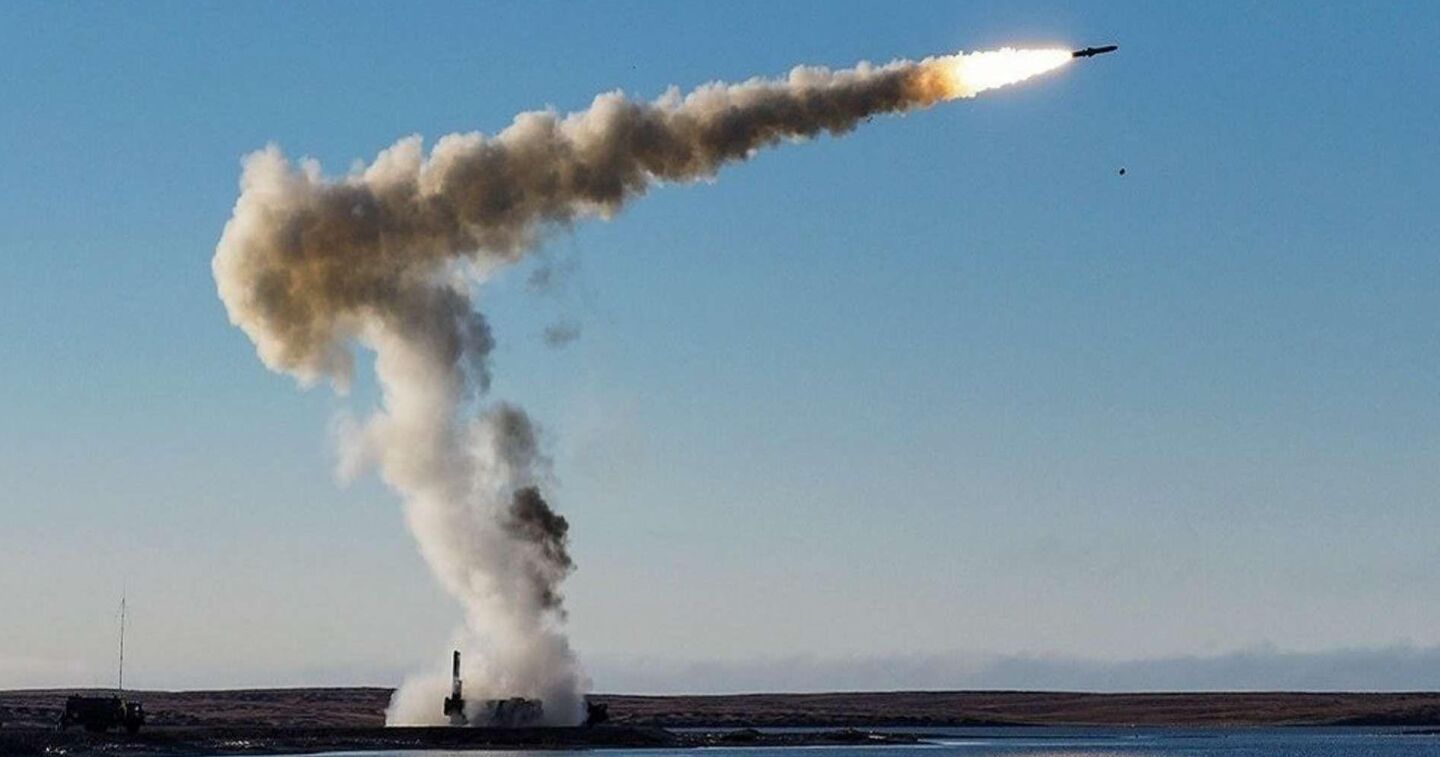
Russia's Pacific Fleet confirmed August 20 that it conducted live-fire anti-ship missile drills near the disputed southern Kuril Islands, striking a simulated enemy vessel more than 186 miles away. The cruiser Varyag launched two P-1000 Vulkan anti-ship missiles, the nuclear-powered submarine Omsk fired a Granit cruise missile, and a Bastion coastal-defense system stationed on Etorofu, the largest of the disputed islands, fired an Oniks missile, all according to the Russian Defense Ministry's own account relayed through Kyodo. Japan protested the activity the same day; Russia disclosed neither the precise launch date nor exact coordinates.
This is exactly the sequence this blog's coverage of Putin's August 13 Kuril Islands visit anticipated, without needing to guess at Russia's next move. That earlier reporting documented Putin touring Iturup flanked by his Pacific Fleet commander and a border-defense general days before Japan's own Defense White Paper anniversary, arguing the visit's real substance sat in the military escorts rather than the fish-processing-plant photo ops, and explicitly noted the timing lined up with Japan's own Type-25 missile deployment to Hokkaido. A live-fire anti-ship exercise involving the exact naval assets, the Varyag, the Bastion system on Etorofu, that this blog's earlier piece already named as central to Russia's decade-long Kuril fortification effort isn't a new development in that story, it's the follow-through this blog's own analysis flagged as the logical next step once the symbolic visit had made its point.
Japanese Prime Minister Sanae Takaichi's own framing this week, that the islands "are an inherent part of Japan's territory, both historically and under international law," echoes language this blog already quoted from her response to Putin's visit itself, "absolutely unacceptable." What's different this time is the demonstrated range: RANE's reporting puts the engagement distance at roughly 300 kilometers, a live validation of exactly the kind of standoff strike capability this blog's earlier coverage described as central to Russia's ability to threaten shipping and reinforcement routes through the Sea of Okhotsk approaches without needing to close to visual range. Analysts cited across multiple outlets read the timing as a deliberate warning aimed specifically at Japan's deepening Ukraine support, potentially including direct Patriot missile transfers, and closer NATO cooperation, a framing this blog's earlier Poland Patriot-scandal coverage gives real, current weight to, since Warsaw's own decision to donate scarce Patriot interceptors to Ukraine is precisely the kind of allied behavior this exercise appears calibrated to discourage Tokyo from replicating.
The nuclear-payload detail worth flagging carefully, since it's easy to overstate: the P-1000 Vulkan is capable of carrying either a 1,000-kilogram conventional warhead or a 350-kiloton nuclear warhead, a dual-capability design rather than confirmation this specific test involved anything beyond a conventional exercise round. Russian military messaging has a consistent pattern, also visible in this blog's earlier Poseidon/UK threat coverage, of foregrounding a weapon's theoretical nuclear ceiling in state media coverage specifically to maximize the intimidation value of an otherwise conventional demonstration, and treating every dual-capable missile test as an implicit nuclear threat would overstate what a single live-fire exercise actually confirms about Russian intent.
Read against this blog's now-extensive documentation of the broader Indo-Pacific and Baltic signaling pattern this summer, the EA-37B's Kaliningrad flight, the Pantsir buildout around Moscow, Russia's UK Poseidon threats, this Kuril exercise fits a consistent operational tempo rather than standing as an isolated escalation. What makes it worth a dedicated update rather than a footnote to the earlier Putin visit story is the concrete demonstration of range and multi-platform coordination, moving from a symbolic presidential visit to an actual validated strike capability in the space of a week, exactly the kind of follow-through this blog's own reporting suggested was the real point of Putin's trip in the first place.

No comments:
Post a Comment