Sunday, July 26, 2026

Strategic Importance of Cyber and Information Domains for Operational Security in Modern Warfare -----------------Sqn Ldr Ali Hamza (Retd)


"War is one of the constants of history, and it has not diminished with civilization or democracy"                                                    Will and Ariel Durant, The Lessons of History

The statement written above is a testament to the fact that even though the intentions of humans for a peaceful society may not be doubtful, the results have been almost completely on the contrary throughout the recorded history of our civilisation. The wars of the past were primarily fought by armies in the domain of land, subsequently adding naval assets to include the domain of sea in the warfare. It was not until 1903 that airplanes started flying and the world witnessed first military use of domain of the air by Italy in Libyan war of 1911. The period from 1914 to 1945 saw two World Wars and exponential growth in the field of airpower and by the start of Cold War in 1948, the air force had become an equally important service of all the militaries around the world.

The domains of land, sea and air were the only ones for a long time that were used as battlefields in various conflicts. From US fighting in Korean and Vietnam wars to regional Indo-Pak as well as Arab-Israel wars, the paramount importance was giving to kinetic weapons. Though information warfare in form of Psychological Operations (PsyOps) and propaganda against communist regimes was an integral part of US military strategy, the true sense of multi-Domain operations (MDOs) can be gathered by the combined strategy of C2 (command and control) against Iraq in First Gulf War of 1991. The concept of network-centric warfare was rapidly replacing the platform-based tactics of the past. Moreover, it also saw the use of non-kinetic domains for achieving military objectives instead of use of pure force only.

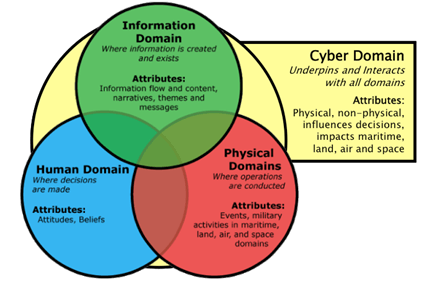
These non-kinetic domains are a direct result of IT revolution and internet 4.0, including fields of cyber, space, AI, information, electronic warfare (EW), unmanned aircraft systems (UAS) or drones, integration of all assets through data fusion, better situational awareness through sensor-fusion and so on. The long list of new battlegrounds and emerging technologies has changed the nature of war. This new art of war is quite different from the use of tactics like attrition of man and machine that was a norm in the past and was preached by the military strategists. The complete annihilation of enemy forces is no more necessary as itsC2 nodes can be taken out by Effect-based operations (EBOs) by using both smart kinetic and non-kinetic means, crippling the command structure and rendering forces on ground useless.

With the advent of doctrines like JADC2 (Joint all-domain C2) and C4ISR (command, control, communications, computers, intelligence, surveillance and reconnaissance), the importance of cybersecurity and information security has become vital, rather indispensable, for the operational security of modern militaries in any kind of warfare. The conventional wars may have been reduced to low-intensity conflicts (LIC) due to the presence of nuclear weapons, but the hybrid and sub-conventional battles e.g. state-sponsored terrorism by using proxies have been a huge threat. Moreover, the list of non-traditional security threats like economy, water, food, instability in society etc. have become weapon of choice for enemies to undermine a state’s national security.

To bring the discussion in context of South Asia’s security dynamics, one just has to take a look at the regional conflicts since 1998 i.e. nuclearization of Pakistan and India. The strategic stability might have increased, and an all-out war may not be on the cards, but nobody can deny the fact that Pakistan has been facing a threat spectrum from multiple sides including terrorism, economy, pressure from defaming by Indian foreign policy, water crisis, cyber-attacks, information warfare and much more. The state of Pakistan has been fighting this multi-front war and has sacrificed a lot in blood and money, but the need of time is to educate our people on the importance of wars fought not out at the front but within our hearts and minds. Hence, it is important to understand that the nation must back its armed forces and we need to fight this war in all available domains.

  To conclude, one must understand that this vast topic of multi-domain warfare needs a lot of attention and brainstorming. As it is multifaceted, the focus here will be on the aspects of cyber and information security (Infosec) to underscore their importance for modern armies. The decision makers in civilian and military top brass are aware of these facts and it is indicated by their policy formulation, but it goes without saying that we have a long way to go. The requirement for data centres on war footing is one of many fundamental requirements to consolidate our information security. A series of articles is required to emphasize the necessity of this for our country and to understand what is infosec, why is it important and how can we incorporate it in our system. By grasping these concepts, we can further enhance our national security and thwart the enemy’s nefarious plans against our homeland.


Author Bio

            Squadron Leader Ali Hamza is a retired PAF pilot with 20 years of experience, defence analyst, airpower expert, gold medallist in MSc DSS (Defence & Strategic Studies) from QAU, currently doing MPhil IR from NUML, Rawalpindi and has a keen interest in modern airpower’s role in the geopolitics at global and regional levels.

YouTube: https://www.youtube.com/@AeronautIR

X (twitter): https://x.com/AliHamzaAwan1

Strategic Proximity: Washington Highlights China's Intelligence Footprint in Cuba Amid Rising Tensions


 Heightening concerns over strategic competition in the Western Hemisphere, a recent U.S. State Department report has formally accused Beijing of operating three distinct intelligence-gathering facilities in Cuba. As detailed in regional analysis, the document—titled “Cuba: The Capital of 21st Century Communism”—characterizes the island nation as a vital staging ground for foreign surveillance directed at American military installations, electronic communications, and maritime traffic.

The report asserts that China maintains a persistent signals-intelligence presence, utilizing geographic proximity—roughly 145 kilometers (90 miles) from the Florida coast—to monitor sensitive activities across the southeastern United States, including key command nodes and space-launch centers. Citing prior open-source research and satellite imagery analysis from the Center for Strategic and International Studies (CSIS), the assessment points to infrastructure developments at sites such as Bejucal, Wajay, Calabazar, and El Salao. These locations reportedly feature advanced technical upgrades, including circular antenna arrays designed to intercept long-range electronic signatures.

U.S. officials framed the growing intelligence cooperation between Beijing, Moscow, and Havana as an acute security challenge. According to the findings, intelligence personnel stationed at these shared facilities use the island as a "force multiplier" to track operational patterns and force movements across the Caribbean basin and the Gulf of Mexico. While Washington views the infrastructure as among its most critical foreign listening concerns, the Chinese embassy in Washington has strongly dismissed the assertions, condemning the reports as fabricated narratives intended to smear bilateral relations. Cuban officials have similarly rejected allegations of hosting foreign spy bases, emphasizing the nation's adherence to regional peace declarations.

The public airing of these intelligence assessments underscores the persistent anxieties shaping modern great-power competition. As strategic rivalries increasingly play out across both digital and geographic frontiers, the enduring geopolitical value of proximity continues to drive intense friction between Washington and its primary global competitors.

Shaping the Future Battlespace: Lockheed Martin Outlines Strategy for Cross-Platform Military Autonomy


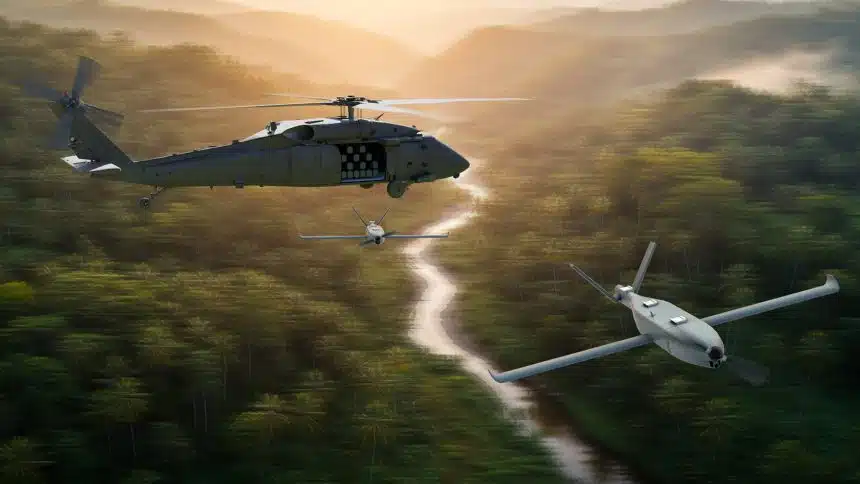
Detailing its vision for the future of uncrewed and human-machine teamed warfare, Lockheed Martin—alongside its Sikorsky division—has outlined its comprehensive framework for scalable, cross-platform military autonomy, as highlighted in recent reporting by The Aviationist. Centered around a unified corporate ethos, the initiative focuses on maximizing software compatibility across diverse assets spanning all operational domains.

At the core of this strategy is alignment with the Autonomy Government Reference Architecture (A-GRA), which champions modular, platform-agnostic software frameworks. By utilizing "plug-and-play" architectures, capabilities developed for one system—such as the MATRIX flight autonomy suite proven on rotary-wing platforms like the Sikorsky Black Hawk and the uncrewed U-HAWK—can be rapidly transitioned to fixed-wing aircraft, ground vehicles, or maritime drones. Company representatives emphasize that this approach allows operators familiar with one autonomous system to easily adapt to others, significantly reducing training overhead and cognitive load.

Beyond developing clean-sheet uncrewed platforms, Lockheed Martin continues to prioritize the autonomous conversion of legacy airframes. Notable examples include the X-62A VISTA—an F-16 modified into an advanced AI-powered testbed—and ongoing transformations of utility helicopters for contested logistical resupply. Furthermore, autonomous safety features like the Automatic Ground Collision Avoidance System (Auto-GCAS) integrated into crewed fighters continue to prove their life-saving utility in frontline service.

As defense requirements increasingly demand resilience against electronic warfare and degraded communications, upcoming trials are shifting away from clean test environments to process "unfiltered" real-world data. By prioritizing software portability and joint-force interoperability, Lockheed Martin's evolving autonomy ecosystem aims to provide allied commanders with the flexibility needed to dominate complex, multi-domain future battlespaces.

Dramatic Skies: RAF Typhoons Scrambled to Intercept Qatar Airways Flight Following Hoax Bomb Threat Linked to 14-Year-Old


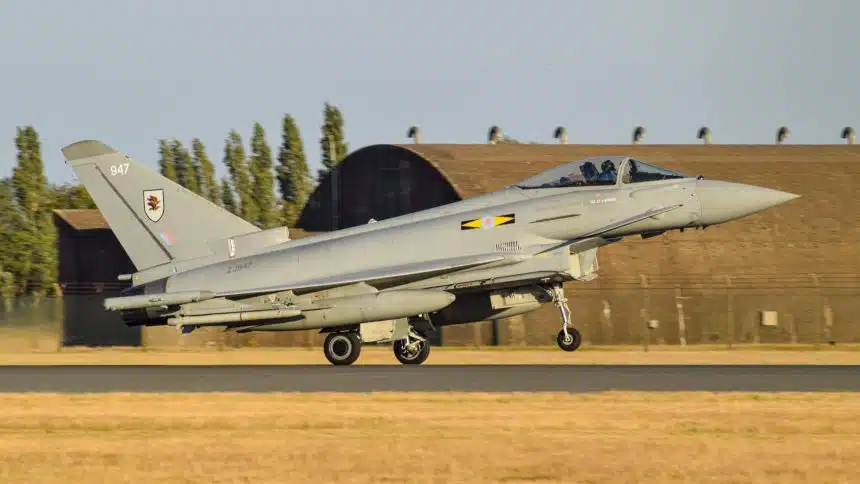
 A routine Friday evening flight turned into a high-stakes security operation after a hoax bomb threat directed at a Qatar Airways aircraft triggered the launch of Royal Air Force Quick Reaction Alert (QRA) fighters, as detailed in recent reporting by The Aviationist. The incident, which unfolded on July 24, 2026, resulted in the rapid scrambling of armed Typhoon FGR4s from RAF Coningsby in Lincolnshire to intercept a Boeing 777 inbound to Manchester Airport from Doha.

According to details released by Greater Manchester Police and civil aviation authorities, the threat was received by National Air Traffic Services (NATS) at approximately 18:00 BST. Recognizing the potential danger, civil authorities coordinated an immediate emergency response with the Ministry of Defence and airport officials. Flight tracking data and cockpit communications revealed that the flight crew became aware of the military escort shortly before 18:14 UTC, issuing an ACARS message to airline operations confirming they were being intercepted by UK military forces and awaiting instructions from air traffic control.

Eyewitnesses on the ground captured striking footage of the interception, tracking the thick contrails of the widebody airliner flanked by the twin streams of the escorting fighter jets. Despite the tense atmosphere aloft, the aircraft maintained its course under close military observation and landed safely at Manchester Airport at around 19:45 BST. It was met by a significant, pre-positioned emergency response presence before taxiing safely to the gate without any reported injuries to the passengers or crew.

Swift investigative work by Greater Manchester Police quickly traced the origin of the alert, revealing it to be a malicious fabrication. Authorities confirmed that a 14-year-old boy from the Bolton area—who was not on board the aircraft—was identified and is currently assisting police with their inquiries. Senior officers condemned the act, emphasizing that false security threats are treated with extreme severity due to the massive diversion of emergency resources, potential danger, and unnecessary panic they cause.

The incident highlights the well-rehearsed protocols governing European airspace defense, where QRA assets remain on perpetual standby to address unexpected airborne emergencies. While standard military intercepts of commercial airliners more frequently occur due to lost communications or transponder anomalies, the deployment of armed fighters to counter a suspected security breach underscores the persistent vigilance required by modern civil-military aviation networks.

Expanding Standoff Reach: Russian Su-34 Integration of UMPK-Kitted FAB-500T Bombs Signals New Tactical Shifts


Providing fresh insight into the rapid evolution of standoff munitions, recent defense reporting highlights the Russian Aerospace Forces' operational deployment of Sukhoi Su-34 fighter-bombers equipped with heavy loads of Universal Gliding and Correction Module (UMPK) upgrade kits mated to FAB-500T high-explosive bombs. Released in official operational footage by the Russian Ministry of Defence, the configurations underscore how tactical aviation is continuously adapting to maximize standoff range and precision delivery against heavily fortified positions.

The integration of the UMPK kit onto the specialized thermal-resistant FAB-500T munition allows the Su-34 to project heavy ordnance from standoff distances well outside the immediate envelope of short- and medium-range frontline air defense systems. Originally designed to withstand the high skin temperatures generated during high-speed, high-altitude flight, the FAB-500T paired with extended-range aerodynamic glide modules provides tactical strike packages with significantly enhanced operational flexibility. Analysts note that these weapon systems allow strike aircraft to deliver multi-hundred-kilogram payloads against static command nodes, logistics hubs, and fortified strongpoints while minimizing exposure to hostile air defense threats.

The continuous refinement of glide-bomb conversion technology represents a major cost-effective shift in modern air warfare doctrine. By transforming legacy unguided iron bombs into precision-guided standoff weapons via bolt-on wing and guidance assemblies, air arms can generate sustained precision strike capabilities at a fraction of the financial cost associated with complex cruise missiles. Recent design iterations—including elongated fairings optimized for improved lift-to-drag ratios and potential propulsion integration—further demonstrate how engineering adjustments are steadily pushing effective glide ranges outward.

This ongoing reliance on heavy tactical strike assets highlights the central role that platforms like the Su-34 "Fullback" continue to play in modern high-intensity conflict. Boasting exceptional combat load capacities, robust onboard electronic warfare suites, and multi-role mission adaptability, the aircraft serves as the primary backbone for sustained aerial bombardment campaigns. As both state and non-state actors study these evolving combat applications, the emphasis on affordable, long-range standoff munitions is permanently altering how air forces approach tactical penetration and force preservation.

Ultimately, the deployment of advanced UMPK-kitted payload configurations underscores the relentless technological cat-and-mouse game defining contemporary aerospace warfare. As engineering teams experiment with enhanced aerodynamics and expanded guidance capabilities, standoff precision weapons will remain a decisive focal point for military planners evaluating future air combat survivability.

Powering the Fleet: U.S. Marines Advance AH-1Z Viper Modernization for Distributed Maritime Operations


Capitalizing on critical modernization frameworks designed to meet future peer-to-peer conflict demands, the United States Marine Corps is actively progressing flight test evaluations for its upgraded rotary fleet under the Structural and Power Improvements for NextGen Effects (SPINE) programme, as detailed in defense analyses by Army Recognition. Centered on enhancing the capabilities of the Bell AH-1Z Viper attack helicopter and its utility counterpart, the UH-1Y Venom, the modernization initiative directly positions the platform for complex, long-range networked warfare across the Indo-Pacific theater.

The core of the SPINE upgrade package—transitioning the aircraft into the advanced "Series A" capability standard—focuses on a massive overhaul of the helicopters' electrical architecture and structural reinforcement. By significantly expanding onboard power generation capacity and upgrading the digital data bus, the modification allows the Viper to seamlessly host next-generation electronic warfare suites, enhanced defensive countermeasures, and net-enabled long-range weapons. Furthermore, the integration of advanced tactical data links like Link 16 bridges a historical connectivity gap, enabling the AH-1Z to function as an active, interconnected node within a broader joint-force architecture.

In the context of the Indo-Pacific's vast maritime expanses, these upgrades fundamentally alter how attack helicopters can support expeditionary advanced base operations (EABO). Operating under decentralized, island-hopping doctrines, modernized Vipers are engineered to exploit radar-shadow zones by flying below clutter thresholds while receiving real-time targeting telemetry from high-end fifth-generation fixed-wing assets or uncrewed reconnaissance platforms standing safely off-shore. This combined-arms approach allows the AH-1Z to project precise tactical lethality against surface combatants and shore installations without exposing vulnerable assets to heavy air-defense networks.

The ongoing trials at Naval Air Station Patuxent River mark a crucial threshold for the Marine Corps as it adapts legacy platforms for high-intensity multi-domain battlefields. By trading localized counter-insurgency support capabilities for scalable, high-power digital interoperability, military planners are ensuring that the H-1 platform remains exceptionally relevant against modern adversaries. As flight validation tests pave the way for fleet-wide implementation, the SPINE-upgraded Viper stands ready to anchor future Marine aviation doctrines in contested environments.

Strengthening Asymmetric Deterrence: Taiwan Navy Commissions First Batch 2 Tuo Chiang-Class Stealth Corvette


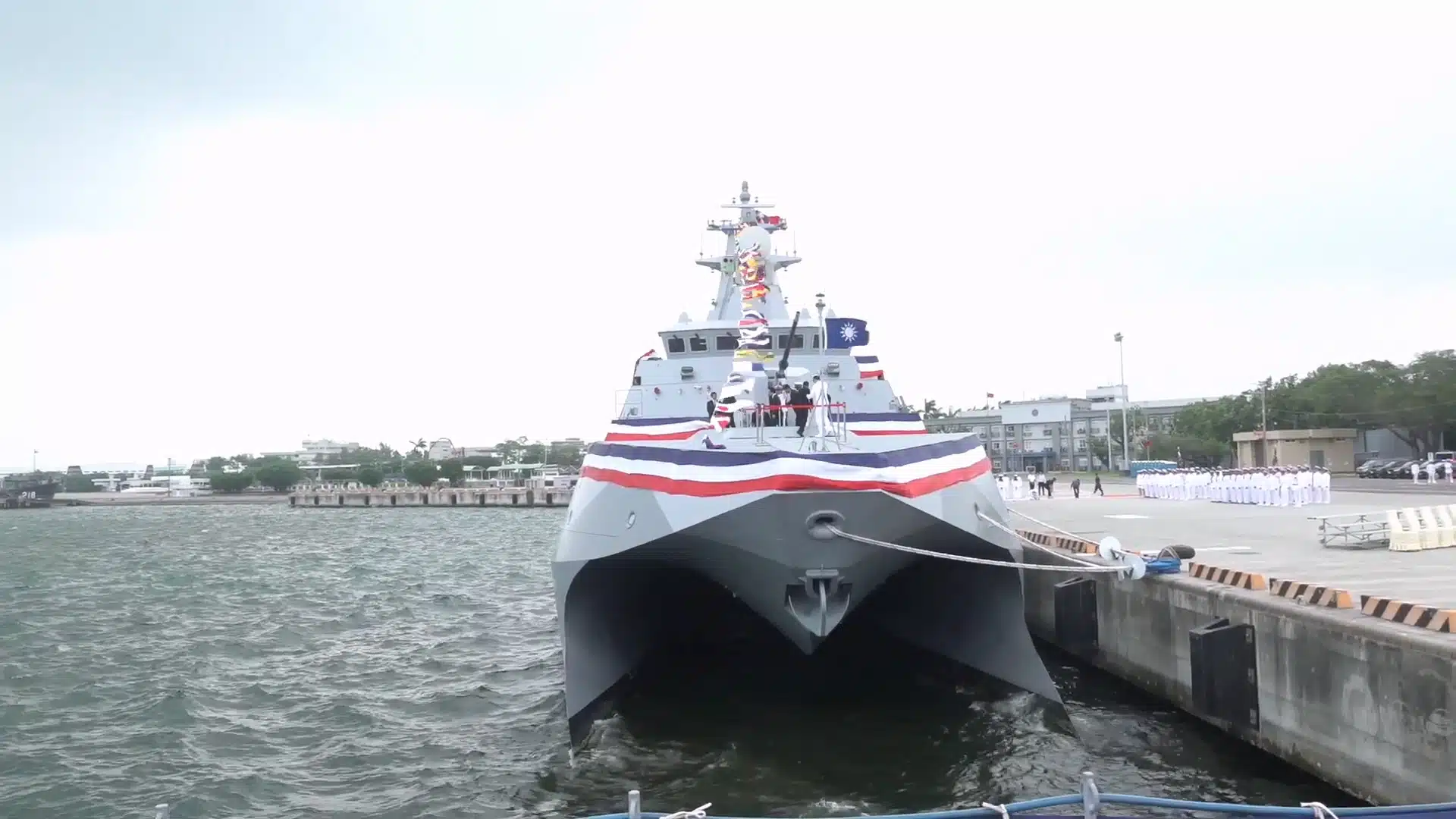
Accelerating its indigenous naval modernization and asymmetric defense posture, the Republic of China (ROC) Navy has formally commissioned the ROCS Tan Chiang (PGG-627), marking the official entry of the first Batch 2 Tuo Chiang-class fast catamaran corvette, as detailed in reporting by Tso-Juei Hsu for Naval News. Presided over by President Lai Ching-te at Tsoying Naval Base in Kaohsiung, the milestone event underscores Taipei's ongoing push to deploy agile, heavily armed surface combatants optimized for contested littoral environments.

The Tan Chiang serves as the eighth overall vessel in the Tuo Chiang program and the vanguard of the second production batch. Displacing approximately 685 tonnes fully loaded, the wave-piercing catamaran features a low-radar-signature profile and is engineered to leverage high-speed hit-and-run tactics against larger adversary surface fleets. Notably, while the first batch of improved corvettes relied on legacy fire-control radar architectures, the Batch 2 vessels are equipped with Leonardo’s advanced NA-30S Mk2 fire-control radar, following export constraints encountered with previous European suppliers.

The class boasts a formidable punch for its compact size, combining subsonic Hsiung Feng II and supersonic Hsiung Feng III anti-ship missile launchers alongside Sea Sword II (TC-2N) surface-to-air missiles for critical local air defense. During the commissioning ceremony, President Lai emphasized that the steady expansion of the fleet—with a total of 12 Tuo Chiang-class corvettes slated to be in active service by the end of the year—highlights Taiwan's growing capability to independently research, design, construct, and upgrade sophisticated naval defense systems.

This rapid procurement cadence reflects a broader doctrinal shift toward distributed maritime operations. By fielding numerous agile, hard-to-detect missile corvettes rather than relying exclusively on vulnerable traditional capital ships, the ROC Navy aims to maximize tactical dispersion and complicate adversary targeting calculus across the Taiwan Strait. As these advanced corvettes continue to join frontline squadrons, they will form a resilient backbone for coastal interdiction and sea-denial missions.

Ultimately, the induction of the Tan Chiang underscores Taiwan's unwavering commitment to building an indigenous defense-industrial base capable of meeting urgent regional security challenges. As the remaining Batch 2 vessels complete final trials ahead of their scheduled year-end deliveries, the Tuo Chiang class stands firmly at the core of modern asymmetrical naval deterrence.

Refining Next-Generation Air Dominance: New Insights Highlight Iterative Design Changes in China's J-36 Sixth-Generation Fighter Programme


 Providing a fresh window into the rapid evolution of Beijing's premier sixth-generation air combat project, recent defense analysis and emerging visual evidence detail significant design adjustments observed across the latest prototypes of the Chengdu Aircraft Corporation's massive unconfirmed stealth platform, widely designated as the J-36. As flight testing campaigns expand to incorporate successive airframes, aerospace observers are closely tracking how engineers are systematically refining aerodynamic geometries to balance low-observable stealth requirements with complex flight control demands.

The focal point of these recent structural updates centers on the aircraft's integration of advanced aerodynamic features, including sophisticated diverterless supersonic inlet (DSI) configurations and evolving exhaust arrangements. While earlier iterations experimented with thrust-vectoring solutions to enhance low-speed maneuverability, newer prototypes have showcased blended configurations aimed at optimizing all-aspect radar cross-section reduction and minimizing infrared signatures. Operating as a large, heavy, tailless trijet design, the platform represents a radical departure from conventional fifth-generation fighters, prioritizing unprecedented combat radius, expansive internal weapons capacity, and deep-penetration tactical reach.

Developing a true sixth-generation combat aircraft presents immense engineering hurdles, particularly given the inherent instability of tailless airframes that lack traditional horizontal tailplanes. To achieve necessary pitch control and agility without compromising broadband stealth characteristics, designers rely heavily on advanced flight-control software and distributed trailing-edge control surfaces. The ongoing iterative rollout of multiple flying prototypes indicates an aggressive, high-tempo testing schedule designed to validate these complex aerodynamic trade-offs long before any eventual production milestone.

The progression of China's heavy stealth program underscores a broader, competitive global race for future air supremacy across the Indo-Pacific theater. Military analysts note that a platform of this scale—optimized for extended range and heavy payload carriage—is envisioned not merely for traditional dogfighting, but to aggressively target high-value support assets such as airborne early warning and refueling aircraft that underpin modern adversary power projection. Consequently, defense planners in Washington and allied capitals are continually recalibrating their long-term modernization strategies to account for these radical shifts in air combat doctrine.

Ultimately, the continued evolution and flight testing of the J-36 prototypes highlight the relentless pace of aerospace innovation reshaping modern military aviation. As engineers gather empirical flight data from these iterative design updates, the international defense community will remain intensely focused on how these next-generation concepts transition from experimental demonstrators into operational frontline capabilities.

This video provides additional context regarding China's sixth-generation fighter development and its strategic implications for future air dominance.


New Imagery Highlights China's Next-Generation Nuclear Attack Submarines


 Providing a rare window into Beijing's rapidly modernizing naval shipbuilding sector, recent imagery has emerged detailing advanced nuclear-powered attack submarines currently being fitted out by the People's Liberation Army Navy (PLAN), as analyzed in military reporting by Army Recognition. Captured at shipyard facilities in Bohai, the visual evidence showcases continued structural progress on next-generation underwater platforms, including variants associated with the anticipated Type 09V (Type 095) class, as Beijing systematically works to close the technological gap in undersea warfare capabilities.

The newly revealed imagery underscores a sustained, large-scale industrial push to field quieter, more heavily armed nuclear attack submarines (SSNs) capable of challenging Western dominance in the Indo-Pacific. Defense analysts note that these newer hulls display refined hydrodynamic designs, advanced pump-jet propulsion integration, and sophisticated acoustic tile arrangements aimed at drastically reducing sonar signatures. These technological upgrades directly address historical shortcomings in PLAN submarine silencing, a critical factor for operating undetected in contested littoral and blue-water environments.

The expansion of China's undersea fleet arrives concurrently with heightened strategic visibility surrounding its strategic deterrent forces, punctuated by recent long-range submarine-launched ballistic missile tests into the Pacific. Together, these developments point to a comprehensive modernization agenda encompassing both ballistic missile submarines (SSBNs) and advanced attack platforms designed to protect naval task forces, interdict adversary supply lines, and project power far beyond the first island chain. Western naval planners are closely monitoring these production milestones as they factor into future fleet architecture and anti-submarine warfare planning.

Ultimately, the emergence of imagery capturing China's newest nuclear attack submarines highlights the intensifying technological competition unfolding beneath the waves. As shipyards accelerate the delivery of these advanced hulls, the balance of undersea power in the Indo-Pacific continues to evolve at a rapid pace. For naval analysts and defense strategists, tracking these structural advancements remains vital to understanding the future of global maritime deterrence.

Modern Art of War: Multi Domain Operations -------------------- Sqn Ldr Ali Hamza (retd), 6th Feb 2026


For any avid observer of modern warfare and use of emerging technologies in the defence sector, the buzzword of the day seems to be Multi Domain Operations (MDOs), focused on networking among multiple fields. Just to quote a few examples from South Asia to NATO, one just needs to read this article published in world’s leading aviation platform Key Aero on 4th February 2026 by Alan Warnes. “Swedish Air Force commander interview - Heading for Multi Domain Ops” Swedish Multi Domain Operations endeavour (Key.Aero is a comprehensive digital platform launched in 2019 by Key Publishing that serves as a central hub for aviation enthusiasts. It offers news, in-depth features, and analysis covering military, commercial, and historic aviation, alongside flight simulation content, videos, and a community forum.)

Another example is the attempts by Indian armed forces with launching programs worth billions of dollars for improving integration and to shift towards network-centric warfare. One must say that this does not seem like a coincidence. Though the importance of non-kinetic domains in recent conflicts has been clear, some sceptical audience thinks ‘seeing is believing’ and it took a practical demonstration by Pakistan in may conflict to convince the doubters. The previous article published here by the author was aimed at importance of information security (InfoSec) for operational security (OpSec) of military plans. This article will explain the phenomenon of these ops further, though the detailed in-depth analysis requires a whole series about all these technical terminologies for a simple explanation that can be understood by even a layman.

As discussed last time too, the domains of land, sea and air were the only ones that were exploited by the military commanders during wars. However, nowadays a modern battlefield cannot only depend on kinetic weapons like guns and missiles. The result of the botched Op Sindoor by Indian Air Force (IAF) on the night of 7th May 2025 is a testament to the fact. Before talking about the 4-day conflict in another episode, we need to understand how a smaller Pakistan Air Force (PAF) successfully thwarted the misadventure of a far bigger adversary. The briefing by a senior PAF officer can be summarised briefly as ‘electromagnetic spectrum supremacy by EMOE (Electromagnetic ops environment), multi domain operations including CEMA (cyber and electromagnetic activities) alongside orthodox air combat tactics.’

We need to develop a simple understanding of MDOs before indulging in the details of cyberwarfare, AI algorithms in weapons, drones and other emerging technologies that have become a cornerstone of strategic decision making. There can be more domains like Quantum technology-based computers and radars, but the main ones are as following:

·       Land

·       Air (includes drones)

·       Sea

·       Cyber (includes AI, EW)

·       Space (includes anti-satellite/jamming capabilities)

Though some of them can overlap, but at the core of it all in electromagnetic spectrum and integration of sensor-shooter networks with all ISR (intelligence, surveillance, reconnaissance) capabilities.

Spectrum Supremcy lies at heart of MDOs

            The last thing to understand before making a simple model of it is OODA loop, made by USAF Colonel (retd) John Boyd. The Observe–Orient–Decide–Act loop is a decision‑making cycle that helps outpace an opponent by adapting faster than they can. It improves agility in conflict or competition by continuously updating actions based on new information. The OODA Loop is crucial for modern militaries because it enables faster, more adaptive decision‑making than the adversary. It supports multi-domain operations, helping forces react swiftly to changing battlefield conditions and gain a decisive tempo advantage.


            With this basic knowledge, we can wrap it up here and leave the details for future writings. By keeping the spectrum at base, the next thing in C4ISR (command, control, communication and computers), which leads to the OODA loop, outmanoeuvring the adversary through network-centric warfare (NCW) and this all is encompassed by the doctrine of multi-domain C2 (command and control), as shown below.


Though a vast subject, this elementary understanding can act as basis for further study regarding any part of this process. With current focus on MDOs by Pakistan Armed Forces, the changing character of warfare means no future conflict can be fought without the help of machines like satellites and computers along with conventional weapons.


Author Bio

            Squadron Leader Ali Hamza is a retired PAF pilot with 20 years of experience, defence analyst, airpower expert, gold medallist in MSc DSS (Defence & Strategic Studies) from QAU, currently doing MPhil IR from NUML, Rawalpindi and has a keen interest in modern airpower’s role in the geopolitics at global and regional levels.

YouTube: https://www.youtube.com/@AeronautIR

X (twitter): https://x.com/AliHamzaAwan1