
"War
is one of the constants of history, and it has not diminished with civilization
or democracy" Will and Ariel Durant, The
Lessons of History
The statement written above is a testament
to the fact that even though the intentions of humans for a peaceful society
may not be doubtful, the results have been almost completely on the contrary
throughout the recorded history of our civilisation. The wars of the past were
primarily fought by armies in the domain of land, subsequently adding naval
assets to include the domain of sea in the warfare. It was not until 1903 that
airplanes started flying and the world witnessed first military use of domain
of the air by Italy in Libyan war of 1911. The period from 1914 to 1945 saw two
World Wars and exponential growth in the field of airpower and by the start of
Cold War in 1948, the air force had become an equally important service of all
the militaries around the world.
The domains of land, sea and air were the
only ones for a long time that were used as battlefields in various conflicts.
From US fighting in Korean and Vietnam wars to regional Indo-Pak as well as
Arab-Israel wars, the paramount importance was giving to kinetic weapons.
Though information warfare in form of Psychological Operations (PsyOps) and
propaganda against communist regimes was an integral part of US military
strategy, the true sense of multi-Domain operations (MDOs) can be gathered by
the combined strategy of C2 (command and control) against Iraq in First Gulf
War of 1991. The concept of network-centric warfare was rapidly replacing the
platform-based tactics of the past. Moreover, it also saw the use of
non-kinetic domains for achieving military objectives instead of use of pure
force only.
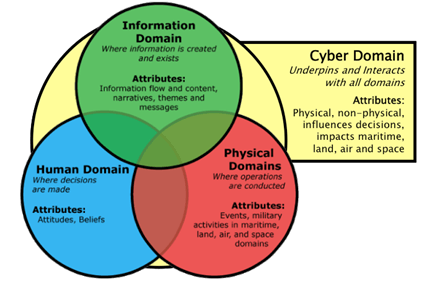
These non-kinetic domains are a direct
result of IT revolution and internet 4.0, including fields of cyber, space, AI,
information, electronic warfare (EW), unmanned aircraft systems (UAS) or
drones, integration of all assets through data fusion, better situational
awareness through sensor-fusion and so on. The long list of new battlegrounds
and emerging technologies has changed the nature of war. This new art of war is
quite different from the use of tactics like attrition of man and machine that
was a norm in the past and was preached by the military strategists. The
complete annihilation of enemy forces is no more necessary as itsC2 nodes can
be taken out by Effect-based operations (EBOs) by using both smart kinetic and
non-kinetic means, crippling the command structure and rendering forces on
ground useless.
With the advent of doctrines like JADC2
(Joint all-domain C2) and C4ISR (command, control, communications, computers,
intelligence, surveillance and reconnaissance), the importance of cybersecurity
and information security has become vital, rather indispensable, for the
operational security of modern militaries in any kind of warfare. The
conventional wars may have been reduced to low-intensity conflicts (LIC) due to
the presence of nuclear weapons, but the hybrid and sub-conventional battles
e.g. state-sponsored terrorism by using proxies have been a huge threat.
Moreover, the list of non-traditional security threats like economy, water,
food, instability in society etc. have become weapon of choice for enemies to
undermine a state’s national security.
To bring the discussion in context of
South Asia’s security dynamics, one just has to take a look at the regional
conflicts since 1998 i.e. nuclearization of Pakistan and India. The strategic
stability might have increased, and an all-out war may not be on the cards, but
nobody can deny the fact that Pakistan has been facing a threat spectrum from multiple
sides including terrorism, economy, pressure from defaming by Indian foreign
policy, water crisis, cyber-attacks, information warfare and much more. The
state of Pakistan has been fighting this multi-front war and has sacrificed a
lot in blood and money, but the need of time is to educate our people on the
importance of wars fought not out at the front but within our hearts and minds.
Hence, it is important to understand that the nation must back its armed forces
and we need to fight this war in all available domains.
To
conclude, one must understand that this vast topic of multi-domain warfare
needs a lot of attention and brainstorming. As it is multifaceted, the focus
here will be on the aspects of cyber and information security (Infosec) to
underscore their importance for modern armies. The decision makers in civilian
and military top brass are aware of these facts and it is indicated by their policy
formulation, but it goes without saying that we have a long way to go. The
requirement for data centres on war footing is one of many fundamental
requirements to consolidate our information security. A series of articles is
required to emphasize the necessity of this for our country and to understand
what is infosec, why is it important and how can we incorporate it in our
system. By grasping these concepts, we can further enhance our national
security and thwart the enemy’s nefarious plans against our homeland.
Author Bio
Squadron Leader Ali Hamza is a retired PAF pilot with 20 years of experience, defence analyst, airpower expert, gold medallist in MSc DSS (Defence & Strategic Studies) from QAU, currently doing MPhil IR from NUML, Rawalpindi and has a keen interest in modern airpower’s role in the geopolitics at global and regional levels.
YouTube: https://www.youtube.com/@AeronautIR
X (twitter): https://x.com/AliHamzaAwan1

No comments:
Post a Comment