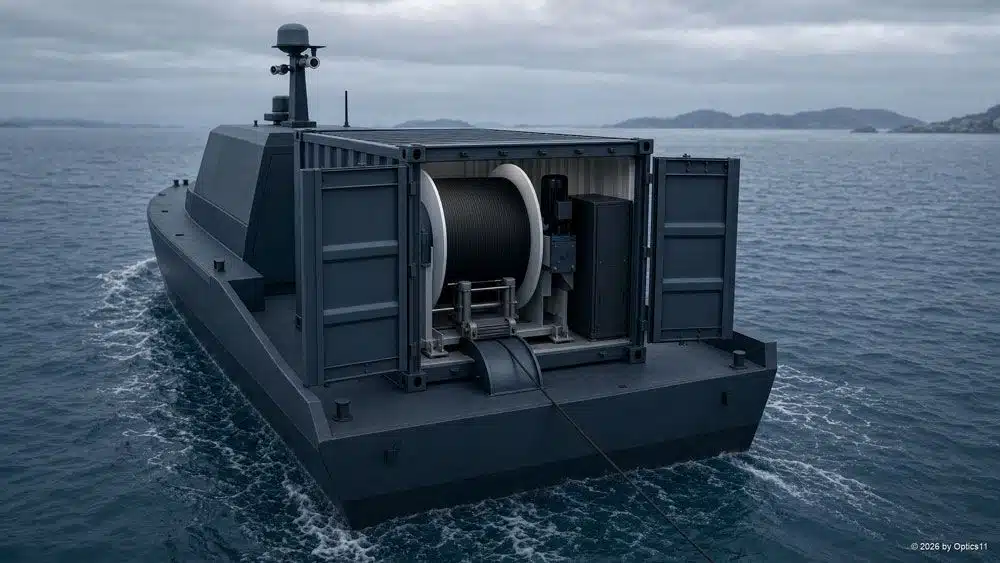
Taking a major step forward in distributed underwater surveillance, the Dutch Ministry of Defence has formally contracted local technology leader Optics11 to develop and deliver operational containerized towed array systems, as detailed in recent reporting by Naval News. Initiated under the innovative ASWINABO ("Anti-Submarine Warfare In A Box") programme, the project is engineered to significantly boost the Royal Netherlands Navy's readiness, flexibility, and operational self-sufficiency in an increasingly contested maritime domain.
Traditionally, advanced anti-submarine warfare (ASW) towed array sonar systems have been restricted to a limited number of highly specialized, dedicated naval combatants due to their size, power requirements, and complex integration profiles. By packing Optics11's next-generation OptiArray technology into a portable, containerized footprint, the ASWINABO concept allows navies to rapidly equip a wide range of vessels of opportunity—including standard surface ships and uncrewed surface vehicles (USVs). This plug-and-play modularity ensures that both crewed and uncrewed maritime platforms can be retrofitted according to immediate tactical demands.
At the core of the system is advanced fiber-optic hydrophone technology, which offers distinct operational advantages over conventional electrical towed arrays. Because the passive optical system relies entirely on light rather than powered electronics throughout the sensing chain, it remains completely acoustically silent while avoiding electromagnetic interference and internal electrical noise. This structural design yields significantly richer acoustic data, enabling earlier target detection, more precise classification, and heightened tactical confidence for naval commanders facing modern submarine threats.
The introduction of containerized ASW capabilities comes as European navies increasingly prioritize the protection of critical subsea infrastructure against hybrid warfare, espionage, and clandestine sabotage. With the exponential proliferation of autonomous maritime drones and unmanned systems reshaping naval warfare, providing scalable, cost-effective underwater sensing across multiple platforms serves as a vital force multiplier. Furthermore, the contract will establish domestic production, integration, and validation capabilities within the Netherlands, bolstering supply chain resilience and industrial readiness.
Ultimately, the adoption of the 'ASW in a box' solution marks a paradigm shift in how mid-sized navies can project underwater domain awareness without relying solely on high-end capital warships. As global security dynamics continue to demand greater operational agility, the pioneering Dutch initiative establishes a benchmark for flexible, modular anti-submarine warfare architecture. The ongoing fielding of these containerized systems will ensure that the Royal Netherlands Navy remains exceptionally well-equipped to detect and deter emerging subsea threats well into the future.