
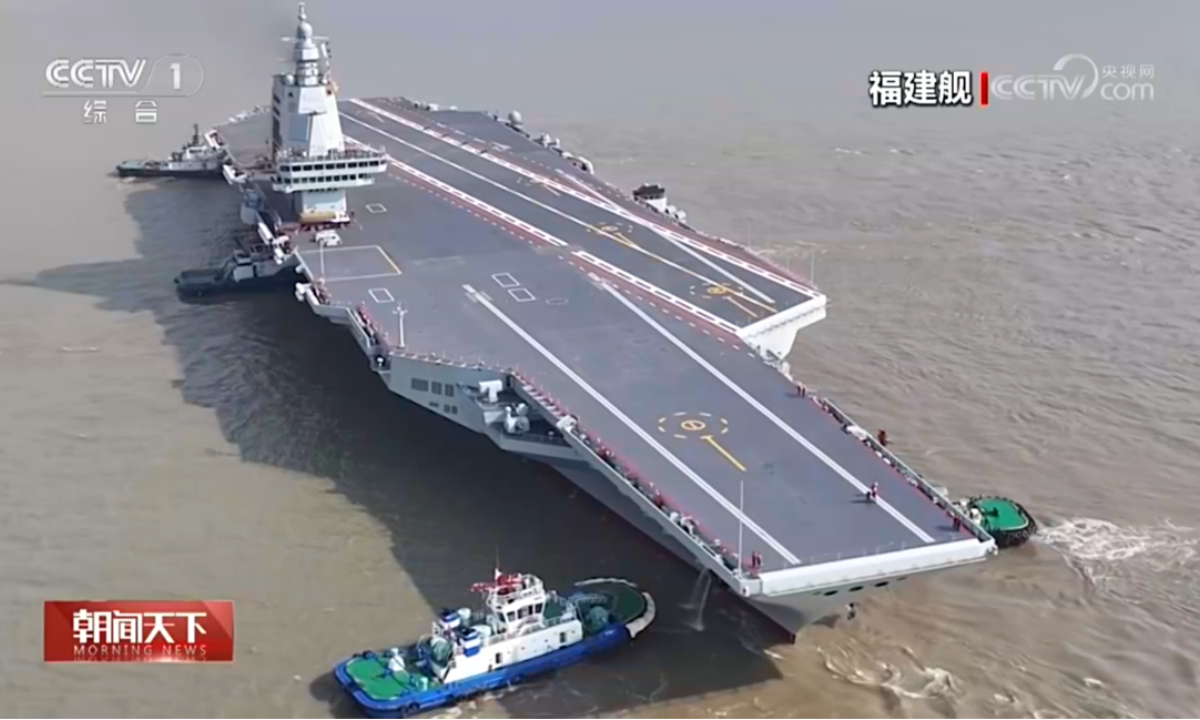
Britain and Germany didn't build dreadnoughts before World War I purely because their admirals thought battleships would win the next war. They built them because a great power without the biggest ship in the world wasn't taken seriously as a great power at all. That's the comparison a new CSIS report draws to explain why China is racing to field a carrier fleet in the first place, and it's the foundation for a genuinely pointed recommendation: if Chinese carriers are prestige projects as much as military assets, the US should stop treating them as an unstoppable threat and start treating them as an exploitable weakness.
The report, titled "Flip the Script," makes its core argument in a single sentence worth quoting directly: "China's expanding carrier force presents a strategic vulnerability that the United States and its allies can exploit, rather than merely a challenge to U.S. dominance." That's a real reframing of a debate that's mostly been about American carriers getting more vulnerable to Chinese missiles and submarines. CSIS is asking the opposite question, why hasn't Washington spent equal effort making Chinese carriers just as vulnerable to American and allied weapons.
The recommended toolkit reads like a checklist of every capability this outlet has already covered building out across the Pacific this year. Submarines and heavier torpedo investment. Air-launched anti-ship missiles cued by satellite surveillance, the same LRASM category the Royal Australian Air Force just declared operational. Land-based anti-ship missiles positioned from Japan down through the Philippines, threatening exactly the chokepoints a Chinese carrier group would have to pass through en route to the Philippine Sea or the South China Sea. Unmanned surface vessels adding pressure directly around Chinese ports and naval facilities. Cyber and electronic operations aimed at disrupting the command and communications networks a carrier group depends on to function as a coordinated force at all. None of these are new concepts individually, what's new is proposing them explicitly organized around one target set, China's own flattops, rather than as a general-purpose deterrent.
The fleet mix CSIS proposes to actually execute this is a real departure from how the Navy currently thinks about shipbuilding: roughly 300 crewed vessels and 300 uncrewed ones, a genuinely radical ratio for a Navy that's spent decades building around a comparatively small number of enormously expensive, heavily crewed platforms. That's the same "distributed, expendable mass" logic this outlet has tracked across the Massed Modular Aircraft program and the Navy's various drone-boat initiatives, just scaled up to the level of the entire fleet structure rather than a single weapons category.
The scale of what this strategy would actually be up against keeps growing. China operates three carriers today, Liaoning, Shandong, and the newly commissioned Fujian, and a 2025 Pentagon study projected the PLAN building six more by 2035, up to nine total, with satellite imagery already showing early hull construction on a fourth-generation Type 004 carrier at Dalian that analysts expect to outweigh even America's own Gerald R. Ford by 10 to 20 percent. A strategy built around making each individual carrier too costly to risk gets proportionally harder to execute the more carriers there are to track and threaten simultaneously.
It's worth being clear about what this report actually is: one think tank's proposal, not a Pentagon strategy document or a funded program. CSIS doesn't set naval policy, and "Flip the Script" is exactly the kind of paper meant to shape a debate rather than announce a decision that's already been made. Whether the Navy's own leadership adopts anything resembling a 300-crewed, 300-uncrewed fleet structure, or simply borrows individual pieces of the targeting logic while keeping its existing force design largely intact, is the actual question this report raises without answering, the same gap that sits between every ambitious defense proposal and whatever the Pentagon eventually decides is affordable enough to actually build.
