Monday, July 8, 2024

India to Test US-Made Stryker AFVs for Enhanced Border Defense Against China


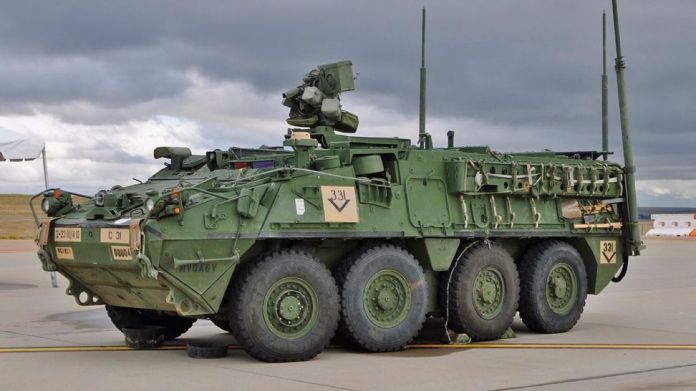
India is set to evaluate the US-made Stryker Armored Fighting Vehicle (AFV) to boost its defense capabilities against potential threats along its northern and western borders. The Stryker AFV has seen extensive use in global conflicts, most recently in Ukraine. Indian media reports indicate that the Indian Army will soon test these vehicles in desert terrains and the high-altitude region of Ladakh. Defense establishment sources reveal that the Indian Army aims to acquire around 530 armored fighting vehicles.

Following the 2+2 ministerial consultations in November 2023 between India and the US, a senior US defense official announced plans for the US and India to collaborate on producing Stryker AFVs for India. Although no official agreement has been signed, sources suggest that negotiations are at an advanced stage. Last month, Indian National Security Advisor Ajit Doval and US National Security Adviser Jake Sullivan discussed the AFVs.

India is expected to make a limited off-the-shelf purchase of Strykers through the Foreign Military Sales (FMS) route. Subsequently, joint production of the vehicles is likely to take place in India under the US-India Initiative on Critical and Emerging Technologies (iCET). The Stryker is under consideration because Indian vendors have not met the required qualitative standards (QR).

However, the Stryker has some technical limitations that are being assessed. Concerns have been raised about the 350-horsepower Caterpillar C7 engine's performance at high altitudes due to thin air. To address this, the US has offered to replace it with a 750-horsepower Cummins Advanced Combat Engine, providing a significant upgrade.

With an eye on China’s People's Liberation Army near the disputed border, India needs an advanced, battle-tested armored vehicle for high-altitude terrains like Eastern Ladakh. The Indian Army, seeking to modernize its Russian-origin BMP-II amphibious infantry fighting vehicles, plans to replace them with wheeled and tracked Infantry Combat Vehicles. The Strykers are likely to be deployed in high-altitude areas along the border with China, such as Eastern Ladakh and Sikkim. Since the 2020 conflict, India has emphasized the need for light tanks and more armored combat vehicles to navigate the challenging high-altitude terrain.

Opinions about the Stryker in India are divided. Some military experts believe the vehicle will strengthen India’s arsenal against the PLA, while others argue that India already has the indigenous capability with the Wheeled Armoured Platform (WhAP). Although the WhAP has demonstrated its capabilities with multiple turrets, a sight system, and a fire control system, some defense sources argue that it lacks comprehensive sight systems, fire control systems, and weaponry.

If approved, the Stryker’s capabilities will need modifications to suit high-altitude regions like Eastern Ladakh. Proponents emphasize the Stryker's versatility, mobility, and flexibility as suitable for India’s needs. They also note similarities between the US Stryker and the Chinese armored vehicle VN22, highlighting the strategic importance of acquiring such technology.

Combatant Commanders require a brigade that can be quickly and strategically deployed, and Indian officials believe the Stryker meets this need. It is lighter and easier to move compared to larger tanks like the T-72 and T-90 in the Indian arsenal. The Stryker, while not as strong as tanks, can operate in various terrains like snow, mud, and sand.

The Stryker has been combat-tested in Iraq, Afghanistan, and more recently in Ukraine against Russian forces, proving its reliability and effectiveness in various combat situations. 

Japan Unveils Future Destroyer with Game-Changing Electromagnetic Railgun Technology


 In October 2023, Japan achieved a significant milestone by becoming the first nation to successfully test-fire a medium-caliber maritime electromagnetic railgun from an offshore platform. Following this success, the Japan Maritime Self-Defense Force (JMSDF) is now considering the development of a new class of destroyers equipped with electromagnetic railguns.

The 13DDX future destroyer concept, developed by the Ministry of Defense’s Acquisition, Technology & Logistics Agency (ATLA), gained momentum after the successful railgun tests. In May 2024, Vice Admiral Imayoshi Shinichi, ATLA’s Director General of Naval Systems, presented the ambitious plans for the 13DDX at the Combined Naval Event 2024 in Farnborough, UK, where he discussed the future destroyer and submarine projects of the JMSDF.

According to ATLA, the 13DDX—Air Defense Destroyer will be equipped with advanced systems including Rail Guns, Active SAMs, High-Power Lasers, High-speed Maneuvering Target Detection Radar, HPM Weapons, a Fire Control Network, IPES (Downsizing Large-Capacity GEN), AI-based CDS, Autonomous Navigation, Automated Damage Control, and modular mission capabilities.

The 13DDX will also feature directed energy weapons (DEW) and a new multifunction radar optimized for detecting high-speed targets. It will incorporate elements from the JMSDF’s Asahi-class destroyers and Mogami-class frigates.

In early 2022, the Japanese Ministry of Defense decided to develop an electromagnetic weapon system to intercept hypersonic missiles. By 2023, ATLA successfully tested this system, marking the first maritime railgun test ever conducted. Railguns use electromagnetic energy to fire projectiles at speeds around Mach 7, targeting ships, missiles, and aircraft without the need for gunpowder or explosive propellants.

A railgun can theoretically fire a projectile the size of a bowling ball fast enough to destroy a small building over long distances. Due to their significant power requirements, railguns are typically large and not portable, though there are proposals to adapt this technology for non-weapon uses such as launching aircraft and spacecraft.

The medium-sized electromagnetic railgun prototype developed by ATLA, first seen in May 2023, can fire 40mm steel rounds weighing 320g (0.7lb). The railgun uses five megajoules (MJ) of charge energy to fire bullets at speeds around 2,230m/s (Mach 6.5). ATLA aims to eventually operate the railgun on 20 MJ of charge energy.

Japan plans to deploy the railgun both on land and at sea. Initially, the Aegis Ashore land-based system was intended to enhance ballistic missile interception capabilities, but this plan was abandoned in 2020. The development and testing of railguns come as Japan seeks to counter the threat from hypersonic weapons developed by China, North Korea, and Russia.

Admiral Shinichi emphasized the need to enhance Japan’s long-range air defense capabilities in response to the challenging security environment and growing anti-access/area denial (A2/AD) capabilities of other countries.

Japan is accelerating the development of formidable firepower due to the tense geopolitical landscape in East Asia. In May 2024, Japan entered a railgun cooperation agreement with France and Germany to jointly explore and deploy this advanced technology. Meanwhile, China faced setbacks in its own electromagnetic hypersonic railgun testing.

Japan is bolstering its defense capabilities with the development of the 13DDX and its electromagnetic railgun technology, signaling a new era in naval warfare. Japan also plans to mount railguns on land-based trucks, creating a mobile defense network capable of intercepting hypersonic missiles. As tensions rise in the Indo-Pacific region, the world will be watching Japan’s naval transformation closely.