
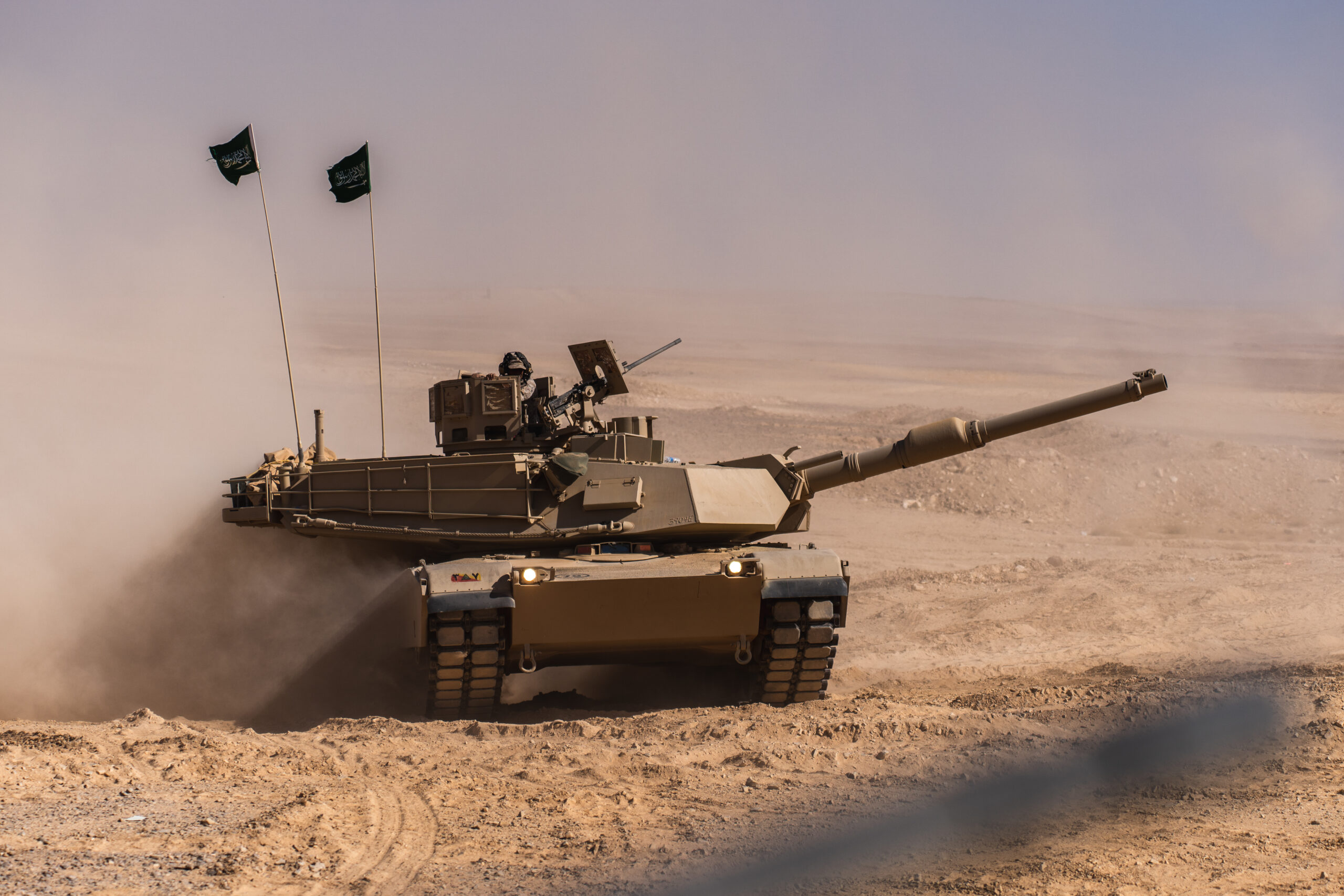
Houthi media released footage this week showing a Rajum quadcopter drone dropping a munition onto a Saudi-operated M1A2S Abrams main battle tank near Marib, triggering what open-source analysts identified as an ammunition explosion in the turret bustle. Both rear turret blowout panels visibly activated in the footage, the engineered failure mode designed specifically to vent an ammunition fire upward and outward rather than into the crew compartment, a design feature no other NATO main battle tank fully replicates in the same configuration. The Royal Saudi Land Forces has not confirmed the loss, and independent battle-damage assessment from the available footage alone can't establish with certainty whether the tank was destroyed outright or merely disabled, but OSINT analysts reviewing the footage were largely in agreement on one technical point worth taking seriously: no Abrams has ever returned to service after an ammunition detonation reaches the turret bustle, regardless of whether the blowout panels functioned as intended.
The blowout panel system is the actual story here, more than the strike itself. It exists precisely because tank designers have long assumed some crews would eventually take a hit that ignites onboard ammunition, and the panels' entire purpose is converting what would otherwise be a catastrophic, crew-killing explosion into a survivable, if vehicle-ending, event. That the system reportedly worked as designed, protecting the crew while writing off a tank worth roughly $10 million depending on configuration, is a genuine engineering success story wrapped inside a genuine capability failure: the tank's own safety architecture assumes it will eventually be hit hard enough to need it, an assumption a $2,000-to-$5,000 quadcopter carrying a small drop munition has now apparently validated against one of the most heavily armored vehicles in the world.
This is the same cost-exchange logic this blog has tracked obsessively all summer, just relocated from interceptors to armor. This blog's coverage of the Patriot and THAAD stockpile drawdown against Iran established the basic asymmetry, multi-million-dollar defensive systems consumed by cheap, mass-produced offensive ones, and the MQ-9 Reaper attrition story extended that same logic to expensive American drones being shot down by layered Iranian air defenses built for a fraction of the Reaper's cost. A Rajum quadcopter disabling an Abrams tank is the armored-vehicle version of the identical pattern: a low-cost, commercially-derived platform defeating hardware that costs several thousand times more to build, not through superior technology, but through the same fundamental math this blog has documented across nearly every domain this summer, cheap and expendable beats expensive and scarce often enough that the exchange rate, not any single engagement, is what actually determines who can sustain a fight.
The Houthi track record against Saudi Abrams tanks specifically stretches back considerably further than this single incident, and it's worth situating this strike inside that longer pattern rather than treating it as a novel vulnerability. Saudi armor has been targeted by Houthi anti-tank weapons since at least 2015, originally through Soviet-designed Konkurs missiles and Iranian-produced variants, a threat vector Riyadh has had over a decade to account for. What's actually new in this specific strike is the delivery method, a drone-dropped munition rather than a guided missile, reflecting the same broader shift toward small, commercially-derived multirotor platforms this blog's coverage of Task Force Falcon Strike and CENTCOM's LUCAS drones already documented as the defining tactical innovation of this entire summer's conflicts, adapted here from a strike role against personnel and logistics into a genuinely effective role against a main battle tank.
None of this means the Abrams is obsolete, or that Saudi Arabia's broader armored force is suddenly indefensible, a single disabled tank, however dramatic the footage, doesn't overturn decades of doctrine on its own. But read alongside this blog's extensive documentation of exactly this dynamic playing out against interceptors, drones, and now armor, the pattern is now broad enough across enough platform categories that it deserves to be treated as a structural feature of contemporary warfare rather than an isolated embarrassment for any single system. The blowout panels did their job. The tank is very likely gone anyway. And the quadcopter that caused both outcomes cost less than a rounding error on the tank's own maintenance budget.

No comments:
Post a Comment