
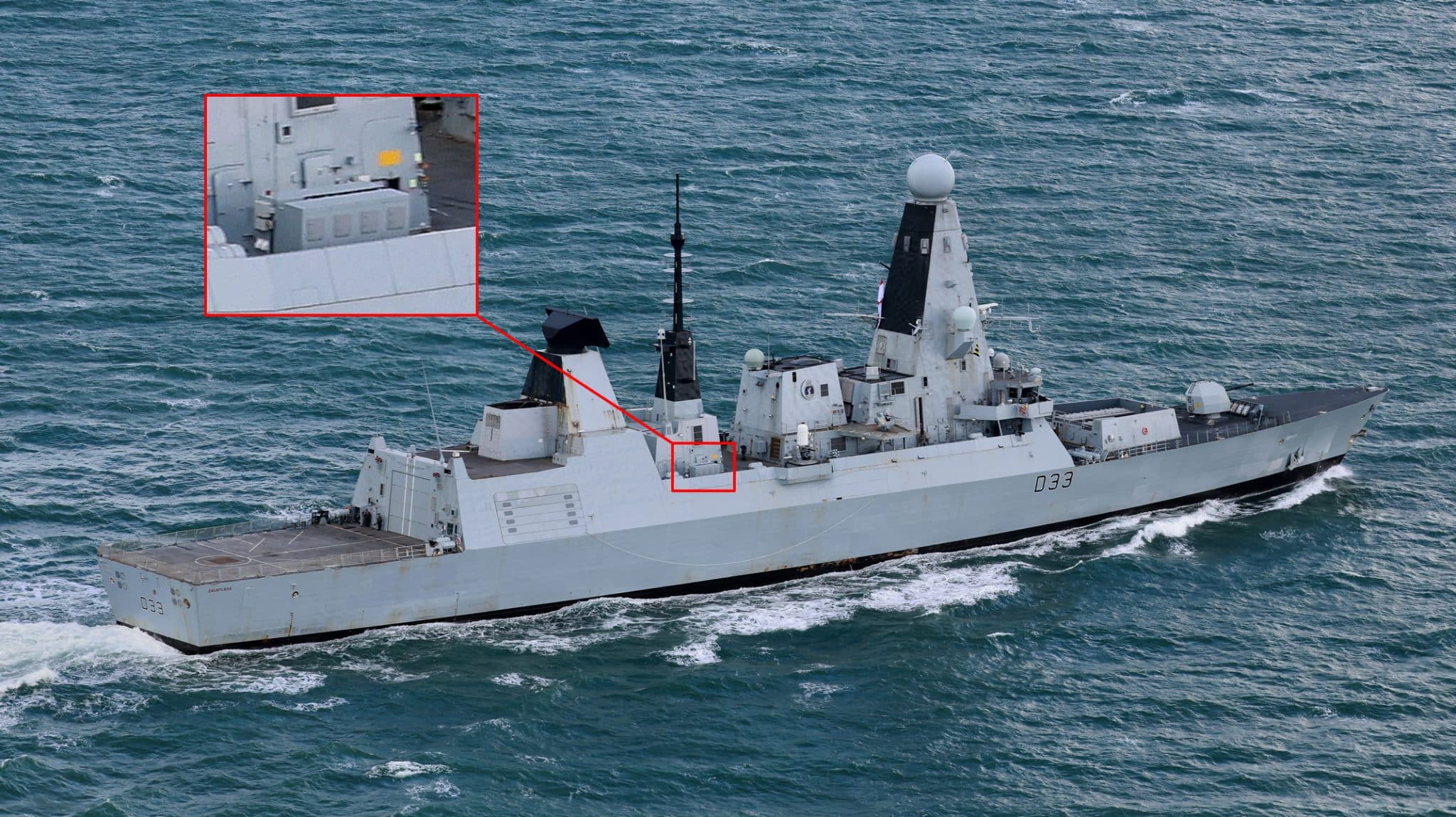
On October 14, 2026, Naval News reported that new images released by the UK Ministry of Defence appear to show a counter-drone system fitted to the Royal Navy Type 45 destroyer HMS Dauntless (D33). The pictures, dated October 10, show the ship carrying out a passing exercise off the Isle of Wight with five Ukrainian minehunters, marking the end of Exercise Lion Protector. That exercise, which began in August, was designed to refine how the nations of the Joint Expeditionary Force protect Europe’s northern flank. The images show two mystery containers on the port and starboard sides of the destroyer’s main communications mast, and Naval News judges they are probably launchers for interceptor drones.
The reasoning behind that conclusion is worth following, because it is all inference. The containers look like purpose-built boxes rather than standard shipping containers, and measured against a nearby SOLAS life-raft canister they appear to be about two metres by one metre. Naval News suggests they house multi-cell vertical launch systems for interceptor drones, which typically need large boxes so they can fly out with their rotors spinning. The report also notes that no new sensors are visible, so the interceptors would presumably receive targeting data from the Type 45’s existing Sampson multi-function radar, the S1850M long-range radar and the electro-optical systems. If true, that would make it a mature, integrated capability rather than a quick fix. When approached, a Royal Navy spokesperson said that, due to operational sensitivities, it would not discuss the equipment fit.
The fitting also comes at a telling moment. The Royal Navy says Dauntless is preparing to escort the carrier HMS Prince of Wales when she resumes her Firecrest 2026 deployment to the High North. Sister ship HMS Dragon returned only last week from a seven-month deployment in the Mediterranean and Red Sea without the system being spotted, which suggests Dauntless may be the first Type 45 to trial it. The experience behind it is real. British ships such as HMS Diamond faced drone and missile attacks from Yemen in the Red Sea in 2024, and the Royal Navy and French Navy have since rehearsed drone swarm defence in exercises such as Sharpshooter and WildFire.
Those exercises exposed a basic problem, which is magazine depth. Naval News notes that the Type 45 and the French-Italian Horizon destroyers carry 48 vertical launch cells, and French air-defence FREMM frigates carry 32, and spending an expensive missile on every cheap drone is not sustainable. Before this, the Royal Navy had begun shifting toward other layers, including the DragonFire laser and Wildcat helicopters armed with Martlet missiles. Interceptor drones would add another layer between those two, and they let the crew match the response to the threat for much less money than a missile.
The same logic is driving counter-drone work elsewhere, as we noted in our piece on the Pentagon’s directed-energy pilot at U.S. bases. Both reflect the fact that drones have changed the economics of defence, since the attacker’s cost per shot is far lower than the defender’s. But there are limits to what can be said. We don’t know the interceptor type, its range, speed or warhead, whether it can handle fast, low-flying threats or only slow Shahed-style drones, or how many each ship will carry. An interceptor drone is also unlikely to answer a supersonic anti-ship missile, which still needs the destroyer’s long-range missiles. That last point is my own analysis rather than anything in the report.
Ultimately, this is a glimpse of a capability, not a confirmation of one. Three things would show how significant it is: an official statement from the Royal Navy on what the system is and who supplied it, evidence of whether other Type 45s receive it, and any live firing or use during the High North deployment. Until then, the fair summary is that the Royal Navy appears to be giving its most advanced air-defence destroyer a cheap answer to cheap drones.

No comments:
Post a Comment