
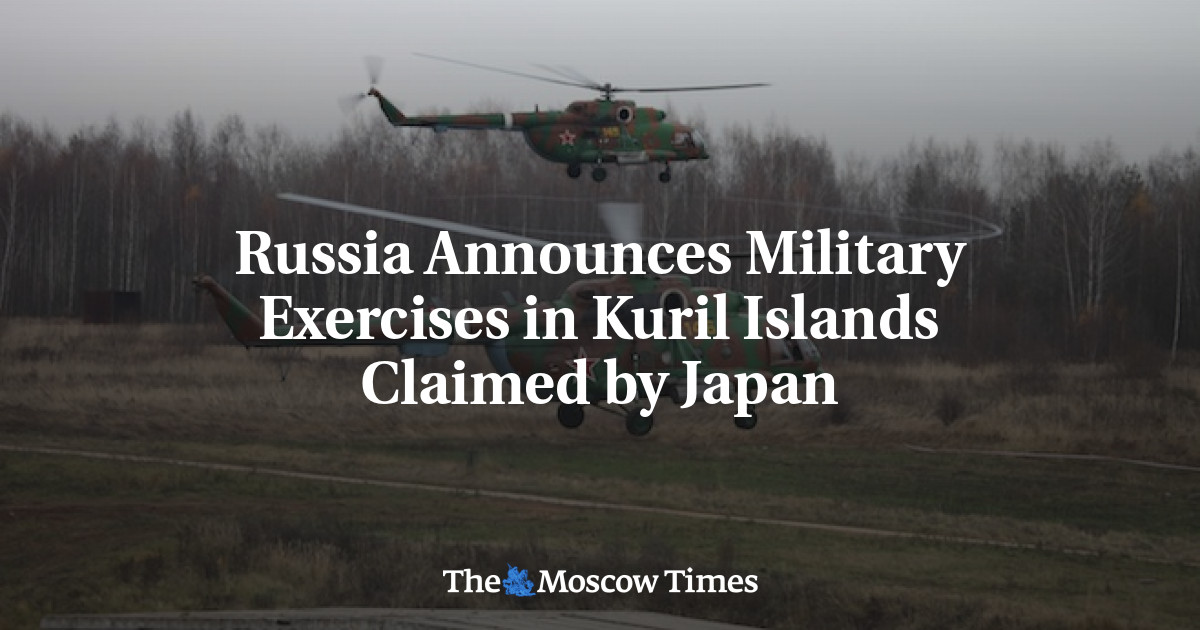
Vladimir Putin made his first-ever visit to the disputed Kuril Islands on August 13, traveling to Iturup, the largest of the four southern islands Japan claims as its "Northern Territories," two days before Japan's August 15 commemoration of the end of the Second World War. Russian state media framed the trip in deliberately domestic, unthreatening terms, Putin touring a fish-processing plant, a hospital, and a school, and meeting residents in the town of Kurilsk, but the itinerary around that visit told a different story: he arrived after conducting naval exercises off Sakhalin involving more than 13,000 servicemen, dozens of warships, and aircraft, and met not just the regional governor but Russia's Pacific Fleet commander, the FSB's Sakhalin border service chief, and the acting commander of the 68th Guards Army Corps, the formation responsible for defending the islands. Japan's response was immediate and pointed: Prime Minister Sanae Takaichi called the visit "absolutely unacceptable," and Foreign Minister Toshimitsu Motegi summoned Russia's ambassador to lodge a formal protest.
The military substance behind the symbolism is considerable and long-predates this particular trip. Over the past decade, Russia has transformed the southern Kurils from lightly defended outposts into a fortified network of coastal anti-ship missiles, ground forces, air-defense systems, and naval and aviation infrastructure, anchored by the 18th Machine Gun-Artillery Division, a formation deliberately structured around isolated-island defense rather than conventional combined-arms operations, with roughly 3,500 personnel spread across Iturup and Kunashir according to Japanese Defence Ministry assessments. That buildup matters strategically well beyond the islands' modest size and 20,000-person population, because the southern Kurils sit directly astride the approaches between the Pacific Ocean and the Sea of Okhotsk, giving whoever controls them meaningful influence over Russian Pacific Fleet access and, by extension, over how freely Japan and its allies can operate in those waters during a crisis.
What the visit's timing actually clarifies, though, is less about Russia's long-standing military posture and more about what's changed on the other side of the strait. Tokyo published its 2026 Defense White Paper just nine days before Putin's trip, and it marks a genuine departure from Japan's traditionally defense-only doctrine: the paper confirms deployment of the Type-25 land-based anti-ship missile with roughly 1,000-kilometer range, formalizes Japan's pursuit of "counterstrike capabilities" including hypersonic weapons, and explicitly plans further Type-25 deployment to Camp Kamifurano, in Hokkaido, the Japanese island closest to the Kurils themselves. Japan had already begun fielding these systems earlier in 2026, alongside an upgraded Type-12 surface-to-ship missile with roughly five times the range of its predecessor, moves the white paper frames primarily around China but which, deployed to Hokkaido specifically, sit within direct reach of the same waters Russia's Kuril fortifications are built to control.
Read against that backdrop, a Russian president touring a fish-processing plant while flanked by his Pacific Fleet commander and a border-defense general reads less like routine domestic politics and more like a calculated signal: Moscow asserting sovereignty and military presence over contested territory at almost the exact moment Tokyo was operationalizing offensive-capable missile systems within range of it for the first time. Neither government needed to say this explicitly for the sequencing to be legible to the other; Russia's own state media chose to lead with military exercises and border-security meetings alongside the softer imagery, and Japan's white paper had already named Russia specifically as a factor in the Far East security environment alongside its primary China focus, citing Moscow's deployment of advanced fighters and coastal missile systems there.
None of this points toward imminent conflict over four small islands with a combined population smaller than a mid-sized Japanese town, and both governments have strong incentives, economic and otherwise, to keep this dispute rhetorical rather than kinetic. But the pattern fits a broader regional trend this blog has tracked elsewhere, from Vietnam's indigenous frigate program to the Philippines' fighter competition, smaller and mid-sized powers responding to a larger neighbor's buildup not through matching capability but through visible, calibrated signaling. The difference in the Kuril case is that Russia is the one holding the fortified territory and Japan is the one whose new missile deployments are prompting the reassurance tour, a reversal of the pattern seen elsewhere in the region and a reminder that Russia's Pacific posture, largely overshadowed by the war in Ukraine, remains an active rather than dormant strategic question.

No comments:
Post a Comment