
Lockheed Martin's AN/TPY-6, formally designated with the "T" standing for "Transportable" under U.S. Department of Defense naming convention, represents the Pentagon's newest attempt to put a Long Range Discrimination Radar (LRDR)-class sensor on a mobile footing rather than confining it to fixed, purpose-built installations like the existing LRDR site in Alaska. Built on the same Subarray Suite radar building blocks as Lockheed's sea-based AN/SPY-7 and derived directly from the fixed LRDR architecture, TPY-6 completed a Live Fire Test event in December 2025, successfully engaging a Mid-Range Ballistic Missile target in conjunction with Aegis command-and-control systems and an SM-3 Block IIA interceptor as part of the Guam Defense System buildup. It's a genuine technical achievement, and also, notably, a capability Russia's air defense industry has treated as baseline requirement rather than breakthrough since the 1970s.
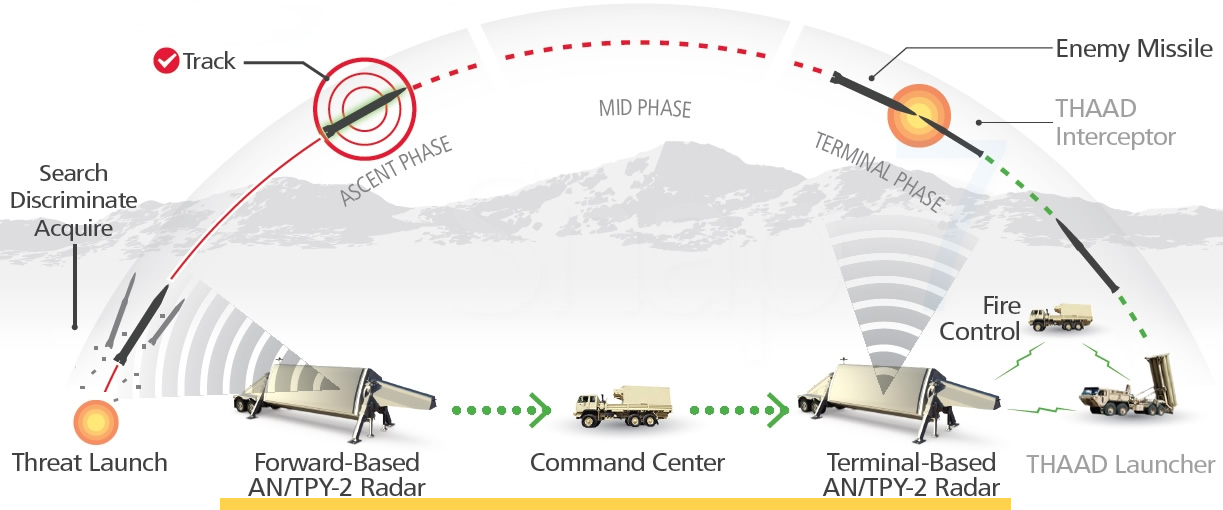
The comparison matters because the entire operating logic behind Russia's S-300 family, and its descendants the S-400 and S-500, has always assumed radar mobility as a survivability requirement, not an optional upgrade. Systems like the 30N6 target-tracking and illumination radar and the 76N6 target-detection radar, both integral components of the S-300PM2 already in front-line Russian service, are designed from the outset to be moved, dispersed, and re-emplaced specifically to complicate an adversary's ability to locate and destroy the sensor half of the kill chain, a lesson reinforced repeatedly during the Russia-Ukraine war, where strikes on precisely these radar types, including a confirmed hit on two S-300 radars during an August 2026 attack on a Voronezh air defense regiment, have demonstrated exactly why mobility matters when your radars are a target. America's THAAD architecture, by contrast, has relied primarily on the AN/TPY-2, itself technically transportable but historically deployed and operated more like a semi-fixed asset within a given theater than as part of a doctrine built around continuous relocation.
That gap in institutional approach helps explain why TPY-6's development path has been anything but smooth. A Government Accountability Office report on the Guam Defense System revealed that despite a single TPY-6 prototype already being present on Guam, an internal Pentagon memo had directed that "other than system experimentation efforts, further development of the AN/TPY-6 radar shall be terminated," with the Missile Defense Agency instead told to prioritize delivering minimum viable Aegis command-and-control and datalink capabilities to enable SM-6 engagements off remote tracks from the existing AN/TPY-2 and the Army's newer LTAMDS (Lower Tier Air and Missile Defense Sensor) radar via a Joint Track Management Capability bridge. In practice, that's the Pentagon hedging on a purpose-built mobile discrimination radar in favor of stitching together sensor data from radars it already has, a workaround rather than the clean mobile-sensor solution TPY-6 was meant to provide.
This isn't a story about American radar technology being inferior, the underlying phased-array and discrimination capabilities embedded in TPY-6 and its LRDR/SPY-7 relatives are genuinely advanced, arguably ahead of Russian equivalents on raw sensing performance. It's a story about institutional starting points. Russia built its entire ground-based air defense doctrine around distributed, relocatable radar networks because Soviet planners assumed from the outset that any fixed radar would eventually be located and destroyed. The U.S. built its ballistic missile defense architecture around fewer, more capable, more fixed installations, reflecting an assumption of relative homeland sanctuary that no longer holds as cleanly against peer adversaries fielding long-range precision strike capability, which is precisely the gap Golden Dome's broader push toward proliferated, resilient sensor architectures is now trying to close.
Whether TPY-6 survives in its originally envisioned form or gets folded into the more improvised AN/TPY-2-and-LTAMDS bridging solution the GAO memo describes, the underlying strategic lesson is the same one Ukraine's own S-300 radar losses have been reinforcing in real time: a missile defense architecture's sensor layer is only as survivable as its ability to move, and that's a doctrine Russia's air defense designers treated as a starting assumption decades before it became a live design question for the systems the U.S. is now racing to field on Guam and elsewhere.

No comments:
Post a Comment