
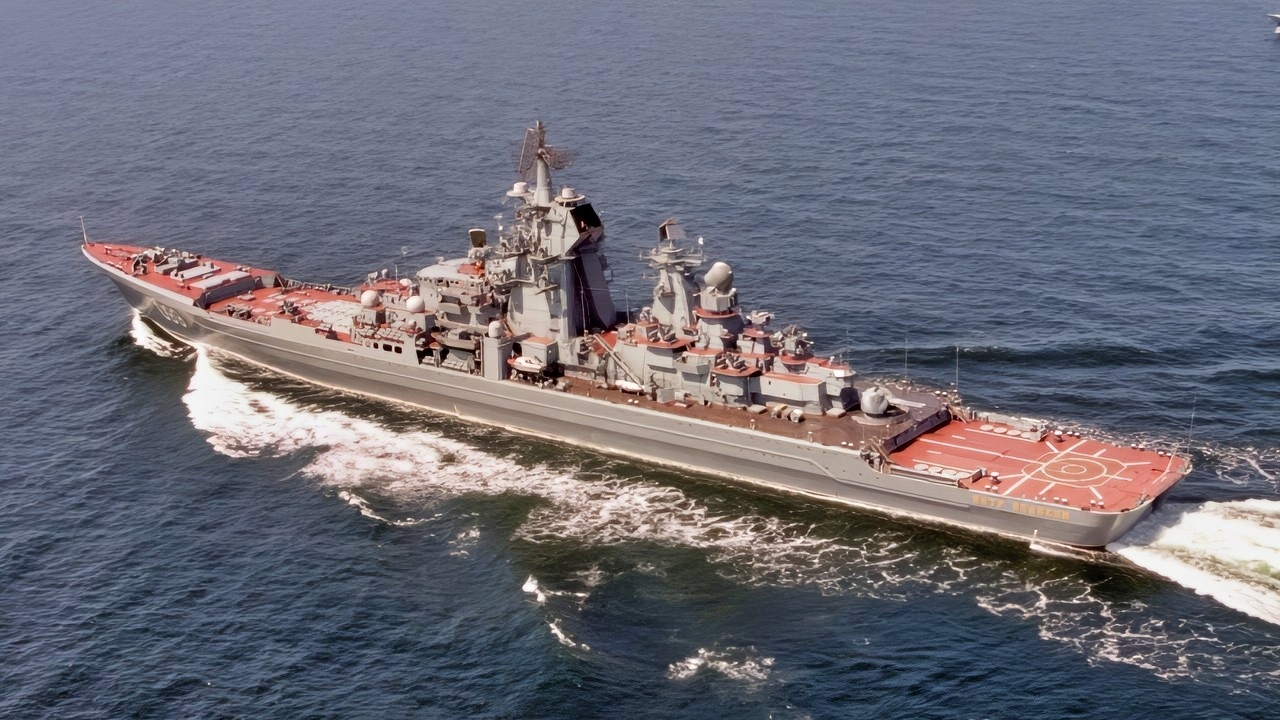
Admiral Nakhimov entered overhaul in 1999. It didn't leave dry dock under its own power again until August 2025. Somewhere in between, its reactors sat cold for so long that restarting them, in December 2024 and February 2025, was itself treated as a milestone. This week, the Russian Navy announced the ship has completed sea trials in the Barents Sea and is expected to formally re-enter service within weeks, closing out a refit that took longer than some of the sailors who'll crew it have been alive.
What Russia gets for that investment, estimated unofficially at around 200 billion rubles, roughly $5 billion, is genuinely staggering on paper. Nakhimov is a 28,000-ton Kirov-class nuclear battlecruiser, nearly three times the displacement of a U.S. Navy Arleigh Burke destroyer, powered by twin KN-3 reactors driving 140,000 shaft horsepower, enough to hit roughly 32 knots, faster than any carrier, cruiser, destroyer, or amphibious ship currently in U.S. Navy service. Its refit swapped out Cold War-era weapons for 80 universal vertical launch cells firing Kalibr cruise missiles, Oniks anti-ship missiles, and 3M22 Zircon hypersonics, backed by 96 more cells for long-range S-400-derived surface-to-air missiles, plus Pantsir-M and Paket-NK systems layered in for close-range air and undersea defense. By missile-cell count alone, it may be the most heavily armed surface warship afloat.
Set against Russian naval doctrine, that arsenal reads less like a traditional cruiser and more like a floating magazine. Analysts tracking the refit have increasingly described Nakhimov's actual role as an "arsenal ship," a platform built less for ship-to-ship duels than for launching massed long-range salvos against targets on land and at sea, extending the same standoff-strike logic Russia has leaned on throughout the war in Ukraine, where cruise missiles fired from well behind the front line have done far more work than direct naval engagement. Based out of Severomorsk, the Northern Fleet's command hub on the Kola Peninsula, the ship is expected to spend its service life protecting Russia's Arctic ballistic-missile-submarine bastions and projecting Kalibr and Zircon range across the North Atlantic.
Here's the tension nobody involved in celebrating this milestone is eager to name directly: the entire premise of concentrating this much firepower, and this much money, into a single irreplaceable hull runs against almost everything the past three years of war have actually demonstrated about naval survivability. Ukraine, with no navy to speak of, has spent this war sinking and damaging Russian Black Sea Fleet vessels using cheap drone boats costing a rounding error of Nakhimov's refit budget. The lesson most navies watching that campaign have drawn is toward distribution, more platforms, individually cheaper and more expendable, rather than fewer platforms carrying more value each. Nakhimov is the opposite bet: one ship holding a meaningful fraction of Russia's total naval strike capacity, in an era where a single successful strike, or even a single mechanical failure, now carries outsized strategic consequence precisely because there's no second Nakhimov waiting in reserve.
None of that makes the ship irrelevant. A genuinely fast, heavily armed, nuclear-powered missile platform still complicates planning for any adversary operating in the Arctic or North Atlantic, and 27 years of delay doesn't erase what's now, on paper, a formidable set of capabilities. But the more interesting question raised by Nakhimov's return isn't how powerful it is. It's whether a navy re-committing this heavily to the concentrated-firepower model, right as the rest of the world has spent three years learning why that model is risky, is making a considered strategic bet or simply finishing a project too expensive and too far along to abandon.

No comments:
Post a Comment