
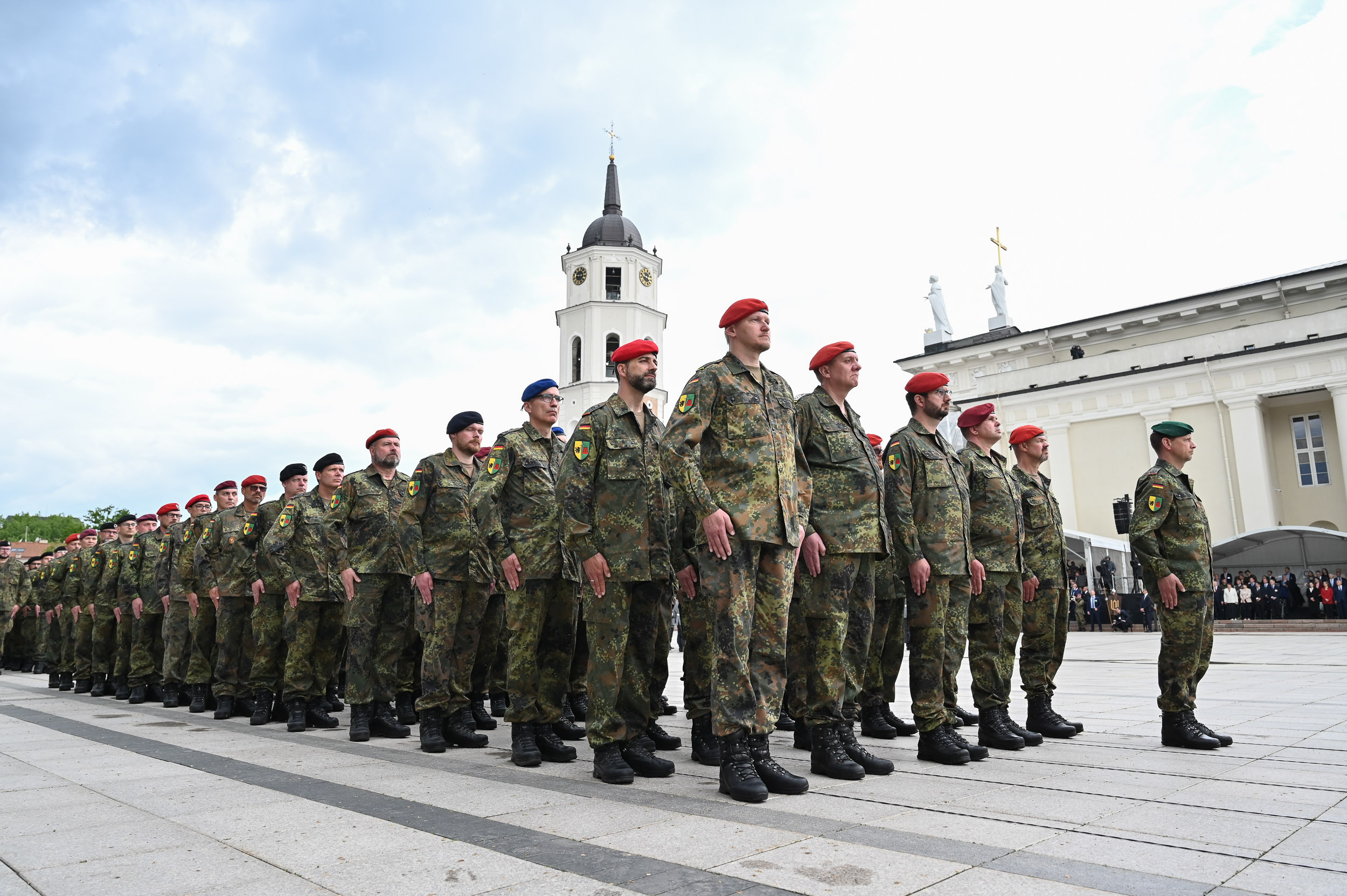
Two senior fellows at the Foundation for Defense of Democracies made the case in Defense News this week that Germany has become NATO's most important ally, pointing to a doubled defense budget, deepening industrial ties with American firms, and above all, the permanent stationing of a combat brigade in Lithuania, the first time Germany has forward-deployed troops abroad since World War II. It's an argument worth taking seriously; it's also missing a detail that changes how impressive that brigade actually is right now.
The budget numbers the piece cites check out. German defense spending has climbed from 1.43 percent of GDP in 2021 to an estimated 2.69 percent this year, with a pledge to reach €162 billion by 2029 and eventually 3.5 percent of GDP by 2035, a commitment made formal at last year's NATO Hague summit. The €100 billion special fund Berlin created in 2022 is real money that's genuinely reshaped procurement across German industry, and firms like Rheinmetall are indeed working on co-production deals with American companies covering 155mm artillery shells and ATACMS.
Where the piece runs into trouble is treating the 45th Armored Brigade in Lithuania as the clean, symbolic payoff of that transformation. It formally activated in April 2025 and is meant to reach full strength, 4,800 troops plus 200 civilian staff, by the end of 2027. As of this summer, it hadn't come close. German media reported in February that only 209 of the first 1,971 planned volunteer positions had actually been filled, roughly 10 percent, prompting Bundestag Defense Committee chair Thomas Röwekamp to say publicly that Germany may need to start assigning soldiers to Lithuania involuntarily if the shortfall continues. Army Inspector Lt. Gen. Christian Freuding confirmed in June that the "guiding principle of volunteering" would now be "supplemented with mandatory measures where necessary," about as direct an acknowledgment as a senior officer gets that the recruitment plan didn't work. The shortage is concentrated in enlisted ranks and technical specialties, logistics, IT, engineering, CBRN defense, while officers have been comparatively easy to find.
None of that means the brigade is a failure or that Germany isn't serious about it. Troop numbers on the ground have grown steadily, from roughly 400 in mid-2025 to about 1,700-1,800 by mid-2026, with a target of 2,000 by year's end, and Berlin has kept publicly reaffirming the brigade remains "on schedule." But "on schedule" and "adequately staffed" aren't the same claim, and a brigade running at 40 percent strength three years into a build-out that's supposed to hit full readiness in 2027 is a genuinely different story than "German soldiers standing guard on NATO's eastern flank," which is the phrase the op-ed uses to make its case that this, more than budget percentages, is what actually reassures Poland and the Baltics.
The op-ed's broader argument, that Washington should welcome German investment rather than treat it with suspicion, doesn't hinge on getting this one detail right. Germany's spending trajectory is real, its industrial partnerships with American firms are real, and a struggling recruitment drive doesn't erase either of those. But an argument built partly on Germany's forward troop commitment as tangible proof of intent deserves to grapple with the fact that the flagship unit embodying that commitment currently exists mostly on paper, staffed at a fraction of its planned strength, with the German army's own leadership now discussing conscription-adjacent measures to fill it. That's a harder, less triumphant story than "Germany is stepping up," even if the underlying direction of travel is genuine.

No comments:
Post a Comment