
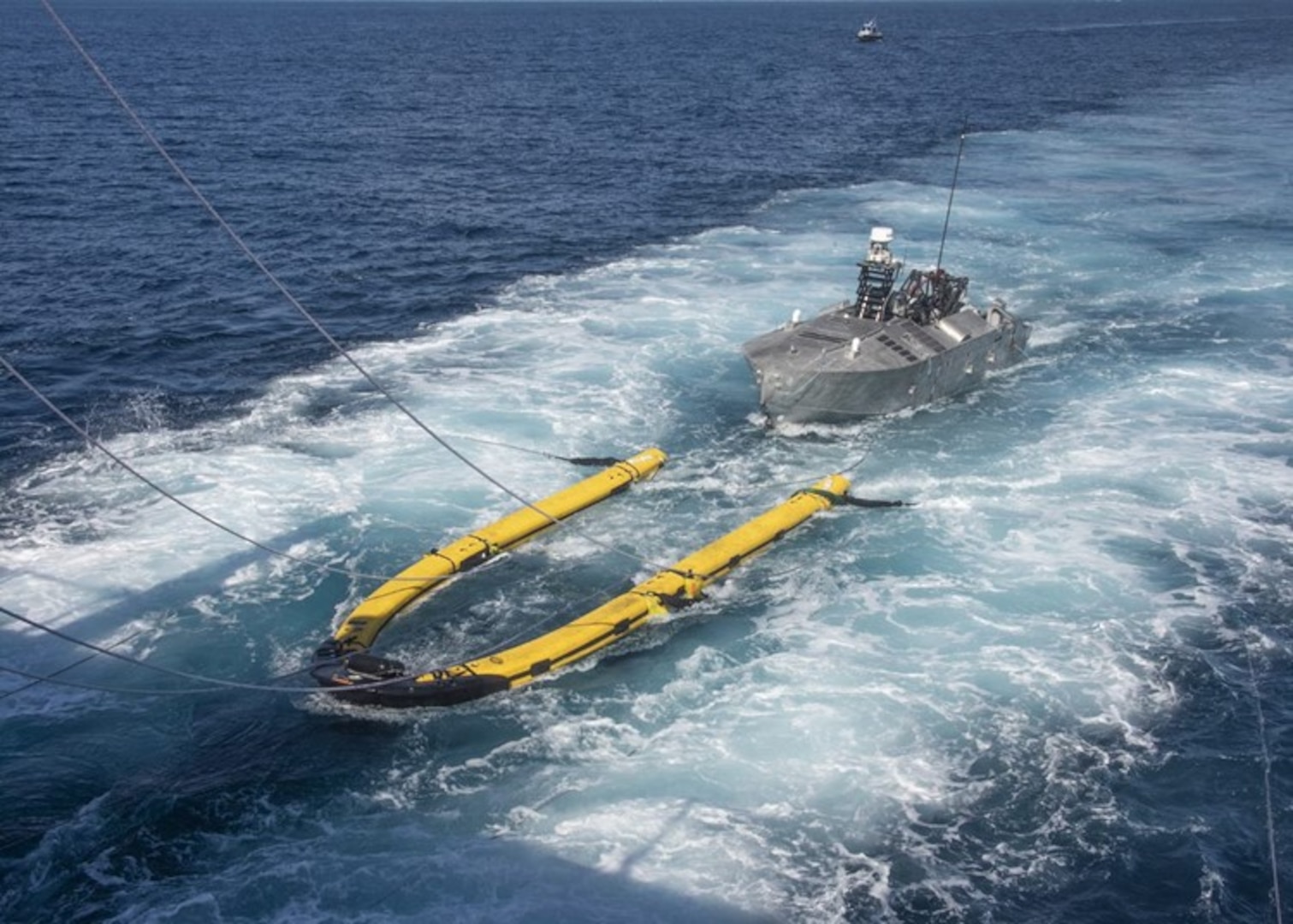
In June 2025, a Navy unmanned surface vessel being towed out of Coronado harbor received a stray command that turned its engine on mid-tow. It accelerated, circled the towboat, and flipped it. The captain went into the water and, per the Navy's own account, declined medical treatment. Nobody died. But the incident, caused by what the Navy called operator error during a routine handling operation, is a small, concrete reminder of something the industry doesn't advertise nearly as much as autonomous sensors or AI targeting: getting an uncrewed boat safely on and off a larger ship remains a genuinely dangerous, unsolved mechanical problem.
Fairbanks Morse Defense and its Norwegian subsidiary Vestdavit think they've built a fix. AutoHook is, at its core, a small robotic connector that finds a moving USV's lifting point in open water, aligns itself using onboard thrusters and a vision system, and clips on, all without anyone standing near the connection point doing it by hand. That's the part worth pausing on: right now, recovering most USVs from a moving mothership means either a crew member physically reaching for a hook, a diver going into the water to make the connection, or bulky cage and ramp systems that add weight and require redesigning the ship. Every one of those options puts a person near a suspended load, a moving hull, and unpredictable sea states at the exact moment things are most likely to go wrong, which is more or less what happened off Coronado, just without a human anywhere near the actual connection.
The mechanics described in Fairbanks Morse's own release are straightforward enough: during recovery, AutoHook activates its vision system as the USV approaches, tracks the moving lifting point, uses air thrusters to hold position over it while a wire lowers from the davit, engages, and confirms the connection to the operator, who then hoists the boat home. A separate stabilizing line from Vestdavit's existing Floating Catching Device helps keep the daughter craft from drifting during the approach. None of the individual pieces, vision tracking, thruster-assisted stationkeeping, remote connector confirmation, is exotic technology on its own. What's new is packaging them into something light enough to bolt onto a standard davit rather than requiring a purpose-built recovery system.
That "works with what ships already have" framing is probably the more important sales pitch than the automation itself. Retrofitting a stern ramp or a full cage-recovery system onto an existing hull is expensive and disruptive; adding a compact connector to a davit a ship already carries is not. For a Navy trying to scale up unmanned surface fleets across destroyers, littoral combat ships, and whatever comes out of the current small-USV procurement push, without redesigning every ship in the process, that's a meaningfully lower bar to clear.
The company says an industrialized prototype will run open-water trials from a naval vessel with professional crews sometime in the fourth quarter of this year, rated to handle sea states up to roughly 8-foot waves. Until that happens, this is a manufacturer's account of its own product, not an independently verified capability, and it's worth reading it that way. But the underlying problem it's aimed at is real and, as the Coronado incident shows, not purely theoretical: a drone boat that can operate itself perfectly for a thousand miles is still only as useful as the ten minutes it takes to safely get it back aboard.

No comments:
Post a Comment