
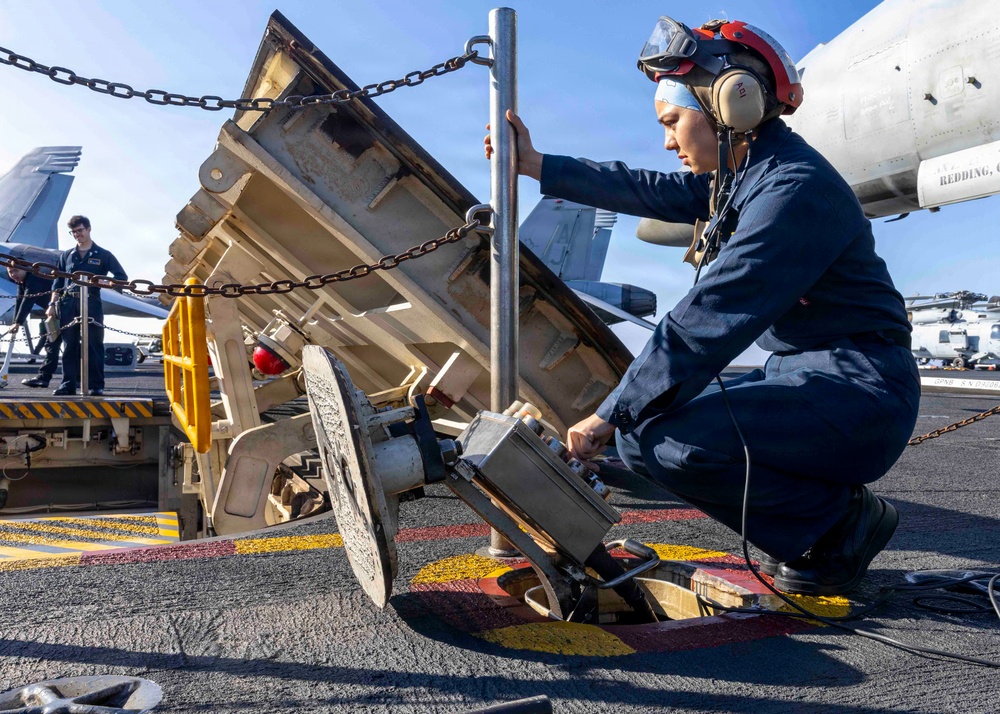
There's a specific number buried in a Navy acquisition report that explains a lot about why USS Gerald R. Ford's arresting gear has spent years generating headlines for the wrong reasons: the system installed aboard the ship runs a three-wire, three-engine configuration, but the operational reliability target the Navy originally set was built around a three-wire, four-engine design. The hardware simply wasn't built to the specification its own performance was being measured against. A fix, adding a fourth engine, is now scheduled to reach the carrier in fiscal year 2029, more than a decade after Ford entered service.
The Advanced Arresting Gear was meant to be a genuine improvement over the hydraulic system Nimitz-class carriers have used for decades, capable of recovering a wider range of aircraft weights and speeds while cutting down on maintenance. Instead it became one of the signature reliability problems of the entire Ford-class program's rocky early years. What's changed, according to an April 2026 Modernized Selected Acquisition Report the Pentagon has now released, is that the numbers have actually started moving in the right direction under real fleet conditions rather than just developmental testing. During the first six months of Ford's second operational deployment, AAG hit an instantaneous operational availability rate of 0.987, edging close to the 0.985 threshold that defines system maturity. During a four-day sortie generation demonstration with Carrier Air Wing Eight, the ship set a new single-day record of 134 aircraft recoveries in one cyclic period, averaging 19 combat-loaded sorties per cycle, with AAG posting a perfect 1.000 availability rate and zero operational mission failures.
Those are genuinely strong numbers for a system that spent its early years defined by underperformance. They're also, worth noting plainly, still short of the Navy's own cumulative reliability threshold, which the report confirms AAG hasn't yet met even as instantaneous performance has improved. The gap between "reached record performance during a good week" and "meets the reliability standard across its full service life" is exactly what the 2029 upgrade is meant to close.
What's actually planned for that upgrade is more than just bolting on a fourth engine. The Navy's report describes engine-room isolation changes, a Wire 2 backup barricade capability, and enhanced high-power fuse protection alongside the fourth-engine solution, changes the Navy estimates could more than triple system reliability compared to the current setup. A parallel software effort is targeting latency and unpredictable behavior in the system's control code, with installation timed to the same 2029 window. None of this is cosmetic; a single arresting-gear failure during high-tempo flight operations doesn't just ground one aircraft, it can back up the entire recovery cycle and choke off the sortie generation rate the whole carrier exists to produce.
The stakes get more concrete once F-35C integration is factored in. The Navy has been running compatibility testing for the stealth fighter on AAG since 2022, moving through deadload and then manned testing, with a formal Aircraft Recovery Bulletin expected in fiscal year 2027, two years before the reliability upgrade itself arrives. That sequencing means the Navy is set to clear the F-35C for AAG recovery on a system it already knows won't reach full designed reliability until two years later, a real if manageable risk given how central the F-35C is becoming to Ford-class air wings.
The price tag attached to all of this is its own story: $3.123 billion in total AAG acquisition spending, plus roughly $3.76 billion in operating and support costs projected across four ships and a 50-year service life. Forty separate obsolescence changes still need to be incorporated into production and retrofitted across Ford, Kennedy, and Enterprise just to keep the fleet on a common configuration. Ford's arresting gear is getting better. It's also a genuinely expensive, still-unfinished fix for a system that was supposed to have four engines from the start and has been quietly running on three the whole time.

No comments:
Post a Comment