
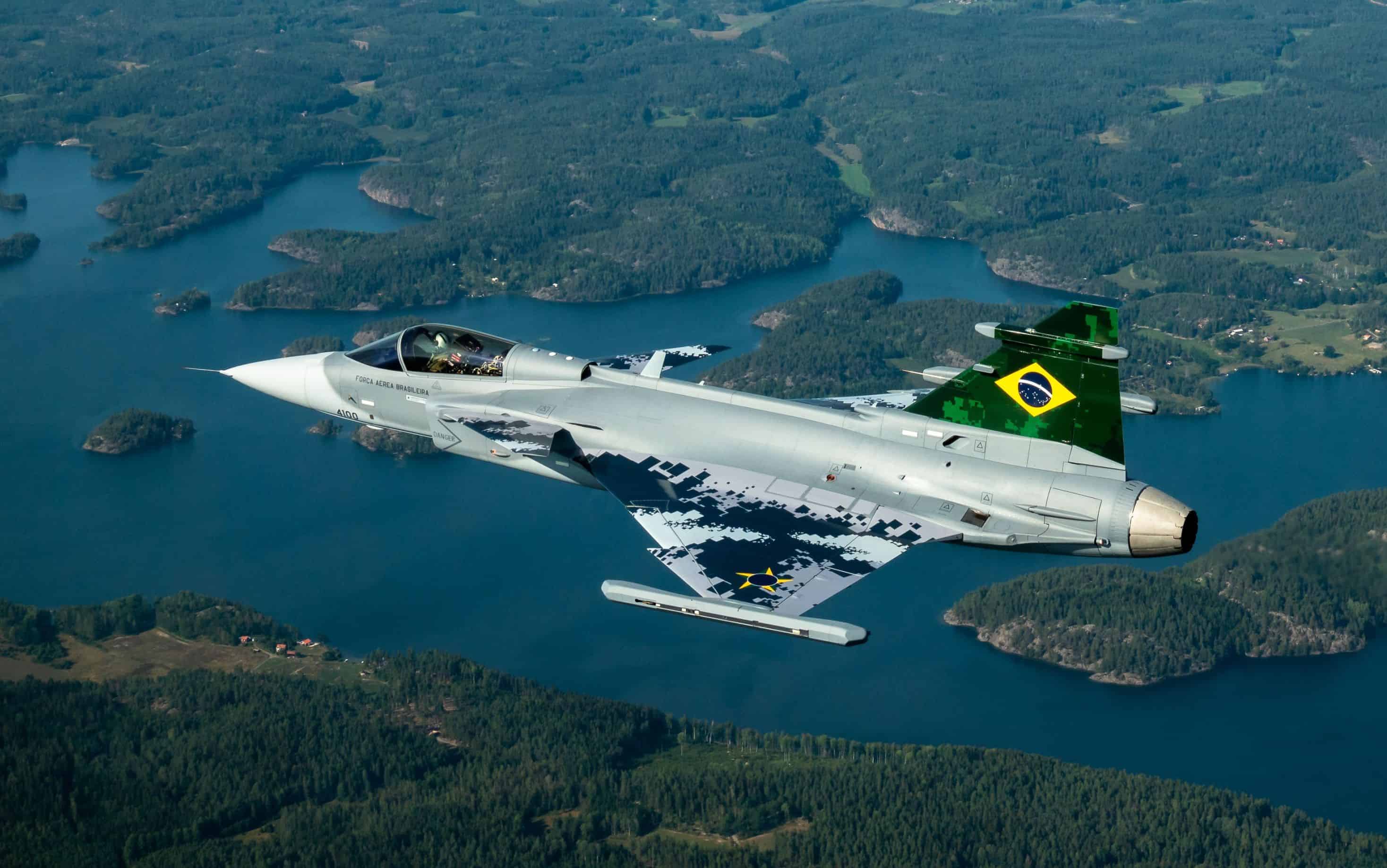
The official reason a second cockpit exists on Saab's new Gripen F is training. Convert new pilots faster, put an instructor behind them in a fully operational fighter, cut down the schedule needed to get someone combat-ready. That's what Saab says the aircraft is for, and it's true as far as it goes. It's also almost certainly not why the company is talking about this jet the way it is.
The aircraft flew for the first time on August 28, a 40-minute sortie out of Linköping with Saab's chief test pilot up front and Brazilian Air Force test pilot Lt. Col. Abdon de Rezende Vasconcelos in the rear seat, a detail Saab clearly wanted noted given how deeply Brazil is embedded in this program. Brazil signed on as the Gripen E's first customer back in 2014, ordering 36 aircraft, 28 single-seat E models and 8 of the twin-seat F, with a technology-transfer deal substantial enough that Embraer builds the jets locally and more than 350 Brazilian engineers, technicians, and pilots have cycled through the development and testing program. This isn't a customer taking delivery of someone else's design; Brazil helped build it.
What Saab's own statements make clear is that the rear seat isn't just for a trainee. In a genuinely difficult mission, one pilot alone is managing sensors, weapons, electronic warfare, and communications simultaneously, a cognitive load that gets worse exactly when things go wrong. A second crew member splits that workload, one person flying and fighting, the other running sensors, coordinating jamming, managing precision strikes, or simply keeping track of a chaotic battlespace while the pilot up front stays focused on the immediate fight. Saab is explicit that the Gripen F retains every piece of the single-seat E's mission system, AESA radar, beyond-visual-range missiles, full electronic warfare suite, so the second seat isn't a stripped-down trainer variant bolted onto a real fighter. It's the same fighter with a second brain added.
That second brain is where this actually gets interesting, and where the training story starts to look more like cover for the real pitch. Saab is already building the Autonomous Collaborative Platform, a stealthy, supersonic drone meant to fly as a companion to the Gripen E, and the company has openly described the rear-seat crew member as a natural operator for exactly that kind of loyal-wingman drone, commanding multiple ACPs for reconnaissance, jamming, target suppression, or acting as decoys, without forcing the front-seat pilot to fly the jet and run a drone swarm at the same time. Sweden's own defense minister has separately called a loyal-wingman drone a "natural further development" of the Gripen system. Put those two programs together and the Gripen F stops looking like a training jet with a bonus seat and starts looking like the crewed half of a manned-unmanned team Saab is building deliberately, piece by piece.
The timing helps explain why Saab wants that story told well beyond Brazil. After a decade-long drought following the original Brazil deal, the Gripen E/F has quietly picked up close to $10 billion in new orders in the past year alone, Thailand, Colombia, and, notably, Ukraine, which signed for 16 Gripen-Es in June with deliveries starting in 2029. Saab is also actively re-pitching the aircraft to Canada as Ottawa reconsiders its F-35A commitment amid tensions with Washington, while Portugal, the Philippines, and Peru have all expressed interest without formal talks yet. Every one of those conversations gets easier if Saab can point to a working demonstration of exactly the kind of manned-unmanned teaming every major air force is racing to field. A twin-seat trainer that happens to double as a drone-control platform is a considerably stronger sales pitch than a trainer alone, and it's hard to believe that's an accident.

No comments:
Post a Comment