
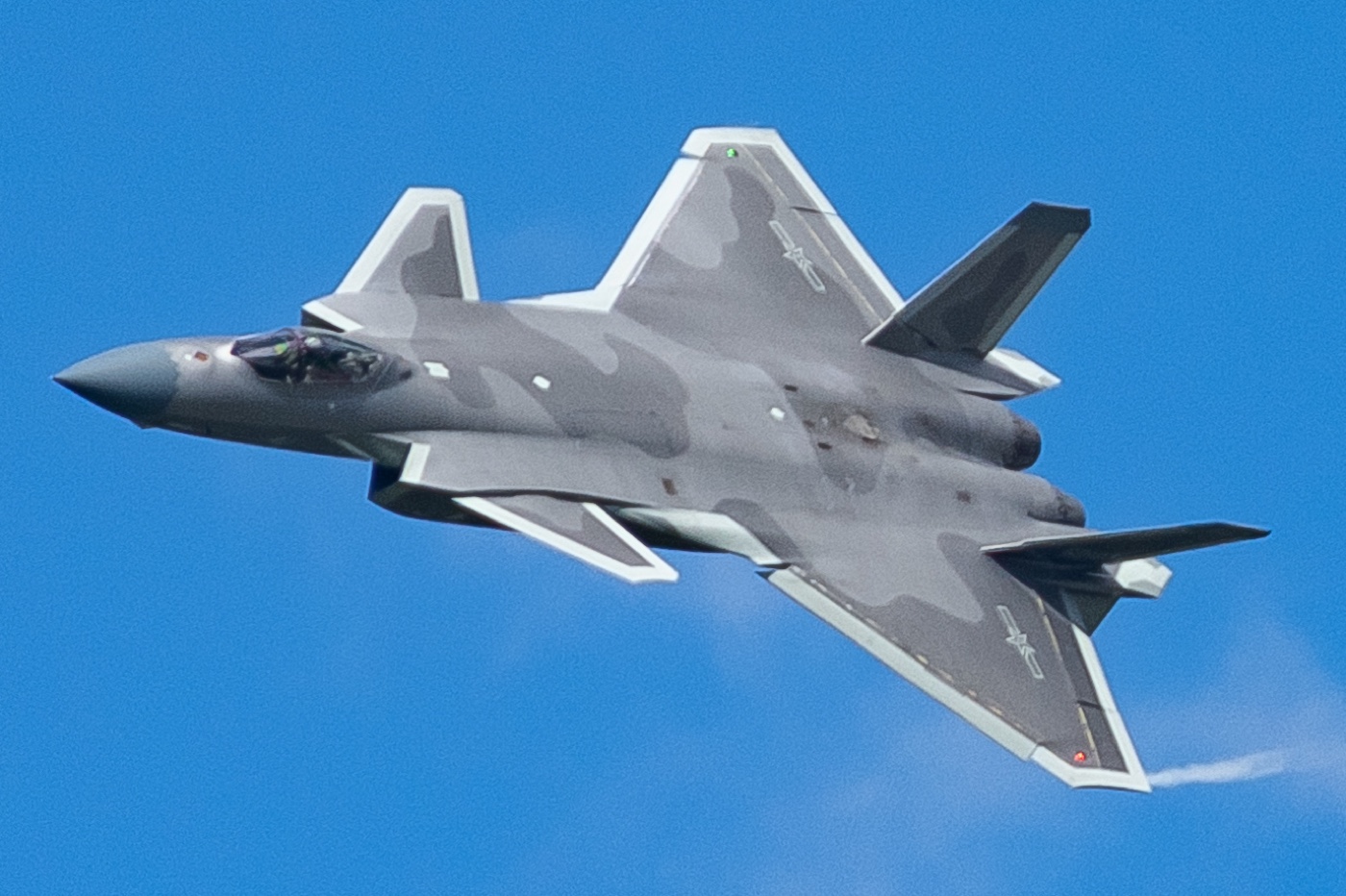
India has no fifth-generation fighter of its own and won't for at least five to ten years, according to retired Air Marshal Anil Chopra, writing for EurAsian Times. China already has an estimated 450 of them. Rather than wait, Chopra describes a quieter Indian Air Force project running in parallel to that gap: training pilots to find and shoot down a J-20 not through a stealthier jet of its own, but through sensors, radar wavelengths, and networking built specifically to expose what stealth is actually good at hiding from.
The physics behind that bet is worth laying out plainly. Chopra's own figures put the J-20's radar cross-section at roughly 0.1 square meters against the Rafale's 1.0, meaning a J-20 shows up on radar far later and at far shorter range than a conventional fighter, that's the whole point of stealth shaping. But stealth coatings and airframe geometry are optimized against the high-frequency X- and Ku-band radars carried aboard most fighters, not against longer-wavelength VHF radar, which scatters differently off a stealth aircraft's surface and can pick it up from angles the shaping wasn't designed to defeat. India's Surya VHF radar and its broader Mission Sudarshan Chakra network are built around exactly that gap, fusing longer-wavelength ground radars, passive and multi-static arrays, AEW&C aircraft, and space-based sensors into a single tracking picture that doesn't depend on any one radar catching the J-20 head-on.
Chopra frames the resulting doctrine carefully, and it's worth taking his framing at face value: the goal isn't a Rafale outdueling a J-20 one-on-one. It's using that fused sensor picture to detect, track, and fire on a J-20-class aircraft before it gets close enough to matter, then letting long-range surface-to-air systems like the S-400 or India's own developing Kusha system finish the job. If the aircraft never leaves the ground, even better, Chopra points to a BrahMos strike on the J-20's Hotan airbase as the more decisive option in his own accounting.
Where India apparently gets its practice against genuine fifth-generation performance is via a proxy: American F-35s, flown alongside IAF fighters in multinational drills like Pitch Black in Australia and Exercise Konkan, with US F-35s set to join India's own Tarang Shakti exercise at Jodhpur this September for the first time on Indian soil. That's the closest thing available to studying how a real stealth aircraft behaves without operating one, watching how late it appears on radar, how it manages its own emissions, how difficult it is to track from the front.
Chopra's piece sits alongside a separate story worth reading together: China's J-16 "Hidden Dragon" drilling for the first time against Egyptian Rafales, the same jet India flies and plans to buy 114 more of. He's dismissive of the wilder claims circulating from Chinese-aligned social media, a reported 7-1 J-16 win he calls "imaginative," and lays out a fairly detailed technical case for why the Rafale's smaller radar cross-section, more integrated SPECTRA electronic warfare suite, and the Meteor missile's unusually large no-escape zone should give it a real edge over the heavier, larger-radar J-16 in a genuine dogfight. That's his assessment as a decorated fighter test pilot with four decades in the IAF, not an independently verified outcome, and it's worth reading with the same caution due any single analyst's technical judgment, however credentialed.
What actually connects the two stories is less about who wins a hypothetical dogfight and more about what both air forces are really doing in Egypt and Jodhpur alike: neither China nor India is trying to settle a one-on-one matchup. Both are quietly building a picture of exactly how the other side's best aircraft behaves, long before either expects to actually need it.

No comments:
Post a Comment