
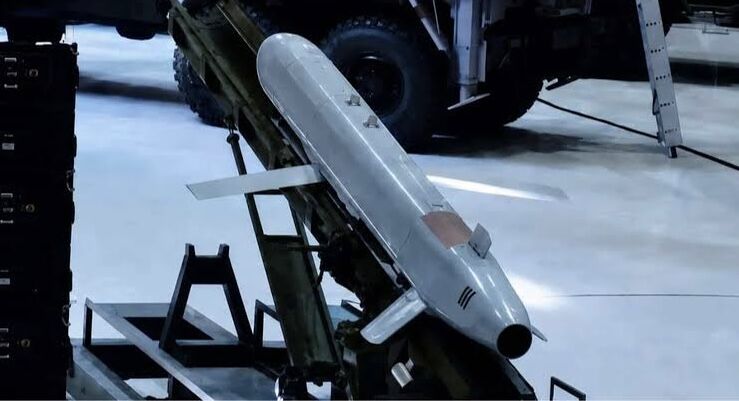
A Ukrainian official didn't mince words describing what's happened to the country's Black Sea shipping corridor this summer: the ports are "98% closed." The weapon doing most of that damage isn't a headline-grabbing hypersonic missile or a massed drone swarm. It's the S8000 Banderol, a small, jet-powered cruise missile that costs somewhere between $100,000 and $300,000 to build, and Russia is now producing around 80 of them a month with a stated target of 1,000 for the year.
The Banderol was built to fill a specific gap. Russia's Shahed-type drones are cheap but slow and relatively easy to track down; its Kh-101 cruise missiles are fast and precise but expensive. Developed by Kronstadt, the same company behind Russia's Orion reconnaissance drone, since 2021, the Banderol lands in between: 150-kilogram warhead, 350 to 500 kilometers of range depending on the source, and a cruise speed around 550-600 kilometers an hour, fast enough that Ukraine's fleet of interceptor drones simply can't catch it. Vladyslav Vlasiuk, Zelenskyy's sanctions-policy commissioner, told Bloomberg that roughly 80 percent of strikes on Greater Odesa's port infrastructure now come from this one missile.
The math behind that success is the real story. A Banderol costs a fraction of what Ukraine needs to shoot one down, and Ukraine simply doesn't have enough of the right interceptors to spare. Interceptor drones can't match its speed; dedicated anti-air missiles that could are in short supply. Russia doesn't need the Banderol to be sophisticated, it needs it to be cheap enough to fire constantly, and Ukrainian trackers describe the resulting pattern as missile "spam," a Banderol or two launched steadily throughout the day, sometimes mixed with Kh-59 cruise missiles or Geran drones, keeping air defense crews perpetually on edge rather than overwhelmed all at once.
Two details point to where this goes next. First, the targets are almost entirely static, port terminals, logistics hubs, grain and food warehouses, not military positions, meaning the campaign functions as economic warfare against Ukraine's export capacity as much as a battlefield weapon. More than 20 ships have reportedly been damaged in the strikes on Greater Odesa alone. Second, Ukrainian intelligence has spotted what looks like a mobile ground launcher for the Banderol, tested from occupied Crimea, a shift from its original air-only launch platforms, Orion drones and Mi-28 helicopters. Analysts covering the sighting are careful to note that photographs of hardware don't prove an operational system exists at scale, but if it does pan out, it would let Russia disperse Banderol launches across multiple sites rather than relying on a limited number of aircraft, stretching Ukrainian air defense even thinner.
There's an irony sitting inside the missile's own guidance system worth noting: Ukrainian investigators who examined recovered Banderol wreckage in 2025 found more than 20 components sourced from the US and other countries, the same pattern of sanctions leakage that keeps showing up in Russia's other precision-guided weapons. A missile designed to be cheap and disposable is still, underneath the cheap airframe, built partly from parts that were never supposed to reach a Russian production line at all.

No comments:
Post a Comment