
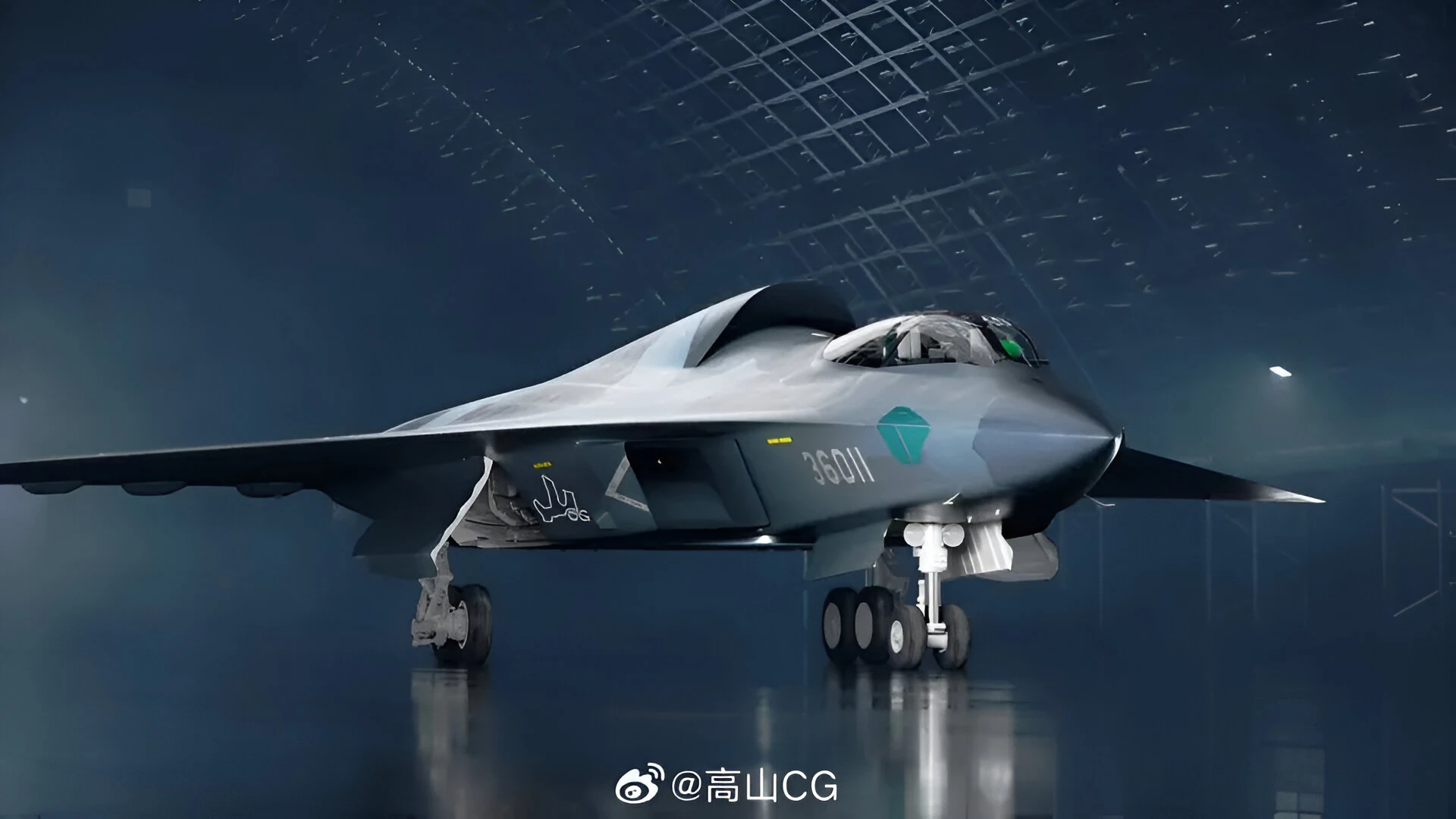
Two seconds of footage, tucked into the closing shot of a film marking ten years of the Y-20 transport's service, is what China chose to confirm its sixth-generation fighter can take fuel in the air. A tanker crewman is asked who he's refueling that sortie. "First the 'Master Six,'" he says, using the established nickname for the H-6 bomber, "then the 'Little Six.'" The camera cuts to a tailless jet sliding into position behind the YY-20 tanker. That's the entire disclosure: no specs, no schedule, no acknowledgment the aircraft even has an official name. Analysts have called it the Chengdu J-36 since prototypes first turned up over the city in December 2024, a designation assigned by outside observers, not Beijing.
The refueling detail matters more than the jet itself, and it's worth explaining why. A stealth aircraft's whole design logic is built around not being found, low radar cross-section, careful shaping, limited emissions. Refueling breaks all of that at once: two aircraft flying in tight, predictable formation for several minutes, radios and datalinks active to coordinate the approach, radar-reflective refueling gear extended, at a location and time an adversary who's tracking the tanker can potentially predict. For those few minutes, an aircraft built to be hard to find becomes, functionally, easy to find. That China is willing to show this in official media, rather than treat it as an operational vulnerability worth hiding, suggests either confidence that the tradeoff is worth it or a deliberate signal that the capability, and the range it buys, matters more than the exposure costs.
And the range is the point. China had barely any meaningful tanker fleet before the early 2020s, a handful of converted H-6 bombers each carrying under 30 tons of fuel. The YY-20, adapted from the same Y-20 transport airframe, changes that math substantially. Pairing it with a fighter believed to have a combat radius past 4,000 kilometers means Beijing isn't just building a fast, stealthy jet, it's building one that can loiter or strike deep into the Pacific and come home, the kind of endurance that starts to resemble a strategic bomber's reach more than a conventional fighter's. Military analyst Fu Qianshao made roughly that point to state media: an aircraft with a bomber's range flying fighter missions can run patrols "of strategic significance."
None of this settles how close the J-36 actually is to service. Five distinct prototypes have flown since December 2024, cycling through at least three configurations, changed intakes, altered exhaust, different landing gear, a pace of iteration that outside analysts have called unusually fast even while cautioning it reflects a methodical flight-test program rather than a finished aircraft. The U.S. Air Force's own read, delivered by then-Pacific Air Forces commander Gen. Kenneth Wilsbach, classifies both the J-36 and its carrier-oriented cousin, the Shenyang J-50, as genuine sixth-generation air superiority platforms, an assessment carrying real weight given how sparingly the Pentagon usually concedes ground on program timelines. Boeing's F-47, America's answer, hasn't flown yet.
What two seconds of tanker footage actually proves is narrower than the headlines around it: China has reached the stage of testing air-to-air refueling on this airframe. Everything past that, timeline to combat readiness, actual stealth performance, whether the exposure during refueling matters operationally, remains outside camera range.

No comments:
Post a Comment