
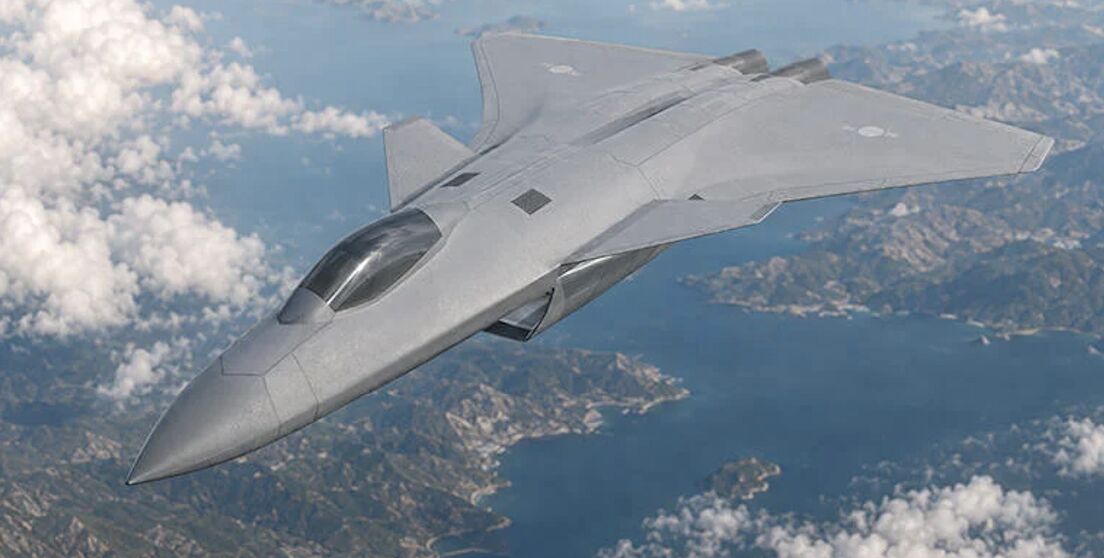
Nine hundred million won. That's the entire budget South Korea's Defense Acquisition Program Administration has set aside for its newly launched conceptual study of a next-generation fighter, roughly $650,000, less than what a single modern jet engine costs to overhaul. DAPA issued the request for proposal on August 21, giving industry 14 months to submit conceptual designs, technology roadmaps, and industrial plans for what would eventually become South Korea's answer to the sixth-generation programs now underway in the US, China, and Europe. The tiny price tag is the point: this is a paper study, not a prototype commitment, and bids aren't even due until October 1.
Two design threads are already circulating ahead of that deadline. DAPA's own RFP calls for both tailless and conventional layouts, twin adaptive-cycle engines capable of supersonic cruise, broadband stealth across the L, S, and X radar bands, and an internal weapons bay. Separately, and with no formal connection to DAPA's study, South Korea's Agency for Defense Development unveiled its own in-house concept at an aerospace conference in Daejeon on July 7: a single-seat, twin-engine, tailless design with a cranked delta wing, canted canard foreplanes, and flat exhaust nozzles. Korean outlets covering the reveal noted the ADD design skips vertical tail fins entirely, a configuration choice that could give it a genuine stealth edge over Europe's GCAP program, which keeps twin tails, while trading away some of the range and payload that a larger airframe like China's J-36 or America's F-47 can carry.
The honest read on scale: South Korea's concept is smaller than every other sixth-generation program currently flying or in serious development. That's a real trade-off, less fuel, fewer weapons stations, shorter legs, but it's also a deliberate one. A compact, tailless, twin-engine fighter is a cheaper aircraft to build and, if South Korea's defense-export record with the K2 tank and K9 howitzer is any guide, a more exportable one. Seoul isn't trying to match Chengdu or Lancashire on size; it's betting a smaller jet built faster and sold wider does more for its air force and its balance sheet than an oversized flagship program would.
What actually makes this credible rather than aspirational is the KF-21 sitting behind it. DAPA formally closed out KF-21 system development on July 29 after more than 1,600 flight tests, with first production aircraft due to the Republic of Korea Air Force later this year. Six prototypes have flown, including a two-seater, and the jet completed its first aerial refueling trial back in 2024, just eighteen months after its maiden flight. South Korea's own defense ministry has already said publicly that the KF-21 itself is meant to evolve toward fifth-generation stealth and eventually feed lessons into a genuine sixth-generation design, meaning this new concept study isn't starting from a blank sheet so much as asking what comes after a program that's already, by most measures, delivered.
The one place every outlet covering this study flags real uncertainty is propulsion. Building a domestic adaptive-cycle engine capable of supersonic cruise is a different order of difficulty than anything South Korea's aerospace industry has attempted before, and Hanwha's own engine work has so far been built on the KF-21's existing, less exotic powerplant. A $650,000 concept study won't answer that question. It exists to sketch what South Korea wants before anyone commits real money to finding out whether its industry can actually build it.

No comments:
Post a Comment