
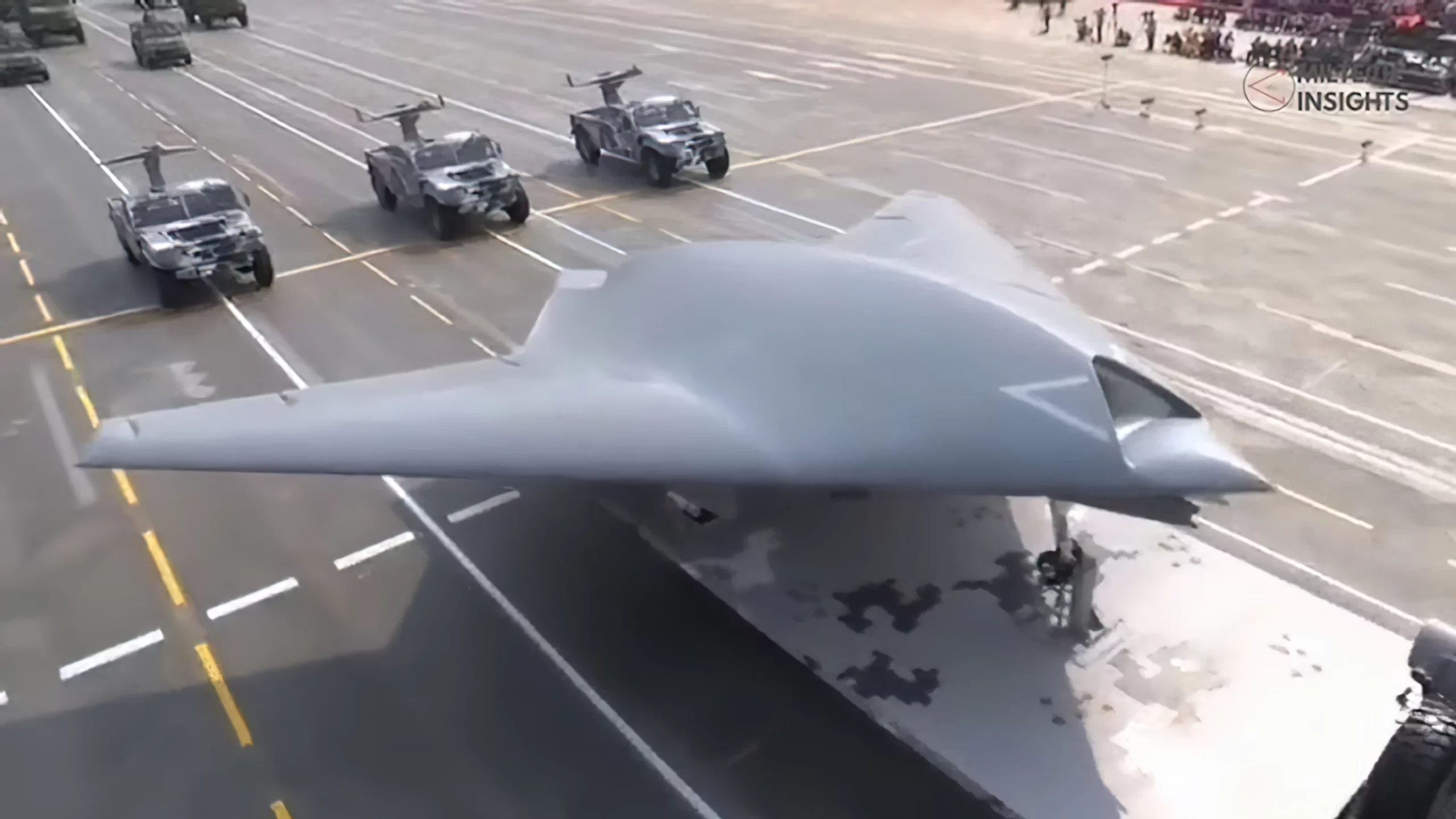
Chinese social media analysts reported this year that a naval variant of the GJ-11 "Sharp Sword" stealth drone, designated GJ-21, flew alongside J-15T and J-35 fighters from the carrier Fujian, part of an exercise apparently testing how manned fighters, the new drone, and KJ-600 early-warning aircraft coordinate together. If accurate, it would make China the first country to operate a stealth combat drone from a carrier deck, ahead of anything the US Navy currently fields. That's a genuinely significant claim. It's also, worth saying plainly, not yet independently confirmed by anyone outside Chinese state and enthusiast media.
What is solidly documented is the hardware itself. The GJ-11 first flew in 2013 and was publicly unveiled at China's 2019 military parade: a tailless flying-wing design, roughly 10 meters long with a 14-meter wingspan, S-shaped air intake and shielded exhaust to reduce its radar signature, painted the same light gray as China's crewed stealth fighters. It reappeared at the September 2025 Victory Day parade with a new detail, visible folding wing hinges, exactly the kind of modification a drone needs before it can fit on a carrier elevator or in a hangar bay. A November 2025 PLA Air Force promotional film showed it flying in formation with a J-20 and a J-16D electronic warfare jet for the first time, evidence the drone has reached at least some level of manned-unmanned operational integration, according to Chinese military commentator Song Zhongping.
The carrier infrastructure to actually operate it is real and observable too. Fujian, China's third carrier, uses an electromagnetic catapult system, only the third in the world after USS Gerald Ford, a launch method that matters here specifically because it can handle heavier, less robust airframes than the ski-jump decks on China's first two carriers. Sichuan, the Type 076 amphibious assault ship that completed sea trials and is expected in PLAN service this year, was apparently built around unmanned aircraft from the start: two aircraft lifts, an air wing expected to lean heavily on drones rather than crewed jets, and the same electromagnetic catapult technology. Satellite imagery has separately shown full-scale carrier test facilities in Wuhan and a site on Changxing Island, near where Sichuan was built, apparently used to rehearse deck handling for exactly this kind of aircraft.
Where the story gets softer is the specific claim that any of this is now "in service" in a meaningful operational sense. The reported Fujian flight comes from Chinese social media analysts interpreting posts, not an official PLAN announcement, and no outside government or independent defense analyst has verified it happened as described. China's own state media has been willing to showcase confirmed GJ-11 milestones plainly, the 2019 parade reveal, the 2025 folding-hinge display, the J-20 formation film, so the absence of an equally clear official statement about carrier operations is itself worth noting rather than assuming away.
The tactical logic behind wanting this capability is straightforward regardless of exactly when it's confirmed: a stealth drone that can extend a fighter's sensor range, absorb the first contact with enemy air defenses, or simply act as a decoy gives a carrier air wing options no manned-only force has. China would be moving here ahead of the US Navy, whose own X-47B carrier drone program proved the basic launch-and-recovery concept back in 2013 before the Navy shelved it in favor of the MQ-25 Stingray tanker drone, a considerably less ambitious mission set. Whether China has actually closed that gap operationally, or is simply further along in testing it than anyone outside the program can currently verify, is the honest state of what's known.

No comments:
Post a Comment