
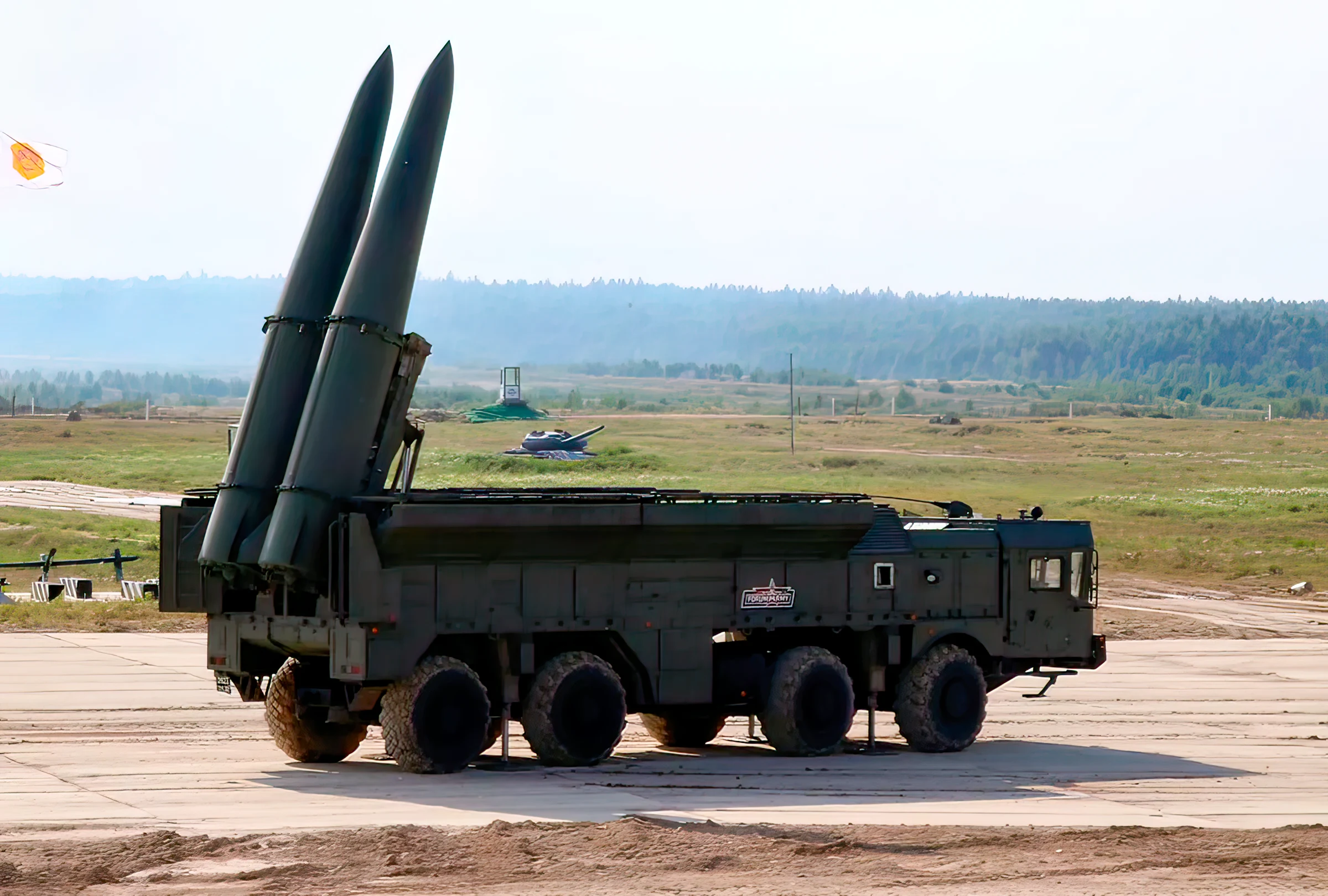
Ukraine's Defense Intelligence agency confirmed August 27 that Russia used an upgraded 9M723-2 ballistic missile, provisionally dubbed the Iskander-1000, against Kyiv during a combined strike this summer, the first confirmed combat employment of this specific variant. The name is misleading in a way worth clarifying immediately, HUR's own confirmed figures put the missile's actual operational range at 550 kilometers, a genuine 41 percent increase over the standard 9M723-1's 390 kilometers achieved primarily through a larger rocket motor and correspondingly enlarged launcher tube, not the 1,000-kilometer figure the informal nickname implies. Army Recognition's own technical analysis is careful to frame the 9M723-2 accurately as "a range-extension package built around an established missile" rather than an entirely new ballistic weapon, and Ukrainian aviation expert Kostiantyn Kryvolap's own assessment, that the upgraded variant's difficulty to intercept hasn't meaningfully changed from the baseline Iskander-M, is a useful corrective against treating this as a qualitatively new threat category.
The development timeline itself, worth noting against this blog's summer of skepticism toward Russian production and capability disclosures, is genuinely fast by any standard: Army Recognition's own research places roughly 27 months between the first visible indication of this extended-range configuration in May 2024 test-range materials and confirmed combat use in summer 2026, with only about a year between planned initial production of the first 18 identified units and actual battlefield employment. That's a considerably tighter development-to-deployment cycle than this blog's summer of coverage on comparable American and allied programs, NGSRI, GMLRS, AHEL, has generally documented, and it's worth registering honestly as a genuine Russian execution success even while treating the specific "1,000 km" branding with appropriate caution.
The detail that connects most directly to this blog's own research this month is buried in Defense News's own reporting on this same story, and it deserves to be the actual headline rather than a footnote: HUR simultaneously released a detailed production-network database for Russia's broader 9M723 Iskander-M missile family, documenting 140 identified components sourced from 35 companies and 108 officials, with only about one-quarter of those components actually manufactured in Russia. The rest comes overwhelmingly from foreign sources despite years of sanctions, 63 components from American manufacturers, eight each from Switzerland and Belarus, four each from Germany and Taiwan, three from China, and in one specific guidance-system unit processing laser-gyroscope flight data, just five of 43 components are Russian-made.
This is direct, independently sourced confirmation of exactly the sanctions-evasion pattern this blog documented through the NVIDIA Jetson Orin chip found inside Russia's S-71 missile wreckage, and through the broader NYT and Fletcher School research this blog cited showing more than 80 percent of Russia's wartime semiconductor purchases flowing through ordinary, largely unconcealed trade channels rather than sophisticated smuggling operations. Where that earlier coverage relied on a single recovered component and aggregate trade-flow statistics, this HUR database provides considerably more granular, weapon-system-specific evidence of the identical dynamic, a flagship Russian ballistic missile system, the one this blog's own Ukraine coverage has tracked hunting Patriot radars and striking Kyiv's power grid all summer, remains structurally dependent on American, German, and Taiwanese components four and a half years into a sanctions regime specifically designed to prevent exactly this dependency.
That dependency connects directly to the Russian cash crisis this blog covered just days earlier, a government cutting non-military spending by 35 percent specifically to sustain weapons production that, per this new HUR disclosure, still can't actually be sourced domestically at anything close to full self-sufficiency. Sustaining a missile program this dependent on foreign, sanctioned components isn't simply a rubles-and-manufacturing-capacity problem, it's a foreign-currency and international-trade-relationship problem layered on top of the fiscal strain this blog already documented, every guidance-system laser gyroscope requiring foreign parts is a foreign-currency expenditure a government facing a genuine liquidity crisis has to find room for regardless of how tight its own domestic budget has become. Whether the Iskander-1000's genuinely fast development timeline reflects Russian engineering competence or simply reveals how much of that competence still runs through components Washington's own export-control regime was supposed to keep out of exactly this kind of weapon is the question this HUR disclosure leaves for policymakers, not analysts, to actually answer.

No comments:
Post a Comment