
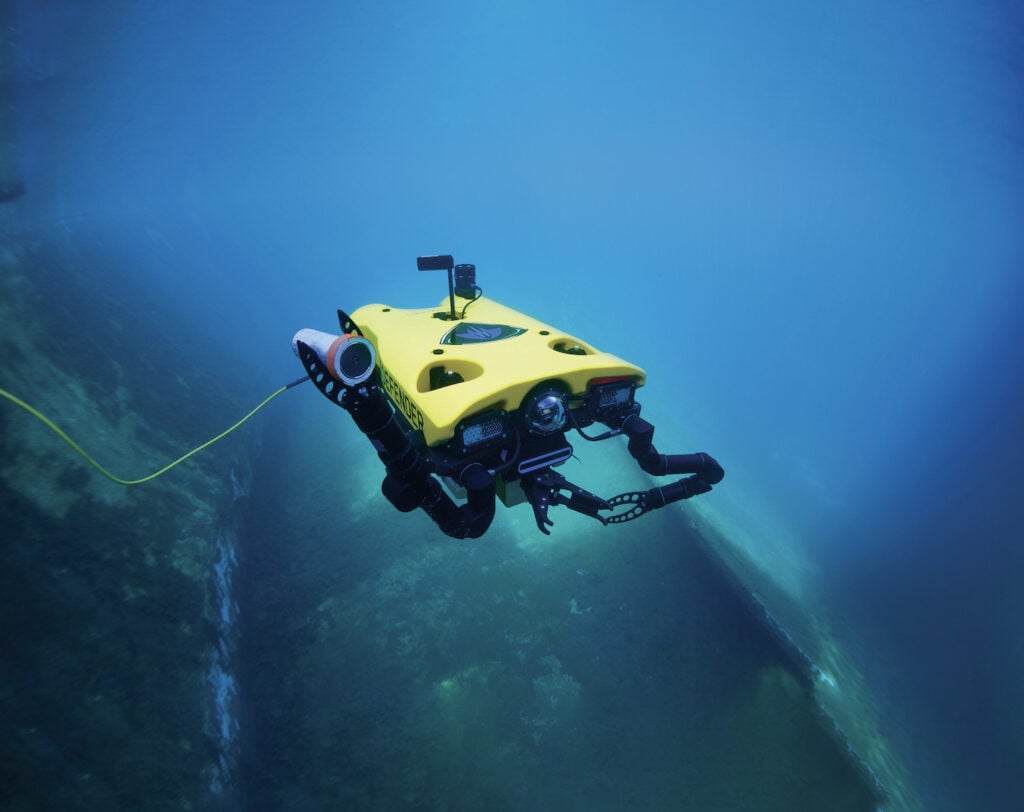
HAVELSAN unveiled AVISTA, a new self-funded underwater autonomy research project, at TEKNOFEST Blue Homeland 2026 in Gölcük, building on the company's existing SANCAR and RAFNAR unmanned marine vehicle programs. The project targets precise underwater positioning where GNSS signals don't reach, three-dimensional underwater mapping, hull inspection, and critical underwater infrastructure protection, developed on a six-degree-of-freedom remotely operated vehicle platform with software architecture explicitly built to be platform-independent, designed for eventual integration across different unmanned underwater vehicles and coordinated operation with HAVELSAN's own ADVENT Combat Management System.
The origin story HAVELSAN discloses in its own press release deserves more attention than a routine capability announcement would normally warrant: the company states AVISTA was initiated specifically in response to the high cost of underwater sensors and customs-related restrictions affecting procurement, aiming to develop cost-effective, readily available sensors rather than depending on foreign-sourced components. That's a direct acknowledgment of the same defense-supply-chain vulnerability this blog's coverage of Ghost Robotics' struggles against Chinese-dominated component sourcing already documented, just applied to underwater sensing hardware rather than robotics actuators, and it fits the broader import-substitution logic running through nearly every Turkish defense program this blog has covered this year.
This is now the fourth distinct Turkish unmanned maritime system this blog has documented in roughly a month, following MARLIN's mine-laying capability, TUFAN's kamikaze strike role, and FNSS's U-MAV amphibious assault platform. AVISTA extends that portfolio into underwater positioning and mapping infrastructure specifically, the sensing and navigation layer that platforms like ÇAKA, HAVELSAN's own submersible hybrid unmanned marine vehicle this reporting confirms AVISTA is meant to directly feed, would actually depend on to operate autonomously and covertly. Where MARLIN, TUFAN, and U-MAV represent the visible, weapon-carrying end of Turkey's unmanned maritime buildout, AVISTA represents the less glamorous but arguably more foundational underlying capability, the ability to navigate, map, and operate precisely underwater without relying on GPS signals an adversary might jam or deny.
That GNSS-denial framing connects directly to the Baltic spoofing research this blog cited through its Vaisala coverage, where independent Gdynia Maritime University and GPSPatron research documented sustained GPS spoofing and jamming attacks against shipping in contested waters near Kaliningrad. A system explicitly built to operate without GNSS access isn't solving a hypothetical problem, it's solving exactly the demonstrated vulnerability this blog's own research has already confirmed is an active, daily threat in contested European waters, extended here to the underwater domain where GPS signals don't naturally penetrate anyway, making genuinely autonomous underwater navigation without surface-relay dependency a considerably harder and more valuable problem to solve than surface-level GNSS resilience alone.
The dual military-civilian framing HAVELSAN emphasizes, underwater search and rescue, forensic investigation, port security, energy-facility inspection, alongside the explicitly stated anti-submarine, anti-surface, mine, and seabed warfare applications feeding into the ADVENT MÜREN combat management system, mirrors the same dual-use positioning this blog identified in Ocius's Bluebottle sonar contracts, technology marketed simultaneously for border-security and defense applications to maximize both domestic budget access and eventual export appeal. With sea trials planned imminently and an operational-readiness target of 2027, AVISTA is still firmly in the early R&D category this blog's summer of coverage has learned to treat with real caution before assuming rapid fielding, but the underlying strategic logic, building indigenous underwater sensing capability specifically to reduce dependence on cost-prohibitive or export-restricted foreign components, is a coherent and increasingly familiar entry in the same self-sufficiency throughline running through nearly every Turkish defense-industrial story this blog has covered this year.

No comments:
Post a Comment