
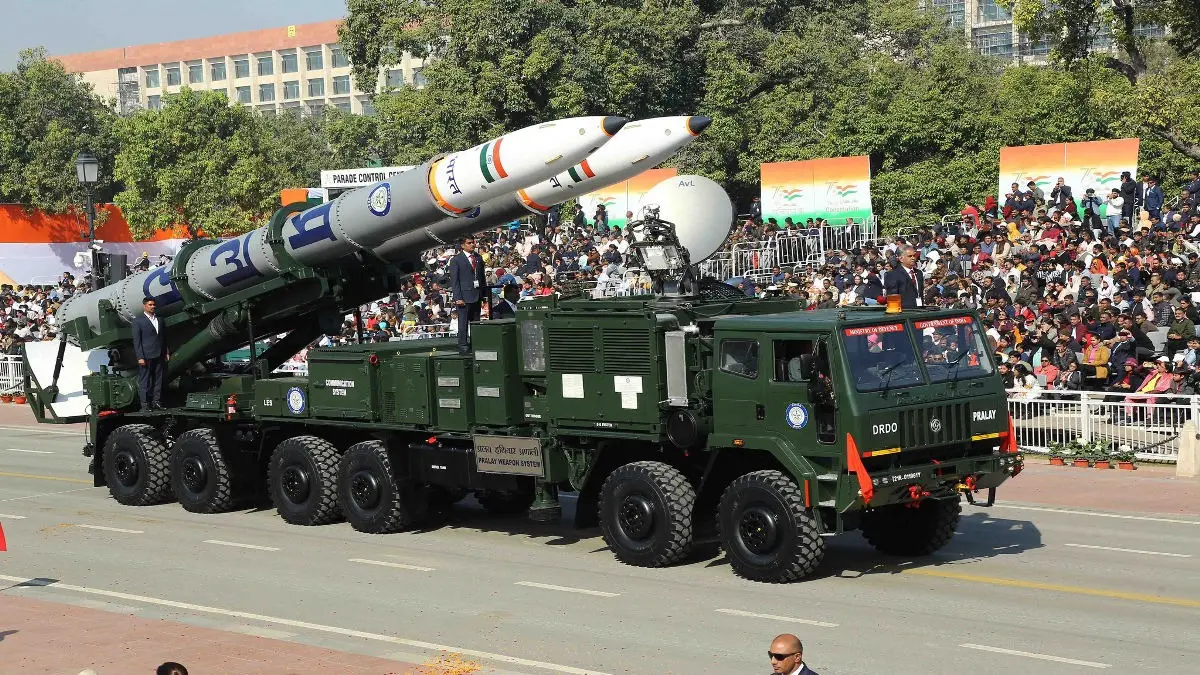
India's Ministry of Defence approved the transfer of DRDO-developed technology for all conventional missile systems to private industry, ending decades of production concentrated in a small number of state-owned agencies. Defence Minister Rajnath Singh's own framing is direct about the motivating fear: shortages of U.S.-made Patriot interceptors straining Ukraine's air defenses and worrying American allies in the Middle East, this blog's own extensively documented interceptor-scarcity throughline, have made clear to Indian planners that a narrow, state-monopolized industrial base cannot rapidly replenish missile stockpiles during a sustained conflict. Bharat Dynamics Limited's own production numbers illustrate exactly why: the Pralay quasi-ballistic missile, capped at just 40 units annually under BDL's sole production, is being scaled to 150-250 units through four parallel assembly lines once Adani Defence, Bharat Forge, and Solar Defence come online alongside it, a six-fold capacity increase from ending a single company's manufacturing monopoly.
This connects directly to the institutional pattern this blog has traced through DRDO's own radar and engine programs all summer. This blog's engagement with Air Marshal Thakur's Virupaksha radar analysis established a fourteen-year Uttam-derived maturation curve; this blog's coverage of the AMCA engine race documented India's outreach to France and the Rolls-Royce-Safran competition specifically because domestic engine development couldn't keep pace with operational timelines. Both of those earlier stories concerned technology development speed, DRDO taking too long to actually build something new. This missile-privatization story reveals the parallel manufacturing-scale problem, DRDO's technology existing and working, but production bottlenecked by a state-owned industrial base too narrow to build it fast enough once developed. Together, the three stories this blog has now covered describe a single Indian defense-industrial institution struggling with both halves of the problem, innovation speed and production scale, simultaneously.
The specific systems being opened, the Long Range Land Attack Cruise Missile at 1,000-1,500 kilometers and the Pralay tactical missile, connect directly to the squadron and fleet-readiness crisis this blog's AMCA coverage already flagged, India's Air Force operating just 29 squadrons against a sanctioned strength of 42.5. A private-sector-scaled missile production base doesn't solve a fighter-squadron shortfall directly, but it does address the parallel readiness gap this blog's Uzbekistan MiG-29 coverage identified as a genuine crisis pattern, a state finding its existing platforms and munitions insufficient for its actual strategic posture, and choosing rapid industrial reform over continued reliance on institutions that have already demonstrated they can't scale on their own. The explicit exclusion of strategic systems, Agni, BrahMos, and the K-series submarine-launched missiles, from this privatization is a sensible boundary, keeping India's nuclear-capable deterrent under direct state control while opening the conventional systems where production volume, not strategic sensitivity, has been the actual constraint.
The export dimension this blog's research surfaced deserves attention as a genuinely different angle than the domestic-readiness framing alone suggests. India's defense exports grew from just $72 million in 2014-15 to $4 billion in 2025-26, and the government's own stated target of ₹50,000 crore in exports by FY 2028-29 treats missile-manufacturing capacity as a genuine commercial opportunity, not simply a domestic-security fix. That connects to this blog's coverage of Turkey's own defense-export dominance through Baykar, and China's J-10C export struggles, a reminder that expanding a country's missile-industrial base serves a dual purpose this blog has now documented across multiple nations this year, meeting domestic readiness needs while positioning for a global arms market this blog's own coverage suggests is expanding rapidly across nearly every conflict-adjacent region simultaneously.
None of this guarantees smooth execution, and this blog's summer of coverage on comparably ambitious Indian defense reforms, the AMCA engine race and Virupaksha radar timeline chief among them, counsels genuine caution before assuming private-sector missile manufacturing scales as cleanly as the government's own six-fold Pralay production target implies. Qualification, certification, and regulatory requirements for new private entrants take real time to establish, and this blog's own research found no confirmation of specific delivery timelines beyond the stated production-capacity targets. But ending a state monopoly that had visibly bottlenecked missile output at a fraction of what India's own armed forces are ordering is a genuinely different, more structurally sound response than simply requesting more funding for the same institutions, and it's worth reading as India applying a lesson this blog's own coverage of interceptor scarcity in Ukraine and the Middle East has spent all summer demonstrating in real time.

No comments:
Post a Comment