
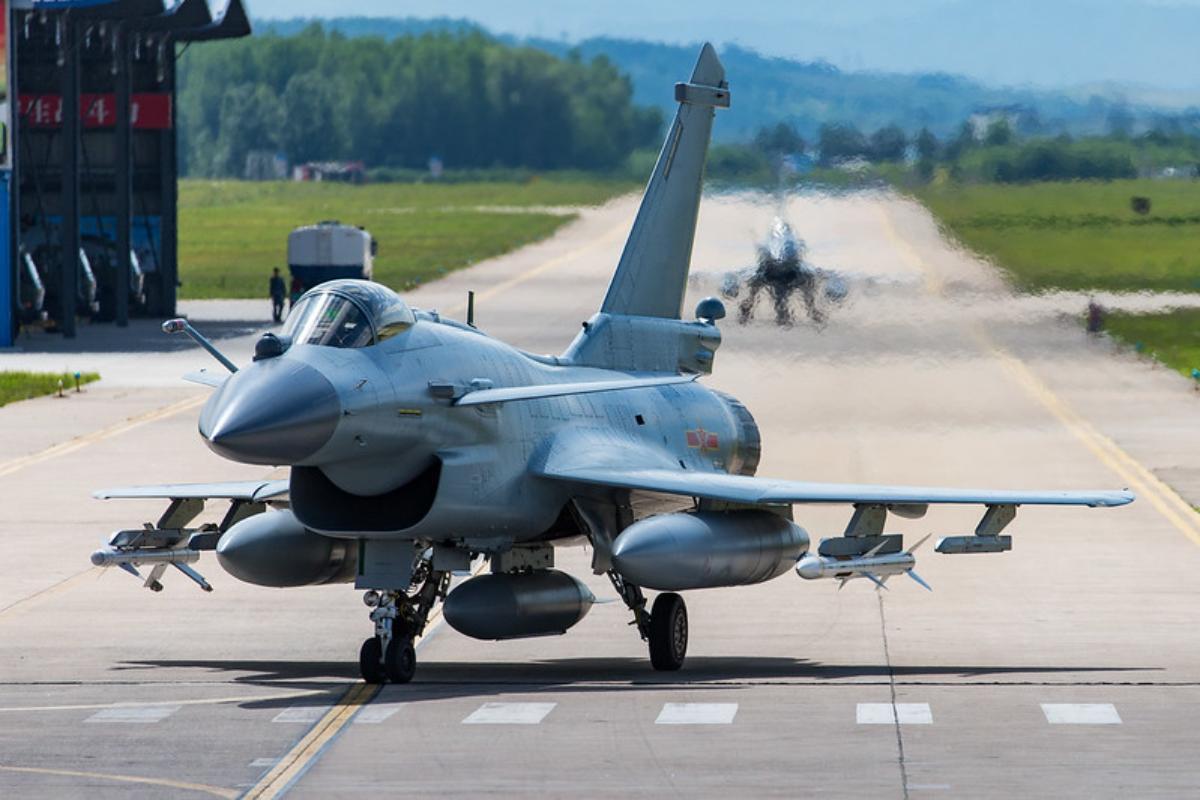
Bangladesh's government has advanced talks to acquire 20-24 Chinese J-10CE fighter jets, with Air Force officials citing Pakistan's own combat claims from its May 2025 clash with India as a factor in Dhaka's decision, according to a Bangladeshi minister quoted in this reporting. The numbers disclosed so far are substantial, roughly $1.2 billion for the airframes alone, up to $2.2 billion for the complete package including weapons, spares, and training, with payments reportedly spread across ten fiscal years through 2035-36. An 11-member inter-ministerial committee, chaired by the Air Force chief, has been negotiating the contract and evaluating the government-to-government procurement process since Bangladesh's former Prime Adviser Muhammad Yunus visited Beijing in March 2025.
This connects directly to the J-10C export struggle this blog has documented extensively all summer, and it would represent a genuinely significant breakthrough in a pattern this blog has repeatedly found frustrating China's marketing ambitions. This blog's coverage of China's aggressive J-10C showcasing, in Thailand, the UAE, and now twice against Egyptian Rafales, established a consistent theme: Beijing has spent well over a year generating combat-adjacent visibility for the aircraft while converting that visibility into actual signed contracts at a pace this blog characterized as strikingly slow, Pakistan remaining the sole confirmed operator despite years of marketing effort. This reporting's own list of countries that evaluated and ultimately passed on the J-10C, Brazil, Egypt, Indonesia, Colombia, and Iran, reads as direct confirmation of exactly that pattern. A completed Bangladesh deal would be China's actual second confirmed export customer, a genuinely different milestone than another showcase exercise or preliminary negotiation.
The specific justification Bangladeshi officials cited, Pakistan's own combat claims from the May 2025 conflict, rests on firmer ground than this blog's earlier coverage sometimes credited. A senior French intelligence official told CNN within days of the clash that Pakistan had downed at least one Indian Rafale, and French Air Force Chief Gen. Jérôme Bellanger later told reporters he had seen evidence pointing to three Indian aircraft losses, a Rafale, a Su-30, and a Mirage 2000, reporting independently carried by the Associated Press and Al Jazeera rather than sourced only to Pakistani or Chinese outlets. India's government has still not issued an official confirmation naming the Rafale specifically, and Pakistan's own claim of three Rafales lost doesn't fully match Bellanger's account of one, so real gaps remain in the public record. But this is no longer a case of dueling, unverifiable national claims with nothing independent to weigh, it's a case where the aircraft's own manufacturer country has, through named senior officers, lent real credibility to at least part of Pakistan's account. That matters for reading Dhaka's decision: Bangladesh isn't simply taking Islamabad's word for what happened, it's citing an outcome that a French general said he'd seen evidence for.
The encirclement framing this reporting builds toward connects directly to this blog's Mecca Pact coverage from earlier this summer. That pact, formalizing collective defense among Pakistan, Saudi Arabia, and Turkey, already gave this blog's coverage a clear throughline on China and Pakistan's efforts to build regional coalitions India would find genuinely destabilizing. Bangladesh's own reported interest in joining that same pact, combined with its existing Bayraktar TB2 deployment near the Indian border and now potential J-10CE acquisition, would place a Chinese-armed, Turkish-drone-equipped, Pakistan-aligned military directly along India's longest land border, 4,096 kilometers, a considerably more consequential strategic picture than any single fighter jet contract on its own. This blog's own SIPRI-sourced research confirms the underlying trend line, China already supplies 72 percent of Bangladesh's major arms imports and accounts for more than two-thirds of its total military inventory, meaning a J-10CE purchase would deepen an already-dominant relationship rather than establish a new one.
None of this confirms the deal actually closes, Bangladesh has previously signed a Letter of Intent with Eurofighter and initially explored the French Rafale, and this reporting itself notes the J-10CE joining a "long list of countries" that evaluated the aircraft without necessarily buying it. But the specific combination here, price advantage roughly half the Rafale or Eurofighter's cost, an already-dominant Chinese arms relationship, and a regional combat narrative China didn't even need to manufacture itself, is a genuinely stronger case than China has managed to build with any other prospective customer this blog has tracked this year, and if it converts into a signed contract, it would finally give Beijing the second export customer its marketing campaign has been chasing since well before this blog started documenting the pattern.

No comments:
Post a Comment