
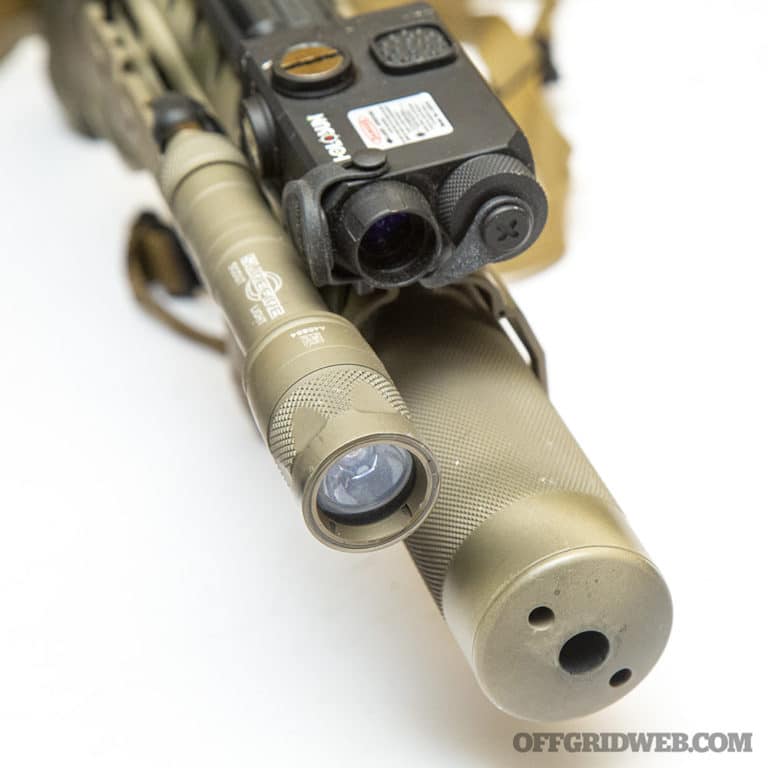
The Marine Corps began fielding its new Squad Aiming Laser to students at School of Infantry-East at Camp Lejeune this summer, replacing the PEQ-16 system that's served infantry units for nearly three decades. Program officer Harry Mandeles' framing was direct about the practical improvement, "significantly less eye strain and a much clearer target picture" through night vision goggles compared to the legacy system, driven by a Vertical-Cavity Surface-Emitting Laser producing a cleaner, more uniform beam than older laser technology. The system covers the M27 Infantry Automatic Rifle, M4A1 assault rifle, M240B medium machine gun, sniper rifles, and next-generation squad weapons, weighs under 10.5 ounces, and Marine Corps Systems Command awarded the underlying $249 million contract to Envision Technology, a Roanoke, Virginia-based small business.
This is a genuinely more modest story than most of what this blog has covered this summer, no interceptor crisis, no contested-theater signaling, no billion-dollar production controversy, and it's worth being honest about that scale difference rather than manufacturing false significance. What it does offer, though, is a useful data point on program execution this blog's summer of coverage on stalled and troubled procurement, GMLRS's failed components facility, AHEL's outright cancellation, NGSRI's hedged production ramp, would recognize as a genuine positive: PM GWS's own account credits SOCOM's Small Business Innovation Research pipeline and small-business agility with moving SAL "from a stated requirement to a major contract award with remarkable speed," fielding to actual infantry training units within the same general timeframe this blog has documented considerably more ambitious programs still struggling to clear.
The tactical rationale, reduced weight improving the M27's balance during high-tempo operations, better beam quality extending effective engagement range under night vision, connects to a smaller-scale version of the same night-fighting and detection throughline this blog traced through the Air Force's target-drone RFI, where the underlying theme was American forces training and equipping against increasingly demanding threat profiles. A cleaner, lower-strain aiming system for the individual Marine riflemen who'd actually be operating in exactly the low-light, high-tempo engagement conditions this blog's broader coverage of contested Indo-Pacific and European theaters has documented all year is a genuinely sensible, if unglamorous, piece of that same broader readiness picture.
There's little more to add here without inflating a routine, competently executed infantry-equipment upgrade into something it isn't. The Squad Aiming Laser replaces aging technology with a real, disclosed performance improvement, was fielded on a timeline this blog's summer of procurement coverage would call genuinely fast, and involved a small business contractor winning a meaningful award through an established innovation pipeline rather than a legacy prime. That's worth noting as one small counterpoint to the execution-risk pattern running through so much of this blog's coverage this year, even if it doesn't carry the same strategic weight as this blog's interceptor-scarcity, Pacific carrier-gap, or Baltic-signaling throughlines.

No comments:
Post a Comment