
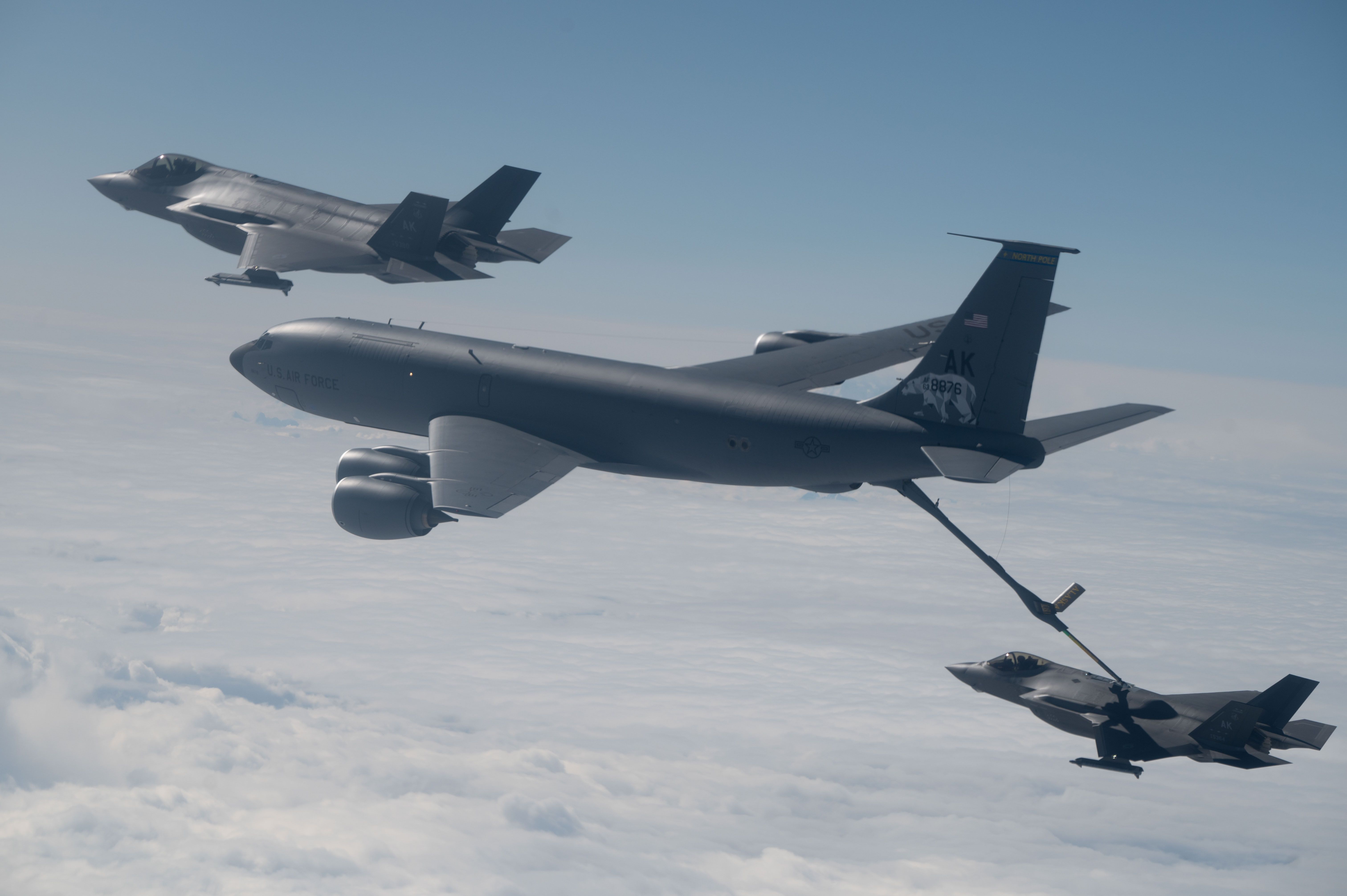
Bloomberg reporting cited by EurAsian Times describes China developing hypersonic glide vehicles capable of launching air-to-air weapons against high-value targets, tankers, AWACS, and electronic-warfare aircraft, thousands of miles away, potentially making the U.S. Air Force's entire stealth fighter fleet operationally moot across the Pacific theater without ever needing to defeat a single F-22 or F-35 directly. The mechanism is straightforward once stated: American stealth fighters have combat radii of roughly 590-600 nautical miles unrefueled, while Guam sits some 1,900 miles from mainland China, meaning the entire stealth fleet's Pacific relevance depends completely on a tanker force that is itself large, slow, unstealthy, and, per this report, potentially now within range of a weapon category no other country is confirmed to operate.
This is precisely the inverse framing of the AIM-174B and AIM-424 Malice story this blog covered in detail, where the strategic insight was that American missiles prioritize destroying China's own KJ-500 AWACS and support infrastructure over dogfighting individual fighters, because degrading an adversary's broader kill-chain matters more than winning any single engagement. China's HGV-launched tanker-hunting concept applies the identical logic in reverse, and reading both stories together confirms something neither fully established alone: both air forces have independently concluded that support aircraft, not fighters, are the actual center of gravity in a contested Pacific fight, and both are racing to build the specific long-range weapon that can reach those support aircraft before the other side's stealth or maneuverability advantage even becomes relevant.
The EurAsian Times piece deserves genuine credit for the caution it builds in explicitly, an unnamed IAF expert's on-record skepticism that "an unverified leap from a 2021 test projectile to an operational, Guam-range tanker-killer is still a claim, not a confirmed capability," is exactly the kind of hedging this blog has applied consistently to Chinese capability claims all summer, the JY-27V's real combat failure, the AI infrared seeker's quietly discounted accuracy figure, the mirror-coating J-35 photos most likely explained by sunlight. This specific claim traces back to unnamed sources in a single Bloomberg report rather than confirmed Chinese state disclosure, and it deserves that same structural caution rather than acceptance at face value, regardless of how coherent the underlying strategic logic sounds.
What doesn't require any speculative capability to validate, though, is the tactic's real-world precedent, and this is where the piece's own reporting connects directly to a story this blog covered through an entirely different lens. This blog's coverage of Zaluzhnyi's warning about NATO's outdated doctrine cited RealClearDefense's account of the March 2026 Iranian strike on Prince Sultan Air Base, which damaged a high-value E-3 Sentry AWACS aircraft and multiple refueling tankers using coordinated missile and drone strikes, exactly the class of target this new China reporting describes HGVs eventually threatening at far greater range. The EurAsian Times piece adds a second, independently sourced confirmation this blog hadn't previously documented, an Iranian-aligned Iraqi militia claiming separate SAM attacks on USAF KC-135s over Iraq, and Iran directly damaging at least five parked KC-135s at Prince Sultan. Tanker-hunting isn't a hypothetical Chinese innovation, it's an already-demonstrated tactic this blog's own Iran-war coverage has touched on repeatedly without ever naming the tanker fleet specifically as the common target.
The stark tanker-fleet imbalance this reporting quantifies, America's 610 active tankers against China's nine, is worth setting against this blog's own coverage of America's broader Pacific readiness strain, the carrier gap, the submarine maintenance backlog, USS Lincoln's extended deployment. A force this numerically dominant in exactly the enabling capability this article identifies as the actual chokepoint should represent genuine American strength, but the same numerical dominance also means America's tanker fleet is the larger, more numerous, harder-to-fully-disperse target, precisely the vulnerability an adversary investing in long-range, support-aircraft-hunting weapons would be rationally incentivized to exploit rather than trying to match stealth-fighter-for-stealth-fighter. Whether China's HGV claim holds up to independent verification or not, the underlying strategic problem it's describing, American airpower's dependence on a numerous but fundamentally vulnerable tanker fleet, is real regardless of which specific weapon eventually gets built to threaten it.

No comments:
Post a Comment