
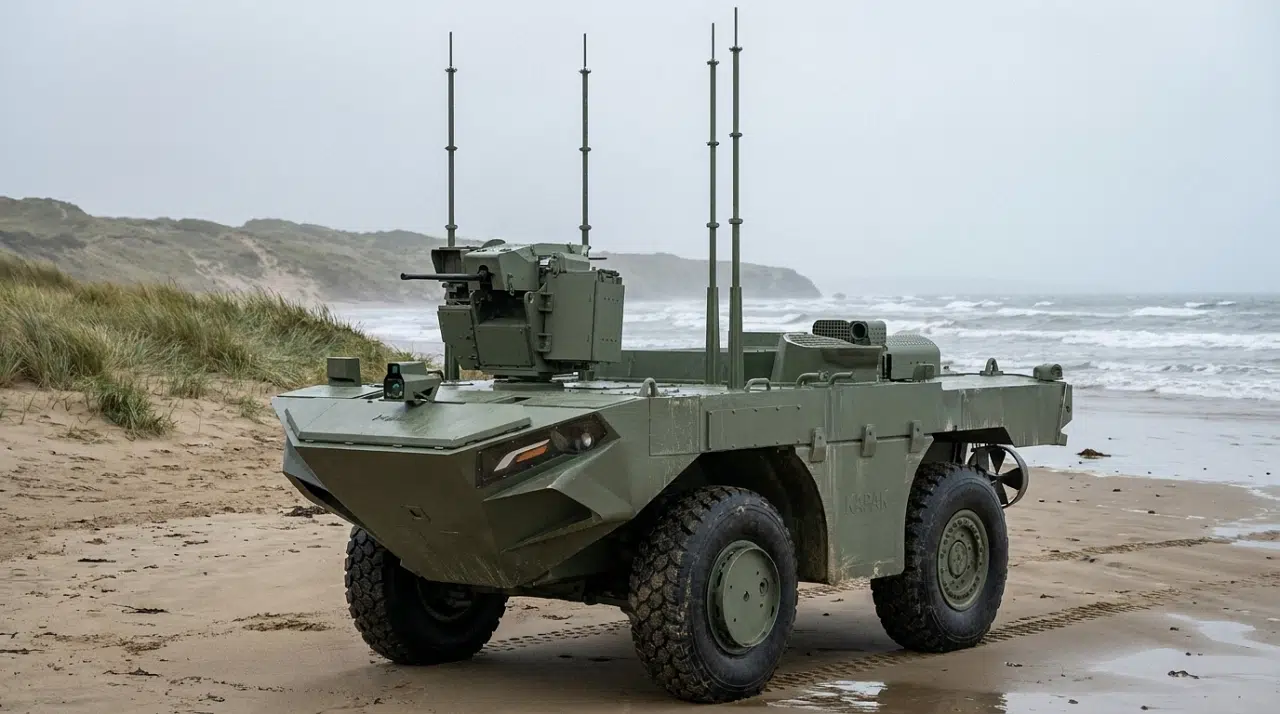
FNSS unveiled U-MAV, also designated ZAHA, at the same TEKNOFEST Mavi Vatan 2026 event this blog's coverage of Turkey's TUFAN kamikaze USV already documented days earlier. The 8-tonne unmanned amphibious vehicle is built to operate ahead of Turkey's existing crewed MAV/ZAHA amphibious assault vehicles, making first contact with beach defenses, clearing mines and obstacles, and preparing the shore for the manned wave that follows, all while keeping operators safely aboard ship. It swims at 7 knots and drives at 70 km/h ashore, swaps between ten distinct mission modules, fire support, mine clearance, electronic warfare, casualty evacuation among them, in roughly 40 minutes, and carries a genuinely novel damage-assessment feature, Nurol Teknoloji's Armor Integrity system, which replaces the human judgment call a crewed vehicle's occupants would normally make about whether to keep fighting after taking a hit.
FNSS CEO Selim Baybaş's framing of the underlying problem is worth quoting directly, since it names exactly the tactical reality this vehicle exists to change: "every second the first assault wave is delayed favours the defender," and the critical interval between an assault force coming within range and crossing the waterline is "decisive for the entire operation." That's the textbook amphibious-assault problem, and U-MAV's answer, removing crews from the highest-casualty-risk phase entirely, connects to this blog's coverage of the U.S. Marine Corps's own Ancillary Surface Craft prototype from just one day earlier. Both programs are responding to the identical structural vulnerability, contested amphibious operations exposing personnel during the most dangerous phase of a landing, but they're solving it through genuinely different mechanisms: the ASC removes the port and pier dependency for sustainment after a landing is established, while U-MAV removes the crew entirely from the actual assault phase itself. Read together, they represent complementary rather than competing answers to the same broader amphibious-warfare problem this blog's Balikatan and Luzon Strait coverage has already flagged as increasingly central to Pacific contingency planning.
The modular, field-swappable mission architecture extends the same doctrinal pattern this blog has now documented across Turkey's entire unmanned-systems portfolio this month, MARLIN's mine-laying capability, TUFAN's expendable strike role, and now U-MAV's beach-clearing and multi-role support function. Three distinct platforms, three distinct missions, all emerging from the same state-coordinated Turkish defense-industrial pipeline within a matter of weeks, is a considerably more comprehensive unmanned maritime warfare buildout than this blog initially registered when covering MARLIN and TUFAN individually. Baybaş's own claim that "very few companies worldwide" can build an unmanned amphibious vehicle at this size and capability level is a genuine, verifiable assertion given how few nations have fielded anything comparable, and it reinforces the export-market positioning this blog's ANKA III coverage already identified as Turkey's consistent strategy, demonstrating a capability domestically first, then marketing it internationally to the same broad client base Baykar's drone-export dominance has already cultivated.
The AI-enabled bandwidth-constrained targeting architecture, transmitting detection data and threat-scored overlays rather than raw video feed, deserves attention against this blog's broader coverage of contested electromagnetic environments this summer, the Baltic GNSS spoofing research cited in this blog's Vaisala coverage, and the jamming-resistant design choices this blog has documented across the Cobra 600 and TAURUS programs. A platform explicitly built to preserve target awareness "in bandwidth-constrained and communications-degraded environments," with inertial navigation specifically sustaining position estimates when satellite signals are denied, is a direct engineering response to exactly the electronic-warfare threat environment this blog's Kaliningrad and Baltic coverage has established as a defining feature of contemporary contested operations, not a generic feature list.
None of this confirms U-MAV reaches operational fielding on any predictable timeline, this remains a public unveiling rather than a fielded or even fully tested system, and this blog's own summer of coverage has repeatedly shown how far early prototype demonstrations sit from combat-ready deployment. But the underlying doctrine, removing human crews from the specific moment of maximum casualty risk in one of warfare's most dangerous operations, extends a pattern this blog has now traced from Ukraine's own drone-boat campaign through Turkey's rapidly expanding unmanned maritime portfolio to the U.S. Marine Corps's own parallel contested-logistics solutions, a genuinely global convergence on the same underlying insight that risking an expensive, irreplaceable human crew during an assault's most exposed phase is no longer a cost modern militaries are willing to accept when a comparably capable unmanned alternative exists.

No comments:
Post a Comment