
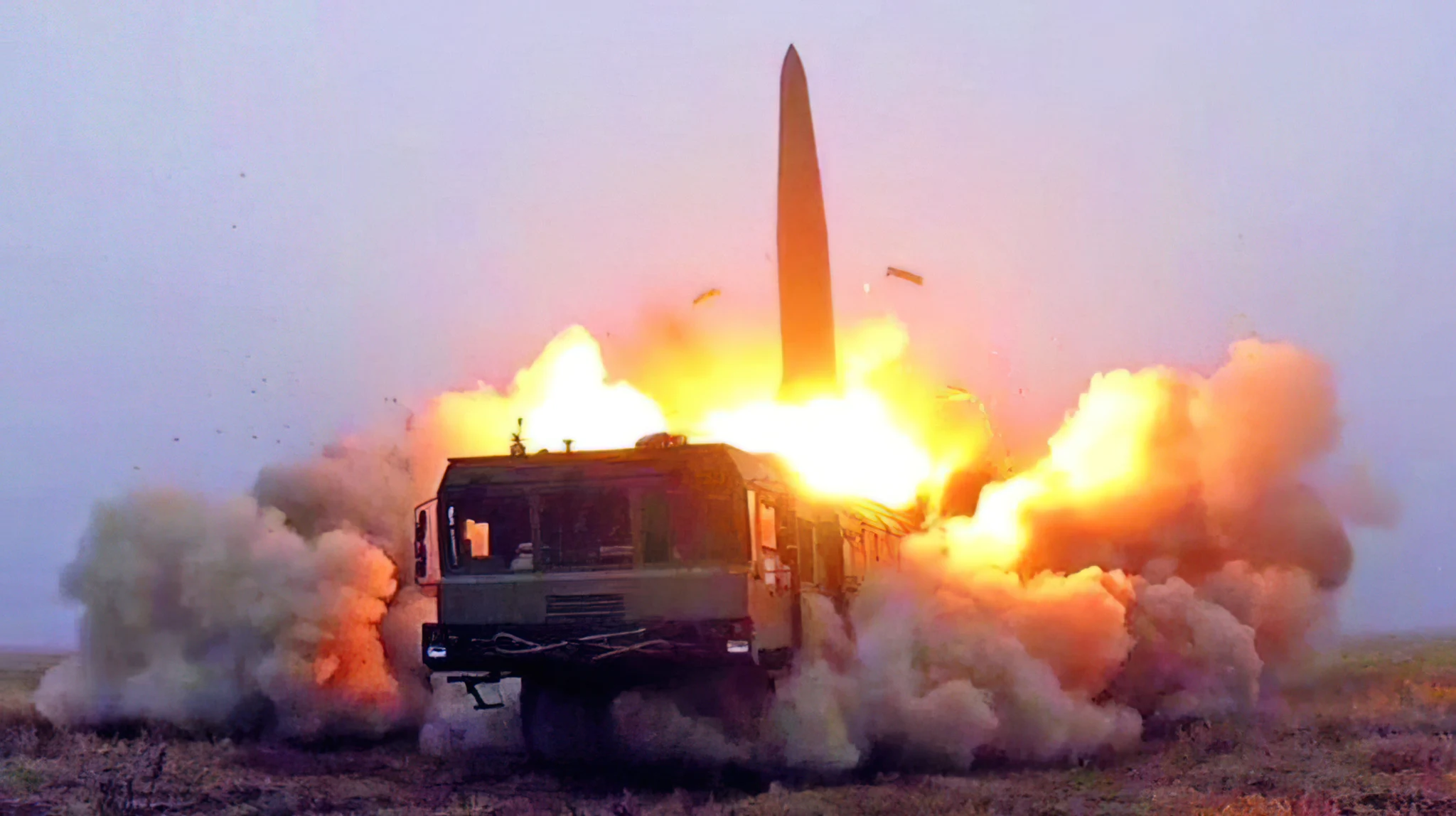
Russian forces used Iskander operational-tactical ballistic missiles to strike a concentration of heavy trucks modified for transporting and launching long-range unmanned aerial vehicles near Boryspil in the Kyiv region, with Russia's Defense Ministry claiming up to 40 such trucks destroyed in the attack. The target set, mobile launch platforms for exactly the kind of long-range strike drones this blog has documented driving Ukraine's own deep-strike campaign against Russian refineries and defense industry, represents Russia applying the identical "hunt the launcher, not the projectile" logic this blog covered just one day earlier through Ukraine's own accelerated FP-7 ballistic missile program and its explicit "shoot the archer, not the arrow" strategic framing.
That mirror-image quality is genuinely worth naming directly, because it reveals both sides of this war have independently converged on the same tactical insight this blog has now documented from multiple angles. Ukraine's own Special Operations Forces have run a sustained, months-long campaign specifically targeting Russian Iskander launchers and storage sites, this blog's research for this post surfaced repeated strikes near Taganrog, in occupied Crimea, and along Russia's border regions throughout 2026, using long-range strike drones like the FP-1 and FP-2 specifically because, as Zelenskyy himself put it, when Ukraine's own "anti-ballistic missiles are limited," hunting the launch sites is "a separate matter, a separate program, a separate operation." Russia's strike on Ukraine's drone-launch trucks near Boryspil is functionally the identical doctrine, aimed at Ukraine's equivalent launch infrastructure rather than the drones themselves once airborne.
This connects the interceptor-scarcity throughline this blog has tracked all summer to something this blog hasn't previously made fully explicit: both combatants are being pushed toward the same archer-hunting strategy for the same underlying reason, intercepting incoming projectiles has become too expensive or too unreliable to sustain as the primary defense, so both sides are increasingly racing to destroy the launch infrastructure before it fires instead. Zelenskyy's own account of SpaceX's refusal to let Ukraine use Starlink connectivity inside Russian territory for exactly this kind of launcher-hunting operation, citing escalation concerns, adds a genuinely interesting wrinkle this blog hasn't covered before, a private American company's own risk calculus directly constraining how effectively Ukraine can execute the identical strategy this blog has otherwise covered approvingly as a rational response to interceptor scarcity.
The claimed 40-truck toll near Boryspil, if accurate, represents a meaningfully larger single strike than the more typical pattern of individual Iskander launcher losses this blog's research turned up on the Ukrainian side, single-launcher strikes near Taganrog, a storage-site hit in Crimea, six vehicles destroyed in a September 2025 incident described as one of the more notable Ukrainian successes against Iskander specifically. That asymmetry in scale is worth flagging honestly: Russia's Defense Ministry claims here are, as with every Russian Ministry combat claim this blog has treated with structural caution all summer, unconfirmed by independent sources and should be read with the same skepticism this blog applied to the disputed Su-35 kill claims and the JY-27V radar's actual combat record. But even discounting the specific 40-truck figure, the broader pattern, both sides investing serious resources in hunting each other's launch infrastructure rather than relying primarily on intercepting projectiles in flight, is independently corroborated across multiple, more granular incidents this blog's research surfaced throughout 2026.
What this ultimately confirms is less about who's winning any single exchange and more about how thoroughly the interceptor-scarcity crisis this blog has documented since Lt. Gen. Rafferty's SMD Symposium disclosures has reshaped both sides' actual battlefield doctrine. Neither Russia nor Ukraine can sustain a purely defensive, intercept-everything posture any longer, and both have arrived, independently and for their own specific reasons, at the same conclusion this blog's FP-7 coverage already flagged as Ukraine's own strategic pivot: destroying the archer is now considered more achievable, and more cost-effective, than reliably stopping every arrow it fires.

No comments:
Post a Comment