
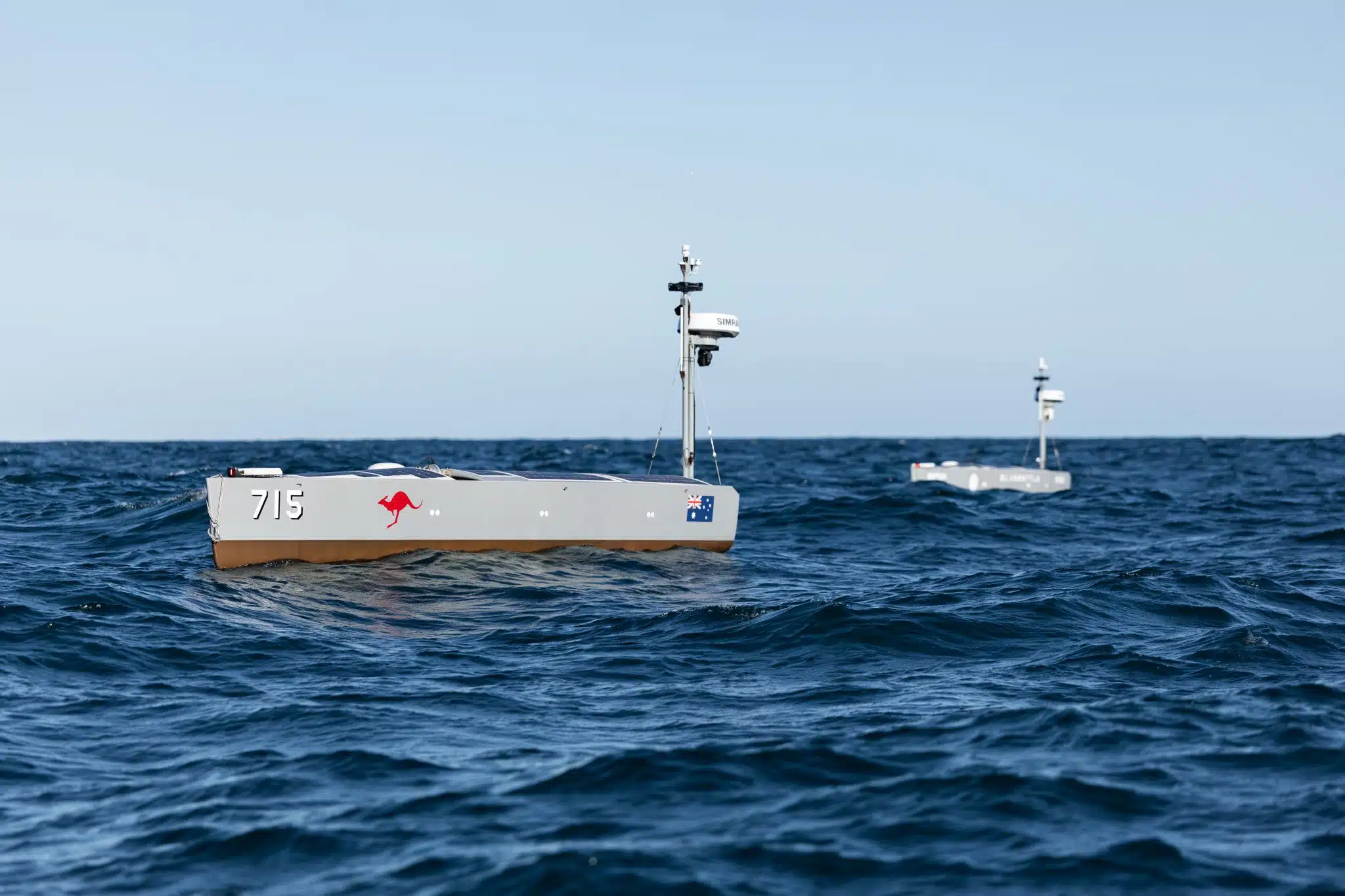
Australian uncrewed surface vessel manufacturer Ocius Technology signed agreements this week to integrate sonar systems from American firm ThayerMahan and Thales Australia across its Bluebottle USV fleet, covering both a AUD$176 million Royal Australian Navy SEA1200 undersea-surveillance program and ongoing border-security operations to Australia's north. ThayerMahan will deliver 40 Outpost acoustic intelligence payloads under a contract Ocius and the Australian government describe explicitly as "a practical application of AUKUS Pillar II," combining Australian autonomous platform technology with American acoustic sensing and processing. Thales Australia's competing BlueSentry arrays, built in Sydney and drawing on sonar heritage from the Collins-class submarine program, will separately equip Bluebottles running Maritime Border Command patrols.
This blog's earlier coverage of the RIMPAC 2026 AUKUS undersea-warfare trials already established the basic contrast this deal reinforces further: Pillar II, the technology-sharing and joint-development half of the trilateral pact, keeps producing genuine, tangible progress, while Pillar I, the actual nuclear submarine transfer program the pact was originally built around, remains mired in production shortfalls this blog documented through Adm. Daryl Caudle's own congressional testimony that Virginia-class output needs "a 100 percent improvement" just to meet existing delivery commitments, a multi-year construction contract still unsigned, and Trump's "Golden Fleet" battleship program reportedly competing for the same limited shipyard capacity. This Bluebottle sonar deal is a third consecutive Pillar II success story this blog has now tracked, following the RIMPAC undersea trials, each one making the Pillar I production gap look more structurally entrenched by comparison rather than less.
The explicit language both the Australian government and ThayerMahan use here, "sovereign" technology, "sovereign" platform, deserves attention given this blog's broader coverage of the tension between allied cooperation and genuine domestic industrial capacity this summer. Thales Australia's own framing, that BlueSentry's Sydney-manufactured sensors represent sovereign Australian technology deployed on a sovereign Australian platform, sits in interesting contrast with the ThayerMahan contract announced the same week, an American company's acoustic payloads integrated into the identical Bluebottle hull. That's not a contradiction exactly, Ocius's own framing of a "payload-agnostic" architecture explicitly designed to accept sensor systems from multiple providers is a genuinely sensible engineering approach, but it does illustrate how loosely "sovereign capability" gets applied even within a single announcement, some components genuinely domestic, others integrated from allied partners, all marketed under the same sovereignty language regardless of actual supply-chain origin.
The persistent-surveillance mission itself connects to the broader undersea-detection throughline this blog has tracked across multiple posts this summer, the Orca XLUUV program's own catch-up dynamic against China's more diversified unmanned undersea vehicle development, and the Ultra Maritime counter-UUV sonar system this blog covered in the context of Baltic cable-sabotage threats. A renewable-powered, long-endurance USV carrying thin-line acoustic arrays specifically for persistent above- and below-water surveillance addresses the identical structural gap this blog's Baltic coverage identified, traditional naval sonar built to detect large, loud submarines struggles against smaller, quieter autonomous threats, and Ocius's own claim that these contracts represent "the largest fielded deployments of persistent above water and below water surveillance USW missions in the world to date" is a genuinely significant scale claim if accurate, extending a detection capability this blog has documented as increasingly necessary from the Baltic to Australia's northern approaches.
None of this resolves the AUKUS Pillar I question this blog has already raised twice this summer, and Robert Dane's own framing of Bluebottle's value, "cost-effective," "scalable," standing on station "as cyclones rolled through," is precisely the kind of practical, demonstrable success that makes Pillar I's comparatively glacial submarine production timeline look worse by direct contrast rather than better. Whether AUKUS ultimately gets remembered as a genuinely transformative trilateral submarine pact or as a technology-sharing partnership that quietly outperformed its own more ambitious centerpiece program may depend less on any single announcement like this one and more on whether Washington's shipbuilding capacity, the same constraint this blog's Finland Model and Navy industrial base office coverage has documented extensively, ever actually catches up to what Pillar I originally promised.

No comments:
Post a Comment