
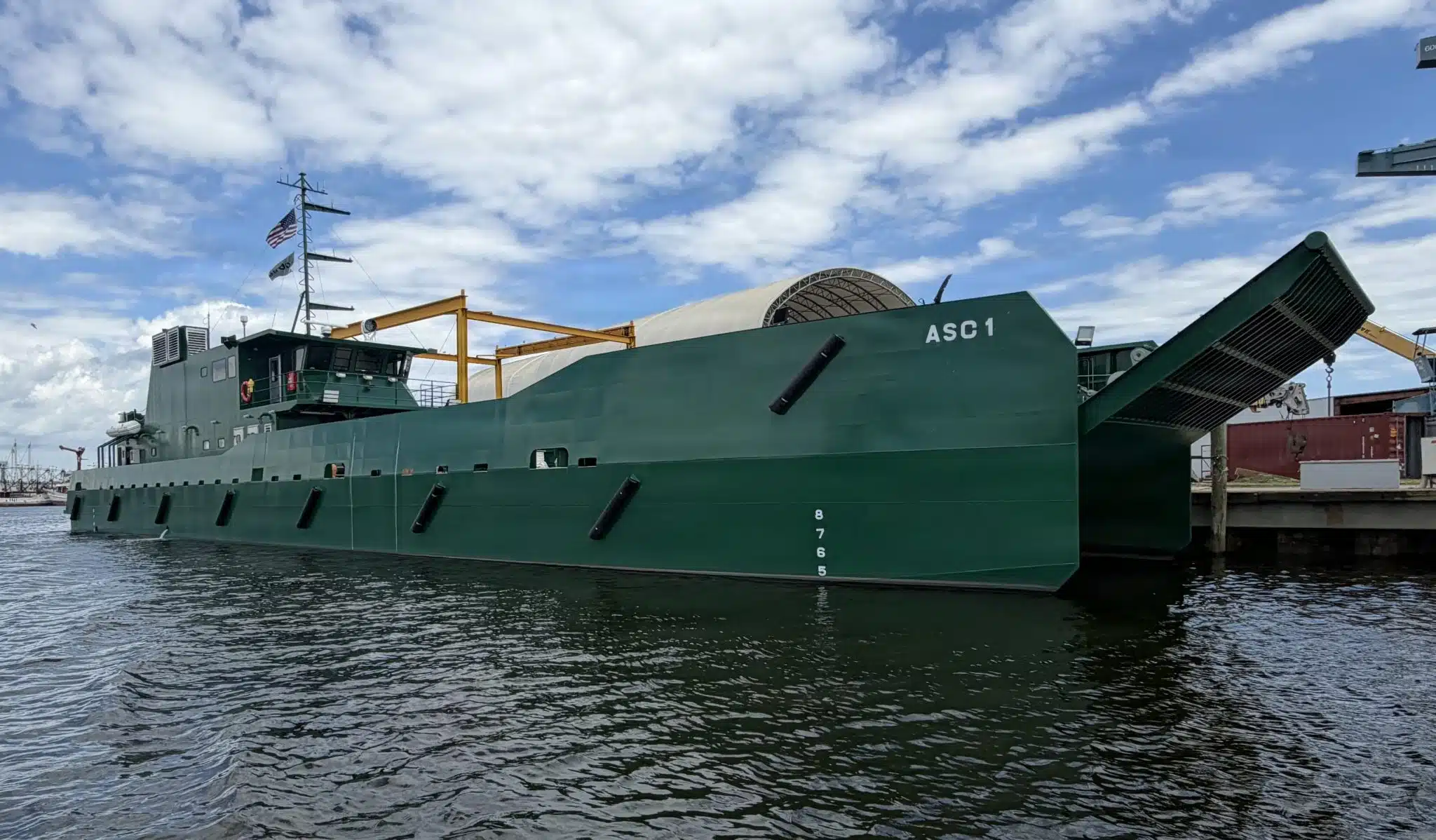
The U.S. Marine Corps Warfighting Laboratory accepted its first Ancillary Surface Craft prototype this month, a roughly 150-foot Australian-designed roll-on/roll-off vessel built by non-traditional shipbuilder Birdon America under a partnership intermediary contract signed in 2024. The ASC can carry 46 tons of cargo or 40 combat-loaded Marines, operates fully in Sea State 5 conditions and survives up to Sea State 7, and carries forward-looking sonar specifically to navigate uncharted, very shallow littoral waters and beach directly on unimproved shorelines. Col. Kenny Jones, the program's Science and Technology Division Director, framed its purpose directly: sustaining forces "without relying on fixed, vulnerable ports."
That specific phrase, avoiding dependence on fixed infrastructure, is the Marine Corps naming the exact institutional weakness its own leadership has been publicly flagging for years. Gen. Eric Smith, the Marine Corps Assistant Commandant, told a Naval Proceedings podcast that logistics "remains the pacing challenge" for the broader Force Design 2030 modernization effort, a blunt admission from the service's own senior leadership that sustaining distributed forces across the vast, infrastructure-poor Pacific remains the single hardest problem in the entire concept. Marine Corps Association analysis of the underlying doctrine, Expeditionary Advanced Base Operations, has been explicit that the current supply chain isn't responsive enough to support the kind of dispersed forces this strategy requires, and that gap only worsens with distance and reduced infrastructure, precisely the operating environment this blog's coverage of the Luzon Strait and broader first-island-chain terrain has documented extensively this summer.
This connects directly to two separate threads this blog has already traced through the Indo-Pacific this year. This blog's coverage of the Balikatan 2026 NMESIS sinking exercise documented U.S. and Philippine special operations forces building a rapid infiltration-and-extraction model specifically because fixed installations invite exactly the kind of Chinese counter-strike this blog's coverage of the PLAN's carrier and amphibious deployments during that same exercise window demonstrated Beijing is prepared to threaten. A rapid-strike force that inserts, fires, and extracts within a single operational window still needs something to physically move fuel, ammunition, and personnel between staging points and the beach, and that's precisely the "last tactical mile" gap the ASC and its complementary Medium Landing Ship are purpose-built to fill, without requiring the kind of port or pier infrastructure this blog's Balikatan coverage already established as a target China's own missile forces would prioritize in any actual contingency.
The Australian design origin and crewing partnership extends the same allied-integration pattern this blog documented through Norway's UH-60M Black Hawk purchase and the NSPO SeaSparrow consortium, genuine multinational co-development rather than a purely domestic American production effort. That's a meaningfully different posture than the go-it-alone production surges this blog has tracked across PAC-3, SM-3, and Tomahawk this summer, and it fits the broader Force Design partnership between the Marine Corps and Australian Army this article describes, both services pursuing complementary modernization concepts specifically built around operating together rather than independently, a genuinely coherent allied logistics answer rather than each country solving the same distributed-sustainment problem in isolation.
This also connects to the underwater half of the same magazine-depth-and-endurance problem this blog covered through the Navy's proposed UUV-based submarine resupply concept from RIMPAC 2026, which argued the Pacific submarine force needs exactly this kind of covert, infrastructure-independent sustainment method to operate through extended contested-water deployments. The ASC represents the surface and littoral equivalent of that same underlying strategic requirement, moving personnel and material to forces ashore without depending on a fixed port a determined adversary could target or blockade. Read together with this blog's UUV coverage, the ASC's acceptance suggests the Navy-Marine Corps team is assembling a genuinely coherent contested-logistics strategy piece by piece across multiple separate programs this year, submarines resupplied covertly underwater, forward forces sustained via shallow-draft surface craft on the beach, both explicitly designed around the same premise that fixed infrastructure is now a liability rather than an asset in a Pacific contingency.
None of this resolves Gen. Smith's own acknowledgment that logistics remains the pacing challenge, a single prototype entering testing is a meaningful step rather than a solved problem, and this blog's own summer of coverage on procurement execution risk, GMLRS, the failed 155mm shell facility, AHEL's cancellation, suggests real caution is warranted before assuming the ASC reaches full fielded capability on any predictable timeline. But a working prototype specifically targeting the exact vulnerability the Corps' own leadership has spent years publicly naming as its hardest unsolved problem is a genuine, concrete step, and it's one more data point in a broader pattern this blog has now documented across submarines, special operations, and now amphibious logistics: American Pacific force design increasingly assumes fixed infrastructure won't survive the fight it's actually preparing for.

No comments:
Post a Comment