
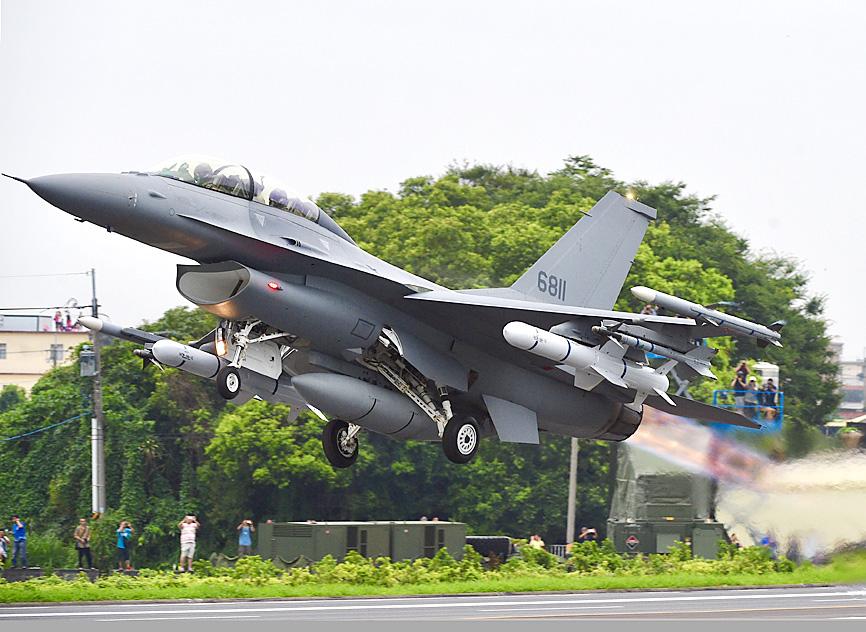
Taiwan's Defense Minister Wellington Koo has acknowledged that completing delivery of all 66 F-16V Block 70 fighters ordered from Lockheed Martin in 2019 by the end of 2026 will be "challenging," and as of this reporting, not a single aircraft under this specific $8 billion contract has actually reached Taiwanese soil. The original schedule called for deliveries beginning in 2023 and wrapping by 2026; that timeline has now slipped repeatedly, first to software integration issues, then supply-chain disruption, then production-line relocation, with the most recent projections pushing full completion into 2027 or later. Fifty of the jets are reportedly under construction at Lockheed's Greenville, South Carolina facility, with contractors running two 20-hour shifts a day specifically to compress the remaining schedule.
The consistent thread across six years of slipping deadlines isn't any single point failure, it's Greenville's own production capacity being stretched across a genuinely long queue of foreign F-16 customers simultaneously, a constraint this blog's earlier coverage of Pakistan's F-16 fleet already touched on from a different angle. That earlier reporting established that Pakistan's F-16s have been operationally superseded by the J-10C for reasons specific to Islamabad, an End-Use Monitoring restriction and a doctrinal shift toward Chinese hardware. Taiwan's situation is structurally different, there's no legal restriction on Taipei's F-16 use and no comparable indigenous alternative waiting in the wings, but the throughline connecting both stories is the same underlying reality: the F-16 production line, whether serving an active combat fleet in South Asia or a deterrence-critical modernization program in the Taiwan Strait, remains a genuine industrial bottleneck rather than a mature, on-demand manufacturing pipeline, regardless of how urgently any individual customer needs its jets.
Taiwan's own broader arms backlog makes the F-16V delay considerably more consequential than an isolated program slip. The same reporting that documents this delay also notes AGM-154C Joint Standoff Weapon glide bombs and Mk-48 torpedoes have similarly moved from 2026 to 2027-28 delivery windows, while Harpoon missiles and Patriot air defense systems remain pending. This blog's own coverage of America's interceptor and munitions production strain, PAC-3, SM-3, Tomahawk, and GMLRS, documented a defense-industrial base struggling to simultaneously supply Ukraine, the ongoing Iran conflict, and domestic U.S. stockpile replenishment; Taiwan's stalled F-16V and munitions deliveries are the same capacity constraint showing up in a fourth theater, a Pacific ally whose deterrence posture depends on exactly the kind of American production surge this blog has documented struggling to keep pace with demand everywhere else it's needed.
The timing pressure behind this specific delay is genuinely different in kind from a routine schedule slip, though, given what this blog's own Taiwan coverage has already documented about the island's defensive planning this year. The tunnel and bridge blockade exercises this blog covered as part of this year's Han Kuang drills reflect a military establishment increasingly focused on urban and chokepoint defense precisely because it can't assume air superiority will be available if Beijing moves, a defensive posture that becomes considerably more necessary, not less, the longer Taiwan's F-16V modernization remains undelivered. A fighter fleet that was supposed to reach full modernized strength this year and instead sits at zero deliveries under this specific contract is exactly the kind of capability gap that reinforces, rather than substitutes for, Taiwan's parallel investment in ground-based urban defense doctrine.
None of this means the F-16V program is failing outright, Lockheed's overtime shifts and Koo's own acknowledgment that the outlook is "already improving" suggest genuine institutional effort to close the gap, and Taiwan retains the option to seek compensation from Lockheed over the delay under its existing contract terms. But six years of slipping deadlines on a deal originally meant to modernize Taiwan's air power well before now is the kind of delay that compounds strategic risk quietly, each additional year of delay is a year Taiwan's frontline air fleet remains more dependent on its existing, less capable F-16A/B and Mirage 2000 aircraft precisely during the period this blog's own coverage shows Beijing's own airpower, from the J-10C to the J-36 and J-50 prototypes, continuing to advance without any comparable production bottleneck of its own.

No comments:
Post a Comment