
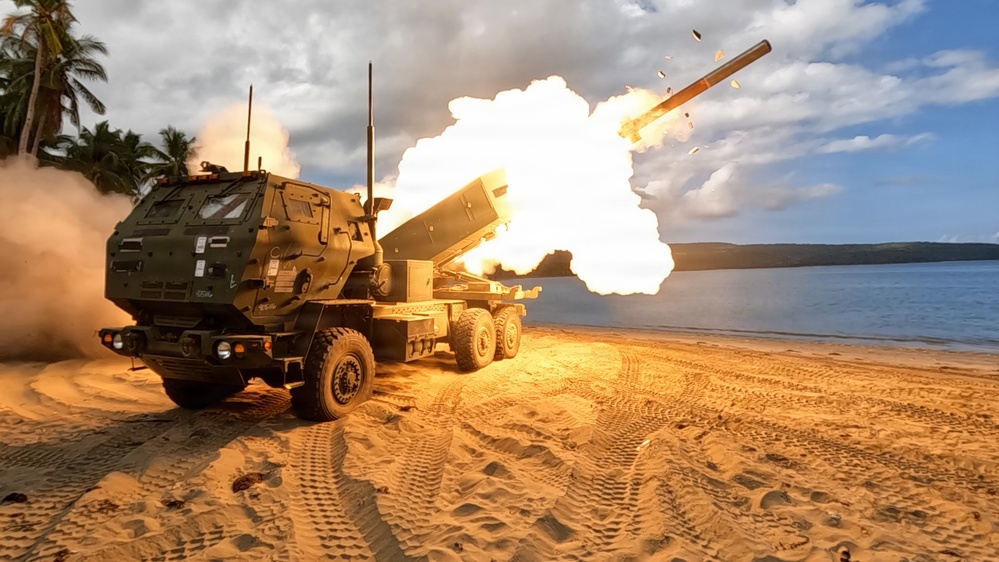
U.S. and Philippine special operations forces sank a target vessel, the decommissioned corvette MV Manfil, in the Luzon Strait on April 24 during Maritime Strike-North, part of the broader Balikatan 2026 exercise that brought together 17,000 troops from the U.S., Philippines, Australia, Canada, France, and Japan. The operation's actual mechanics are what make it notable: special operators built a real-time kill chain off Itbayat island, feeding targeting data from airborne surveillance into a strike package combining a Marine Corps NMESIS anti-ship missile system, an Army HIMARS launcher, unmanned surface vessels, and shaped charges, all flown in and extracted by Air Force C-130s rather than arriving via any fixed, permanent installation. The target sat roughly 100 miles south of Taiwan, placing this demonstration directly astride the Luzon Strait chokepoint that would function as a critical reinforcement and transit route in any Taiwan contingency.
This is the same broader deployment this blog would recognize from its own coverage of the region's escalating force posture: Task Force 107's missile systems deployed to a remote Luzon Strait island during this exact exercise window, described by regional analysts as capable of "holding U.S. reinforcement routes from Guam and the wider Pacific at risk in any Taiwan or South China Sea contingency," a counter-intervention framing that applies with equal force to the anti-ship capability demonstrated in this sinking exercise. What distinguishes the special operations dimension of Balikatan 2026 from a standard bilateral drill is the deliberate emphasis on rapid infiltration and extraction rather than fixed basing, NMESIS and HIMARS units airlifted in, employed, and pulled back out within the same operational window, a posture explicitly designed to complicate Chinese targeting by never letting these systems sit as fixed, mappable installations for long.
China's own response during the same exercise window sharpens the stakes considerably. The PLAN deployed the aircraft carrier Liaoning and an unspecified Type 075 landing helicopter dock into waters near the Philippines concurrent with Balikatan 2026, prompting one regional security analyst's assessment that Beijing was "signalling it can apply pressure on multiple axes simultaneously." That's worth reading directly against this blog's earlier coverage of the Philippines' own fighter-acquisition competition and the Eurofighter budget-gap analysis, where PAF Chief Lt. Gen. Arthur Cordura was quoted acknowledging Manila "cannot be at par with China even 10 to 20 years from now." The special operations, rapid-infiltration model demonstrated in this Luzon Strait exercise is functionally the American answer to that same asymmetry, since Washington and Manila together clearly can't match China's conventional naval buildout ship-for-ship in the near term, the strategic logic instead leans on dispersed, hard-to-target, rapidly emplaced strike capability that raises the cost of any Chinese move through the strait without requiring platform parity.
The broader missile buildout across this year's Balikatan drills reinforces that this was not an isolated special-operations vignette. Naval News's own tracking of the exercise documented an extensive network of long-range fire potential distributed across the Philippine archipelago, HIMARS batteries conducting live-fire events near Chinese artificial island bases in the South China Sea, additional NMESIS and Japanese Self-Defense Force missile launchers participating in a separate sinking exercise near Ilocos Norte involving American, Japanese, and Philippine forces simultaneously. Taken together with the Luzon Strait special operations demonstration, this year's Balikatan wasn't a single high-profile stunt but a genuinely comprehensive rehearsal of distributed, allied, rapid-strike area-denial capability spanning the exact geography, the Luzon Strait, the South China Sea approaches, the first island chain, that this blog's coverage of Japan's own counterstrike buildout and the broader Indo-Pacific throughline has repeatedly identified as the critical terrain in any future contingency.
None of this guarantees deterrence actually holds if tested, exercises demonstrate capability and intent, not combat performance, and China's own simultaneous carrier and amphibious deployment is itself evidence Beijing isn't especially deterred by a single sinking exercise regardless of how sophisticated the kill chain behind it. But the specific tactical model on display here, elite forces inserting scarce, high-value anti-ship systems into contested terrain for a short window rather than defending fixed installations indefinitely, is a genuinely different answer to the capability gap this blog has documented across the Philippines' broader defense posture, and it's one that trades platform numbers for unpredictability, a trade this blog's coverage suggests the Philippines and its allies may have little choice but to keep making for the foreseeable future.

No comments:
Post a Comment